
Last Updated:
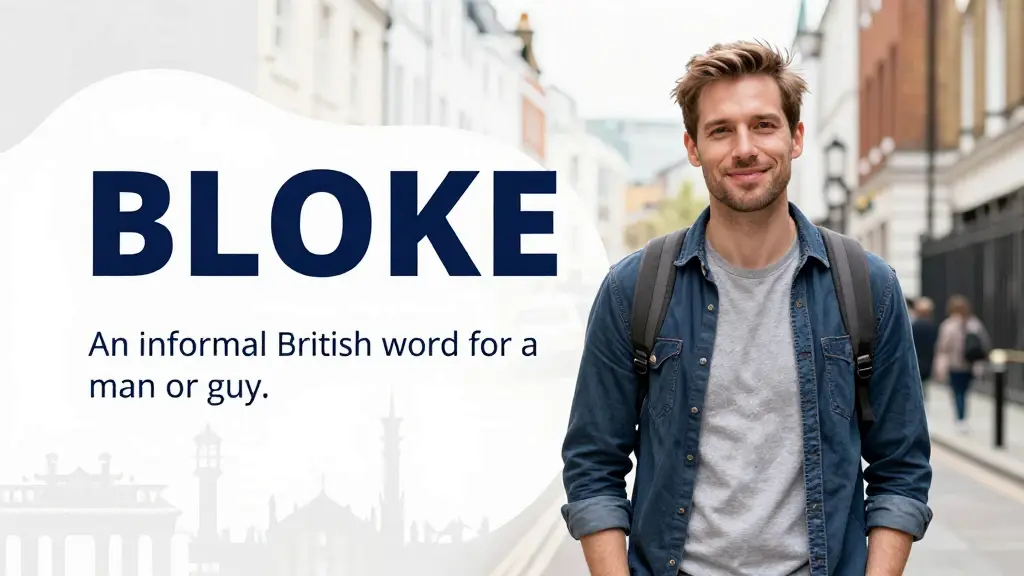
Have you heard someone say “that bloke,” “some bloke at work,” or “He’s a nice bloke” and wondered what it means? Bloke is an informal British English word for a man or guy.
It is especially common in the United Kingdom and is also widely used in Australia and New Zealand.
The word is usually casual and friendly, although its tone can change depending on the situation.
For example, someone might say, “He’s a good bloke,” meaning he is a decent, trustworthy man.
Another person might say, “Some bloke asked me for directions,” simply referring to a man they do not know.
Unlike words such as “gentleman,” which can sound formal or polite, bloke is relaxed and conversational.
It is commonly heard in everyday discussions, television shows, films, and British comedy.
In this guide, you will learn the meaning of bloke, how it is used in British slang, what it means in texting, how it compares with “guy” and “dude,” and how to use it naturally in sentences.
Quick Answer: What Does Bloke Mean?
Bloke means “man” or “guy” in informal British English. It is commonly used in the UK, Australia, and New Zealand to refer to a male person. The word is generally neutral or friendly, depending on context.
Examples:
- “He’s a nice bloke.” — He’s a nice guy.
- “I met a bloke at the station.” — I met a man at the station.
- “That bloke is my neighbor.” — That man is my neighbor.
Bloke Meaning at a Glance
| Category | Meaning |
| Word | Bloke |
| Part of speech | Noun |
| Pronunciation | BLOHK |
| Main meaning | Man or guy |
| Language variety | Informal British English |
| Other common regions | Australia and New Zealand |
| Tone | Casual, conversational, often friendly |
| American English equivalent | Guy or man |
1. What Does Bloke Mean in British Slang?
In British slang, a bloke is a man or guy. It is a very common informal word used in everyday conversation.
People use it to refer to a man they know, a stranger, a friend, or a person they are talking about.
Examples:
- “He’s a really nice bloke.”
- “I saw a bloke walking his dog.”
- “That bloke works at the local shop.”
- “Who’s that bloke over there?”
- “He’s an ordinary bloke who enjoys football.”
The word does not automatically suggest anything about a man’s personality, social status, or behavior. It is simply a casual way of referring to him.
For example, if someone says, “I spoke to a bloke on the bus,” they mean they spoke to a man on the bus.
The word is particularly natural in informal British conversation, where people often use it instead of “man” or “guy.”
2. What Does Bloke Mean in Texting?
In texting, bloke means the same thing as it does in everyday British English: a man or guy.
People may use it when talking about a stranger, a friend, a colleague, or someone they are dating.
Examples of Bloke in Text Messages
Example 1
Person A: “Who helped you carry those bags?”
Person B: “Some bloke outside the shop.”
Meaning: A man outside the shop helped.
Example 2
Person A: “What do you think of James?”
Person B: “He’s a good bloke.”
Meaning: James is a decent, likable guy.
Example 3
Person A: “Who’s that bloke you’re talking to?”
Person B: “He’s a friend from work.”
Meaning: The person is asking about a man.
Example 4
Person A: “I met a lovely bloke yesterday.”
Person B: “Oh, really? Tell me more!”
Meaning: The speaker met a man they liked, possibly in a romantic context.
Bloke is not an abbreviation or acronym. It is a complete word that people use naturally in informal messages.
3. What Does “Good Bloke” Mean?
“Good bloke” is a common expression in British, Australian, and New Zealand English. It usually means a decent, trustworthy, friendly, or likable man.
For example:
- “He’s a good bloke who always helps his friends.”
- “My boss is a good bloke.”
- “You can trust him. He’s a good bloke.”
The expression is usually a compliment. It suggests that the person is reliable, fair, or easy to get along with.
In Australia and New Zealand, the phrase can also express respect for someone who is down-to-earth and treats others well.
However, “good bloke” is informal rather than a formal character reference. Its exact meaning depends on the speaker and situation.
4. What Does “Some Bloke” Mean?
“Some bloke” means “some man” or “a man I don’t know or don’t need to identify.”
It is often used when the person’s name is unknown, unimportant, or forgotten.
Examples:
- “Some bloke knocked on the door.”
- “Some bloke left his jacket at the café.”
- “I got a call from some bloke asking about my car.”
- “Some bloke told me the train was delayed.”
The phrase is usually neutral, but it can sound dismissive if the speaker is deliberately treating the person as unimportant.
For example, “Some bloke came in and started shouting” simply refers to an unidentified man, but it may also convey annoyance about his behavior.
5. What Does Bloke Mean in Australia?
In Australian English, bloke is an everyday word for a man or guy. It is widely understood and is often used in friendly, casual conversation.
Examples include:
- “He’s a good bloke.”
- “That bloke lives down the road.”
- “I met a bloke at the pub.”
- “He’s a hardworking bloke.”
In Australia, the word may appear in expressions associated with friendliness, reliability, or an ordinary, down-to-earth personality.
However, bloke itself does not always mean a stereotypically masculine or rugged man. In most situations, it simply means “man.”
The same basic meaning applies in New Zealand English.
6. Is Bloke a Rude Word?
No. Bloke is generally not considered rude or offensive. It is an ordinary informal word for a man.
For example:
- “He’s a nice bloke.” — Friendly and positive.
- “I met a bloke at work.” — Neutral.
- “That bloke is annoying.” — Negative because of the opinion expressed, not because bloke is inherently offensive.
The word can sound dismissive in certain sentences, particularly when used with an irritated or contemptuous tone. However, it is usually much more neutral than an insult.
In formal writing, such as a business report or official letter, “man,” “person,” or the individual’s name may be more appropriate.
7. What Is the Difference Between Bloke, Guy, and Dude?
Bloke, guy, and dude can all refer to a man, but their usage varies by region and tone.
| Word | Meaning | Typical usage |
| Bloke | Man or guy | Especially common in British, Australian, and New Zealand English |
| Guy | Man or person, depending on context | Common in American and British English |
| Dude | Man or guy | Informal, especially common in American English |
| Fella | Man or fellow | Informal, especially in British and Irish usage |
| Gentleman | A man | More polite or formal |
| Lad | Boy or young man | Common in British and Irish informal speech |
Examples:
- British: “He’s a good bloke.”
- American: “He’s a good guy.”
- Casual American: “That dude is funny.”
- More formal: “He’s a respectable gentleman.”
The meanings overlap, but bloke sounds particularly British or Australian to many English speakers.
8. What Is the Difference Between a Bloke and a Lad?
A bloke usually means a man, while a lad often refers to a boy or young man.
For example:
- “That bloke works at the bank.” — That man works at the bank.
- “The lads are going to the match.” — The boys or young men are going to the match.
In British English, lad can also refer more generally to male friends, regardless of whether they are teenagers or adults.
The expressions “the lads” and “a group of lads” are common in informal conversation, particularly when talking about a group of male friends.
The distinction is not absolute, but bloke usually emphasizes the person being a man, while lad can suggest youth or membership in a group of male friends.
9. How Do You Pronounce Bloke?
Bloke is pronounced BLOHK, with one syllable.
It rhymes approximately with words such as “smoke” and “joke.”
To say it naturally:
- Start with the “bl” sound in “blue.”
- Add a long “oh” sound.
- Finish with a hard “k.”
The pronunciation is generally similar across British, Australian, and New Zealand English, although accents may affect the vowel slightly.
10. Ten Examples of Bloke in Sentences
Here are ten examples showing how bloke is used in everyday English.
- “He’s a really nice bloke.”
Meaning: He’s a friendly and likable man. - “I met a bloke at the station.”
Meaning: I met a man at the station. - “That bloke is my neighbor.”
Meaning: That man lives near me. - “Some bloke called while you were out.”
Meaning: An unidentified man called. - “He’s a good bloke to work with.”
Meaning: He’s a reliable and pleasant colleague. - “Who’s that bloke in the blue jacket?”
Meaning: Who is that man wearing a blue jacket? - “I know a bloke who can fix your bike.”
Meaning: I know a man who can repair your bike. - “He’s an ordinary bloke with a normal job.”
Meaning: He’s an everyday man with an ordinary job. - “That bloke made everyone laugh.”
Meaning: That man made everyone laugh. - “She’s dating a bloke from Manchester.”
Meaning: She’s dating a man from Manchester.
FAQs:
1. What does bloke mean in simple words?
Bloke means “man” or “guy.” It is an informal word used especially in British English, as well as Australian and New Zealand English. For example, “He’s a nice bloke” means “He’s a nice guy.”
2. Is bloke British slang?
Yes. Bloke is strongly associated with informal British English. It is also widely used in Australia and New Zealand. In these varieties of English, it is a common everyday word for a man.
3. What does good bloke mean?
A good bloke is a decent, friendly, trustworthy, or likable man. The expression is generally a compliment and may suggest that the person is reliable and treats others well.
4. What does some bloke mean?
“Some bloke” means an unidentified man or a man whose name is not important to the conversation. For example, “Some bloke asked me for directions” means an unknown man asked the speaker for help.
5. Is bloke a rude word?
No. Bloke is generally a neutral, informal word for a man. It can sound dismissive in certain situations, but the word itself is not usually considered offensive.
6. What is the American equivalent of bloke?
The closest American English equivalent is “guy” or “man.” For example, “He’s a good bloke” would usually be expressed as “He’s a good guy” in American English.
7. Can bloke refer to a friend?
Yes. Someone may call a friend a bloke, especially in British, Australian, or New Zealand English. For example, “He’s a good bloke” often describes a friend or acquaintance positively.
8. What does bloke mean in Australia?
In Australia, bloke means a man or guy. It is a familiar, informal word often used in everyday conversation. The phrase “good bloke” is particularly common and usually means a decent or trustworthy man.
9. What is the difference between bloke and lad?
Bloke generally means a man, while lad often means a boy or young man. “The lads” is also a common informal expression for a group of male friends. Usage varies by region and context.
10. Is bloke used in texting?
Yes. People use bloke in text messages just as they do in speech. For example, “I met a nice bloke today” means “I met a nice guy today.” It is a regular word, not an acronym.
Conclusion:
Bloke is a common informal word for “man” or “guy,” particularly in British, Australian, and New Zealand English.
It can refer to a stranger, friend, colleague, or any male person.
Expressions such as “good bloke” are usually positive, while “some bloke” simply refers to an unidentified man.
The word is generally friendly and neutral rather than rude.
If you hear someone use bloke in a conversation or text message, you can usually understand it as a casual alternative to “guy.”

Rachel Morgan is a U.S.-based writer who specializes in vocabulary and English expressions. She is interested in the different ways words can be used depending on context. Her articles provide straightforward explanations and realistic examples to help readers better understand everyday language.