
Last Updated:
The word radical has several meanings depending on how it is used.
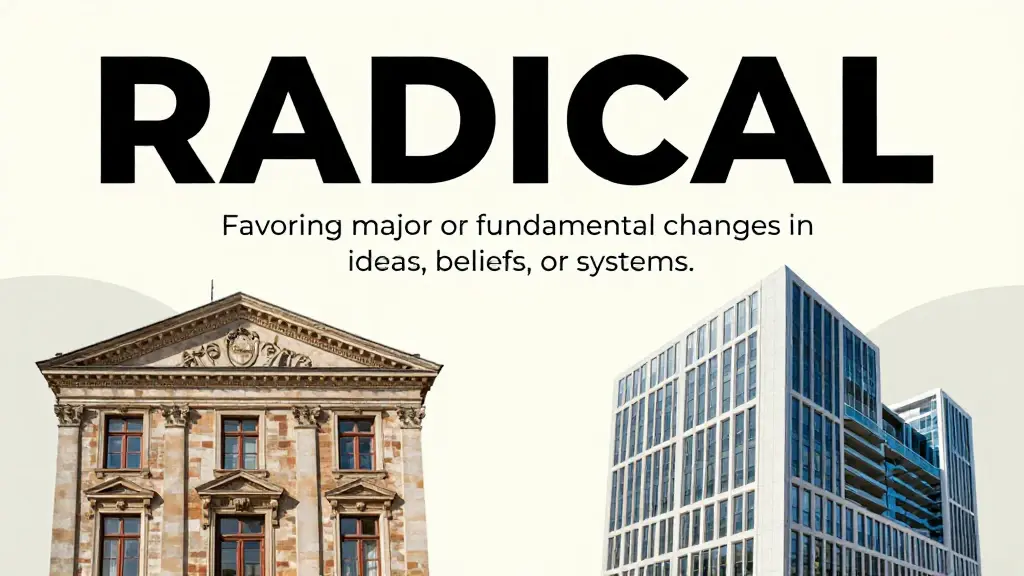
In everyday English, radical often means something that is very different from the usual way of doing things, or something that involves a major change.
It can also describe a person who supports significant political or social change.
In informal slang, especially in older American expressions, radical can mean “excellent,” “awesome,” or “cool.”
For example, “The company introduced radical changes” means the company made major changes.
However, “That skateboard trick was radical!” means the trick was amazing or impressive.
The word also has specific meanings in mathematics, chemistry, and medicine. In mathematics, it can refer to a root symbol, such as the square-root sign.
In chemistry, a radical is an atom or group of atoms with an unpaired electron.
In this guide, you will learn the meaning of radical in simple English, its use in slang, politics, and different fields, along with examples, synonyms, and frequently asked questions.
Quick Answer: What Does Radical Mean?
Radical means involving a fundamental change, going to the root of something, or being very different from what is traditional or usual. Depending on the context, it can describe bold ideas, political movements, major changes, or something excellent in slang.
Examples:
- “The school made radical changes.” — The school made major changes.
- “She has radical political ideas.” — She supports significant political change.
- “That trick was radical!” — That trick was awesome.
Radical Meaning at a Glance
| Category | Meaning |
| Word | Radical |
| Part of speech | Adjective; also a noun |
| Pronunciation | RAD-i-kuhl |
| Main meaning | Fundamental, far-reaching, or involving major change |
| Slang meaning | Excellent, awesome, or cool |
| Political meaning | Supporting major political or social change |
| Mathematical meaning | Related to roots or root symbols |
| Tone | Depends on context; can be positive, neutral, or negative |
1. What Does Radical Mean in Simple English?
In simple English, radical describes something that is very different from what normally happens or that changes something in a fundamental way.
A radical change is not a small adjustment. It is a major change that affects the basic structure, nature, or operation of something.
For example:
- “The business needs radical reform.”
- “They proposed a radical new design.”
- “Moving to another country was a radical change in her life.”
- “The scientist developed a radical new approach.”
In each example, radical suggests something substantial rather than minor.
The word can also mean relating to the basic or original nature of something. For instance, a radical solution may address the underlying cause of a problem instead of treating only its symptoms.
Whether radical sounds positive or negative depends on the situation. A radical idea might be innovative and exciting to one person but extreme or risky to another.
2. What Does Radical Mean in Slang?
In informal slang, radical can mean “awesome,” “excellent,” “amazing,” or “cool.”
This use is particularly associated with American slang from the late 20th century, including skateboarding, surfing, and youth culture. It can still be used today, often playfully or nostalgically.
Examples:
- “That skateboard trick was radical!”
- “Your new bike is radical.”
- “We had a radical time at the beach.”
- “That concert was totally radical.”
In these sentences, radical is a compliment. It does not mean that something is politically extreme or that it involves a major change.
The tone can sound old-fashioned or deliberately playful to some modern English speakers, depending on the setting.
Radical vs. Awesome
Both words can express enthusiasm, but they have slightly different associations.
| Word | Meaning | Example |
| Radical | Awesome, exciting, or impressive in slang | “That jump was radical!” |
| Awesome | Very good or impressive | “That jump was awesome!” |
| Cool | Stylish, appealing, or impressive | “That’s a cool trick!” |
| Epic | Remarkably impressive or memorable | “That was an epic performance!” |
If someone says, “That was radical!” while watching a skateboarder perform a difficult trick, they probably mean that the trick was impressive.
3. What Does Radical Mean in Politics?
In politics, radical describes ideas, movements, or people that seek major changes to an existing political, economic, or social system.
A radical political position generally goes beyond small adjustments to existing policies. It may propose changing institutions, laws, or the underlying structure of society.
Examples:
- “The party proposed radical political reforms.”
- “She supports radical changes to the education system.”
- “The movement called for a radical restructuring of the economy.”
The word is not automatically positive or negative in political contexts.
Supporters might use radical to describe bold, necessary reforms. Critics might use it to suggest that a proposal is too extreme or disruptive.
It is also important to distinguish between radical and extremist. Radical generally refers to far-reaching change, while extremist often suggests views or actions far outside accepted political norms. The terms can overlap in some discussions, but they are not interchangeable.
The meaning of radical also varies across historical periods and countries. A proposal considered radical in one society might be considered mainstream in another.
4. What Does Radical Mean in Everyday Conversation?
In everyday conversation, radical usually describes a major change, an unconventional idea, or something that differs greatly from what people expect.
Examples include:
Radical change: A major transformation.
“The company made radical changes to its working hours.”
Radical idea: An idea that challenges conventional thinking.
“His radical idea could change how the team works.”
Radical improvement: A substantial improvement.
“The new software brought radical improvements to the process.”
Radical difference: A very large or fundamental difference.
“There is a radical difference between the two approaches.”
In these examples, radical emphasizes the scale or significance of the difference. It does not necessarily mean that the change is good or bad.
5. What Does Radical Mean in Mathematics?
In mathematics, radical refers to a root or an expression involving a root. It is commonly associated with the radical sign, √.
For example:
[
\sqrt{25}=5
]
The expression (\sqrt{25}) is called a radical expression, and its value is 5 because (5 \times 5 = 25).
Another example is:
[
\sqrt[3]{8}=2
]
This is a cube root: 2 multiplied by itself three times equals 8.
Common mathematical terms include:
- Radical sign: The symbol √ used to indicate a root.
- Radical expression: An expression containing a root, such as (\sqrt{16}).
- Radicand: The number or expression under the radical sign.
In mathematics, radical is a technical term and does not mean extreme, unusual, or awesome.
6. What Does Radical Mean in Chemistry?
In chemistry, a radical is an atom, molecule, or group of atoms that has an unpaired electron. Such species are often called free radicals.
Because of their unpaired electrons, many free radicals are highly reactive and can participate in chemical reactions.
Examples include the hydroxyl radical (•OH) and the methyl radical (•CH₃).
Free radicals play roles in several chemical and biological processes. Some are produced naturally in the body, while others can form through environmental exposure or chemical reactions.
In biology and health discussions, free radicals are often mentioned in relation to oxidative stress. However, they are not always harmful: they also have roles in normal biological functions.
This scientific meaning is different from the everyday use of radical to describe major change.
7. What Does Radical Mean in Medicine?
In medicine, radical often describes a treatment or procedure that aims to remove or address a disease extensively, rather than making a limited or conservative intervention.
For example, a radical surgery may involve removing a tumor along with surrounding tissue or other structures when medically appropriate.
The exact meaning depends on the specific procedure and medical specialty.
The word can also appear in the expression “radical treatment,” referring to an approach intended to eliminate the underlying disease rather than merely relieve symptoms.
In medical language, radical does not mean “awesome” or necessarily “extreme” in the everyday sense. It has a specialized meaning that should be interpreted in context.
8. What Is the Difference Between Radical and Extreme?
Radical and extreme sometimes overlap, but they emphasize different things.
Radical usually highlights a fundamental change or a departure from established ideas.
Extreme usually highlights being at the far end of a range, going beyond what is considered usual, or being unusually intense.
For example:
- “The government proposed radical reforms.” — The reforms would make major changes.
- “The weather conditions were extreme.” — The conditions were unusually severe.
- “She suggested a radical new approach.” — Her approach challenged conventional methods.
- “He took an extreme position.” — His position was at the far end of the available views.
A radical proposal can be reasonable or carefully considered. An extreme position may be radical, but the words do not always mean the same thing.
9. Synonyms and Antonyms of Radical
The best synonym for radical depends on the intended meaning.
Synonyms
| Synonym | Meaning |
| Fundamental | Relating to the basic nature of something |
| Major | Large or significant |
| Sweeping | Affecting many things or covering a wide scope |
| Far-reaching | Having extensive effects |
| Revolutionary | Introducing a dramatic transformation |
| Drastic | Involving a substantial or severe change |
| Unconventional | Different from customary methods or beliefs |
| Awesome | Excellent or impressive, in slang |
Antonyms
| Antonym | Meaning |
| Minor | Small in scale or importance |
| Gradual | Happening slowly over time |
| Moderate | Not extreme |
| Conventional | Following established customs or practices |
| Traditional | Based on long-established beliefs or methods |
| Conservative | Favoring limited change or preserving existing arrangements, depending on context |
Not every synonym or antonym fits every use of radical. For example, awesome is a synonym only when radical is being used as slang.
10. Ten Examples of Radical in Sentences
Here are ten examples showing how radical is used in different situations.
- “The company introduced radical changes to its business strategy.”
Meaning: The company made major changes to how it operates. - “She came up with a radical solution to the problem.”
Meaning: She suggested a very different or fundamental solution. - “That was a radical skateboard trick!”
Meaning: The trick was awesome or impressive. - “The candidate supports radical political reform.”
Meaning: The candidate wants significant changes to the political system. - “Moving overseas was a radical change in his life.”
Meaning: Moving abroad transformed his life considerably. - “The artist is known for radical designs.”
Meaning: The artist creates designs that differ greatly from conventional styles. - “The square root of 36 can be written using a radical sign.”
Meaning: The mathematical expression uses the root symbol. - “Free radicals can participate in chemical reactions.”
Meaning: Chemically reactive species with unpaired electrons can take part in reactions. - “The doctors discussed whether radical surgery was appropriate.”
Meaning: They discussed an extensive surgical procedure intended to treat the disease. - “The new policy represents a radical departure from the past.”
Meaning: The policy is very different from previous approaches.
FAQs:
1. What does radical mean in simple words?
Radical means involving a major or fundamental change, or being very different from what is usual. In slang, it can also mean awesome or excellent. The intended meaning depends on the sentence and situation.
2. Does radical mean good or bad?
Radical can be positive, negative, or neutral. A radical improvement may be positive, while a radical change that causes disruption may be viewed negatively. In slang, radical is generally a positive word meaning excellent or cool.
3. What does radical mean in slang?
In slang, radical means awesome, amazing, or cool. For example, “That was radical!” means “That was really impressive!” This usage is associated particularly with American youth, surfing, and skateboarding culture.
4. What does radical mean in politics?
In politics, radical describes ideas or movements that seek major changes to existing political or social systems. It does not automatically mean violent or extremist. The word’s connotation depends on the proposal and the speaker’s perspective.
5. What does radical change mean?
A radical change is a major transformation that affects the basic structure or nature of something. For example, replacing an entire working system rather than making a small adjustment could be described as a radical change.
6. Is radical the same as extreme?
Not exactly. Radical emphasizes fundamental change or a departure from established ideas, while extreme emphasizes being at the far end of a range or going beyond what is usual. The meanings can overlap, but they are not identical.
7. What is another word for radical?
Depending on context, synonyms include fundamental, major, sweeping, far-reaching, drastic, revolutionary, and unconventional. When radical is used as slang, synonyms include awesome, excellent, and cool.
8. What is the opposite of radical?
Possible opposites include moderate, minor, gradual, conventional, and traditional. The best antonym depends on the sentence. For example, a radical change may contrast with a minor adjustment, while radical ideas may contrast with conventional ideas.
9. What does radical mean in mathematics?
In mathematics, radical refers to a root or an expression containing a root. The symbol √ is called the radical sign. For example,
(\sqrt{49}=7), because seven multiplied by seven equals forty-nine.
10. What does radical mean in chemistry?
In chemistry, a radical is an atom, molecule, or group of atoms with an unpaired electron. Many radicals are reactive and take part in chemical reactions. This scientific definition differs from the everyday meaning of major or fundamental change.
Conclusion:
The meaning of radical depends on context.
In everyday English, it usually describes a major change, a fundamental idea, or something very different from the norm.
In slang, it can mean awesome or cool. In politics, it often refers to far-reaching social or political change, while mathematics and chemistry use the word in specialized ways.
To understand radical correctly, look at the subject and the surrounding sentence.
Once you recognize the context, it becomes easy to tell whether the word means fundamental, unconventional, impressive, or something more technical.

Brian Mitchell is an American writer focused on English language usage and vocabulary. He produces educational content covering definitions, phrases, terminology, and common expressions. His writing emphasizes practical information and clear examples that readers can easily apply to everyday communication.