
Last Updated:
Have you ever heard someone ask, “Is this plan viable?” or read that a business idea is not viable?
The word viable is often used when people discuss plans, ideas, projects, and possible solutions.
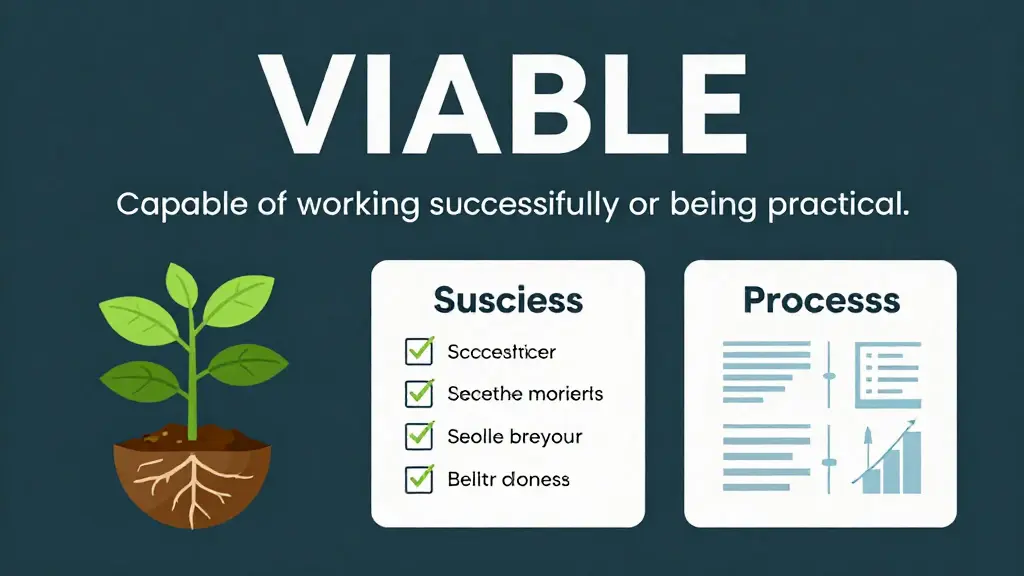
Viable means capable of working, succeeding, or continuing to exist.
If something is viable, it has a reasonable chance of working in a real situation.
For example, if you have a business idea that people want and you can afford to run it, the idea may be viable.
However, if the costs are too high and there are not enough customers, it may not be viable.
The word is common in business, science, technology, healthcare, and everyday conversations.
Its exact meaning depends on the situation, but it usually describes something that can work or survive.
Quick Answer
Viable means practical, workable, or capable of succeeding or surviving. For example, “This is a viable solution” means the solution has a reasonable chance of working.
Quick Meaning Table
| Feature | Meaning |
| Word | Viable |
| Part of speech | Adjective |
| Simple definition | Able to work or succeed |
| Pronunciation | VY-uh-buhl |
| Synonyms | Workable, feasible, practical, possible |
| Opposites | Unworkable, impractical, impossible |
| Example | “We need a viable plan.” |
1. Viable Meaning in Simple Words
In simple English, viable means that something can work in real life.
It is often used when people want to know whether an idea, plan, or solution is possible and practical.
For example:
- A viable plan is a plan that can work.
- A viable business is a business that can operate successfully.
- A viable solution is a solution that can solve a problem.
- A viable option is a choice that could work.
Imagine that you want to start selling handmade products online. You have enough materials, people are interested in buying them, and you can afford the costs. Your idea may be viable.
But if you cannot afford the materials or find any customers, the idea may not be viable in its current form.
In short, viable means that something has a realistic chance of working or continuing to exist.
2. Viable Meaning in a Sentence
The word viable is useful when discussing whether something can work or succeed.
Here are some examples:
Example 1: “We need to find a viable solution.”
Meaning: We need to find a solution that can work.
Example 2: “Her business idea is viable.”
Meaning: Her business idea has a reasonable chance of succeeding.
Example 3: “This plan is not financially viable.”
Meaning: The plan is unlikely to work because the money or costs do not make sense.
Example 4: “The team developed a viable alternative.”
Meaning: The team found another option that could work.
Example 5: “Is this project viable in the long term?”
Meaning: Can this project continue to work successfully over time?
These examples show that viable usually describes something that is possible and practical, not just something that sounds good.
3. What Does Viable Mean in Business?
In business, viable means that a company, product, service, or idea has a realistic chance of succeeding and continuing to operate.
A business may be considered viable when it has customers, manageable costs, enough resources, and a workable plan.
For example, suppose someone wants to open a small bakery. Before starting, they check the cost of rent, ingredients, equipment, and workers. They also study whether enough people want to buy their products.
If the expected income can cover the costs and support the business, the bakery may be viable.
However, a business idea is not automatically viable just because it sounds exciting. It must also work in real conditions.
Example sentence:
“The owner tested the idea to see whether it was commercially viable.”
This means the owner wanted to know whether the idea could succeed as a business.
4. What Does Viable Mean in Finance?
In finance, viable often refers to whether a plan, investment, or project makes financial sense.
A financially viable project has a reasonable chance of covering its costs and meeting its financial goals.
For example:
“The company needs a financially viable expansion plan.”
This means the company needs a plan it can afford and sustain.
Another example:
“Buying new equipment may not be viable this year.”
This means the purchase may be too expensive or may not provide enough value at the moment.
Financial viability depends on factors such as costs, income, available money, and future risks.
5. What Does Viable Mean in Science and Biology?
In science and biology, viable can mean capable of living, surviving, or developing.
For example, scientists may describe a cell as viable if it is alive and functioning under the conditions being studied.
In biology, the word may also describe whether an organism, seed, or other living material can continue developing.
Example sentences:
- “The researchers tested whether the cells were viable.”
- “The seed remained viable after storage.”
- “Scientists studied the conditions needed for the organism to survive.”
In these examples, viable relates to life or the ability to survive, rather than whether a business or plan can succeed.
6. What Does Viable Mean in Healthcare?
In healthcare, viable can have a specific medical meaning. It may describe whether cells, tissues, or an organism are alive or capable of continuing to develop.
For example, medical professionals may use the term “viable tissue” to refer to tissue that is still living.
The meaning depends on the medical context. If you see the word in a medical report, its exact meaning may depend on the body part, test, or condition being discussed.
Example:
“The test helps determine whether the tissue is viable.”
This means the test helps assess whether the tissue is still living.
Medical uses of viable can be more specific than its everyday meaning of “workable” or “practical.”
7. What Does Viable Mean in Technology?
In technology, viable usually describes a solution, product, or system that can work effectively under real conditions.
For example, a software company may test a new feature to determine whether it is viable before releasing it.
A technology solution may be viable if it can perform its intended task, meet users’ needs, and operate within available resources.
Example sentences:
- “The developers proposed a viable technical solution.”
- “The team is testing whether the new system is viable.”
- “This design may not be viable because it requires too many resources.”
The main question is whether the technology can work as intended in practice.
8. Viable vs. Feasible
Viable and feasible have similar meanings, but there is a useful difference.
Feasible means that something is possible or practical to do.
Viable often goes a step further by asking whether something can work successfully or continue over time.
| Word | Simple meaning | Example |
| Viable | Able to work or succeed | “The business is viable.” |
| Feasible | Possible to carry out | “The project is feasible.” |
| Practical | Useful and sensible in real life | “That is a practical solution.” |
| Possible | Able to happen or be done | “The change is possible.” |
For example, building a new shop might be feasible because you have the skills and resources to build it. But it may not be viable if there are too few customers to keep it running.
The words can overlap, and their exact difference depends on the context.
9. Viable Synonyms and Antonyms
Synonyms are words with similar meanings. Antonyms have opposite meanings.
Synonyms of Viable
- Workable: Able to work successfully.
- Feasible: Possible and practical to do.
- Practical: Suitable for real-life use.
- Possible: Able to happen or be done.
- Sustainable: Able to continue over time.
- Realistic: Based on what can reasonably happen.
- Achievable: Possible to accomplish.
These words are related, but they are not always interchangeable. For example, sustainable emphasizes the ability to continue over time, while achievable focuses on whether a goal can be reached.
Antonyms of Viable
- Unworkable: Unable to work successfully.
- Impractical: Not sensible or suitable for real-life use.
- Unfeasible: Not realistically possible to carry out.
- Unsustainable: Unable to continue over time.
- Unachievable: Not possible to accomplish under the given conditions.
Example:
“This plan is viable.”
Opposite:
“This plan is unworkable.”
10. Ten Examples of Viable in Sentences
Here are ten examples showing how to use viable in everyday English.
1. “We need a viable plan for the project.”
Meaning: We need a plan that can work.
2. “Her business idea seems viable.”
Meaning: Her idea has a reasonable chance of succeeding.
3. “The company is looking for a viable alternative.”
Meaning: The company wants another option that can work.
4. “This solution is not financially viable.”
Meaning: The solution does not make enough financial sense.
5. “The team found a viable way to solve the problem.”
Meaning: The team found a workable solution.
6. “Is it viable to complete the work in one day?”
Meaning: Is completing the work in one day realistic and possible?
7. “The scientists tested whether the cells were viable.”
Meaning: The scientists checked whether the cells were still alive and functioning.
8. “We need a viable option for the future.”
Meaning: We need an option that can work over time.
9. “The old system is no longer a viable choice.”
Meaning: The old system can no longer meet the needs effectively.
10. “The manager approved the viable proposal.”
Meaning: The manager approved a proposal that could realistically work.
FAQs:
1. What does viable mean in simple words?
Viable means able to work, succeed, or survive. A viable plan is one that has a realistic chance of working.
2. What is an example of viable?
“This is a viable solution” is an example. It means the solution is practical and has a reasonable chance of solving the problem.
3. What is another word for viable?
Common synonyms include workable, feasible, practical, possible, and achievable. The best synonym depends on the sentence.
4. What is the opposite of viable?
Common opposites include unworkable, impractical, unfeasible, and unsustainable. These words describe something that cannot work or continue successfully.
5. What does viable mean in business?
In business, viable means that a company, product, or idea has a realistic chance of operating successfully and continuing to exist.
6. What does financially viable mean?
Financially viable means that a plan or project makes financial sense and has a reasonable chance of covering its costs or meeting its financial goals.
7. What is the difference between viable and feasible?
Feasible means possible or practical to carry out. Viable often emphasizes whether something can work successfully or continue over time.
8. What does viable mean in biology?
In biology, viable can mean alive or capable of surviving or developing. For example, viable cells are living cells that remain capable of functioning.
9. How do you use viable in a sentence?
You can say, “We need to find a viable solution.” This means you need to find a solution that can realistically work.
10. Is viable a positive word?
Usually, yes. It often suggests that something has a reasonable chance of working or succeeding. However, the phrase “not viable” means it is unlikely to work or survive.
Conclusion:
Viable means able to work, succeed, or survive under real conditions.
It is commonly used to describe plans, business ideas, solutions, and living cells.
A viable option is one that has a realistic chance of working, while something that is not viable may be too costly, impractical, or unlikely to succeed.
Words such as workable, feasible, and practical have similar meanings.
Learning the word viable can help you understand business discussions, scientific information, and everyday English.

Educational Writer committed to helping readers improve their English through simple, well-researched content.