
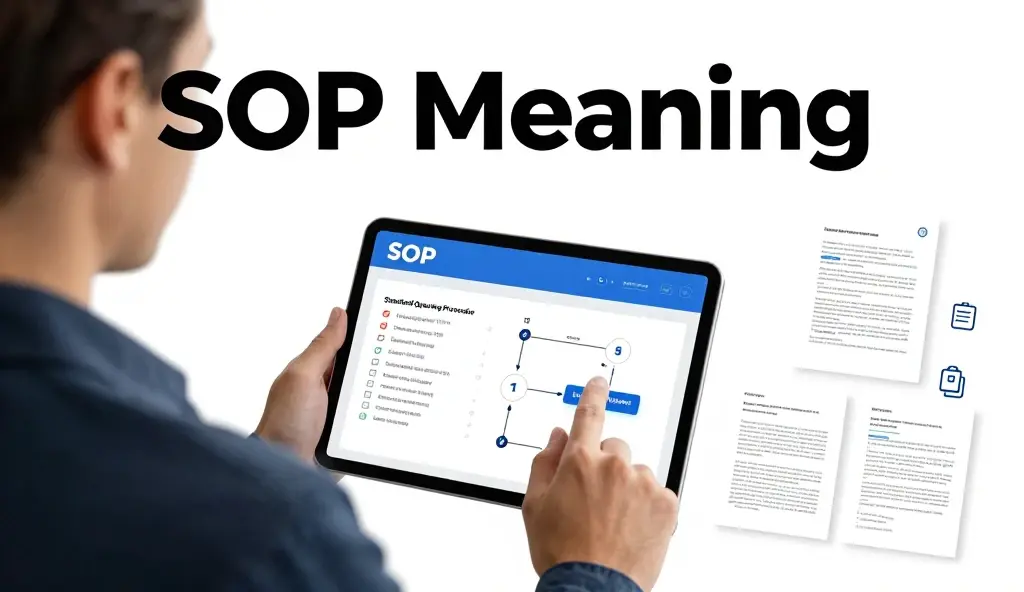
What does SOP mean? SOP most commonly means “Standard Operating Procedure,” a set of written steps that explains how to complete a task correctly and consistently.
SOPs are common in workplaces, schools, hospitals, laboratories, businesses, and many other organizations.
For example, a company may have an SOP explaining how employees should handle customer complaints.
However, SOP can have different meanings depending on the context.
In education, applications, and admissions, SOP often means “Statement of Purpose,” a document explaining a person’s academic or career goals.
In everyday texting, SOP is much less common and does not have one universal slang meaning.
Quick Answer
SOP most commonly stands for “Standard Operating Procedure” — a documented, step-by-step process businesses and organizations use to complete tasks consistently. Separately, “sop” is also a regular English word meaning something soaked in liquid, or figuratively, a concession given to calm or please someone.
Quick Meaning Table
| Term | Main Meaning | Full Form | Pronunciation | Usage | Example |
| SOP | A documented standard process for completing a task | Standard Operating Procedure | Said as individual letters: “S-O-P” | Business, workplaces, healthcare, manufacturing | “Follow the SOP for handling customer refunds.” |
What Does SOP Mean?
SOP most commonly stands for “Standard Operating Procedure.”
SOPs are extremely common in workplaces, especially in industries like healthcare, manufacturing, food service, and customer service, where consistency and safety really matter.
SOP Meaning in Simple Words
Think of an SOP as an instruction manual for a specific task at work. Instead of everyone doing something their own way, an SOP lays out the exact steps to follow, so the outcome stays consistent no matter who’s completing the task.
SOP Full Form
SOP stands for “Standard Operating Procedure.” This is by far the most common and widely recognized meaning of the abbreviation, especially in business and workplace contexts.
Different Meanings of SOP
While “Standard Operating Procedure” is the most common meaning, “sop” also exists as a completely separate, regular English word with its own meaning.
- Business/workplace meaning (SOP): A documented process or set of instructions for completing a task consistently.
- Regular word meaning (sop): A piece of food, like bread, that’s been soaked in liquid, such as soup or gravy.
- Figurative meaning (sop): Something given to calm, please, or distract someone, often used dismissively — as in “a sop to public opinion,” meaning a minor concession meant to quiet complaints without addressing the real issue.
SOP in the Workplace
SOPs are widely used across industries to standardize processes, train new employees, and ensure quality and safety. Common examples include:
- Healthcare: Procedures for patient intake, medication administration, or equipment sterilization
- Manufacturing: Step-by-step instructions for operating machinery or handling materials safely
- Food service: Procedures for food safety, cleaning, and preparation
- Customer service: Scripts or steps for handling common customer requests or complaints
- IT and tech: Documented processes for troubleshooting, software deployment, or data handling
Well-written SOPs are usually clear, specific, and easy to follow, often including numbered steps, visuals, or checklists.
SOP Meaning in Texting and Everyday Use
Outside of formal business contexts, “SOP” is sometimes used casually to describe someone’s usual routine or default way of doing something, even outside of work. For example: “Getting coffee before every meeting is just his SOP at this point,” meaning it’s simply his standard, expected habit.
The Older Meaning: “Sop” as a Regular Word
Separately from the acronym, “sop” is an old English word with two related meanings.
- Literal meaning: A piece of bread or food soaked in liquid, such as soup, gravy, or wine.
- Figurative meaning: Something offered to placate or quiet someone, often used critically, as in “the policy change was just a sop to critics,” implying it was a minor, insufficient gesture rather than a real solution.
This word is much older than the modern business acronym and comes from a completely different origin.
Origin of SOP
The acronym “SOP” (Standard Operating Procedure) developed alongside the growth of formal business process documentation in the 20th century, especially as industries like manufacturing and healthcare began emphasizing standardized, repeatable processes for safety and quality control.
The unrelated regular word “sop” comes from Old English “sopp,” referring to bread soaked in liquid, with the figurative meaning (“a token concession”) developing later as an extension of the idea of something offered to satisfy or quiet someone, much like tossing food to a growling animal.
How to Pronounce SOP
As an acronym, SOP is typically said by spelling out the letters: “S-O-P.” As a regular word (“sop,” meaning soaked bread or a placating gesture), it’s pronounced as one syllable, rhyming with “stop.”
How to Use SOP in a Sentence
- “Every new hire is trained using the department’s SOP.”
- “The company updated its SOP after the safety audit.”
- “Please review the SOP before operating this equipment.”
- “Our customer service SOP outlines exactly how to handle refund requests.”
- “The hospital’s SOP for medication administration is strictly enforced.”
- “He followed the SOP step by step to avoid any mistakes.”
- “The new manager rewrote several outdated SOPs.”
- “Cleaning the equipment daily is part of our standard SOP.”
- “The audit found that staff weren’t following the correct SOP.”
- “Each department has its own SOP for handling emergencies.”
Conversation Examples
Example 1:
Priya: how do I process a return for this customer? Marcus: check the SOP folder, there’s a whole guide for refunds
Example 2:
Dana: why does he always check his email before doing anything else? Jake: that’s just his SOP, he does it every single morning
Synonyms and Similar Words
- Protocol — a close synonym, especially in healthcare and formal settings
- Procedure — a more general term, often used interchangeably with SOP
- Guidelines — implies more flexibility than a strict SOP, which is usually meant to be followed exactly
- Process — a broader term describing a series of steps, not necessarily formally documented
- Playbook — a more casual, modern business term for a documented set of standard actions
SOP specifically implies formal documentation meant to be followed consistently, which sets it apart from more casual or flexible terms like “guidelines.”
Common Confusions
- SOP vs. policy: A policy explains the “what” and “why” of a rule, while an SOP explains the specific “how” — the exact steps to follow.
- SOP vs. sop (the word): These are completely unrelated — one is a business acronym, the other is an old English word about soaked food or a placating gesture.
- SOP vs. guidelines: Guidelines are usually more flexible, while an SOP is meant to be followed precisely and consistently.
FAQs:
What does SOP mean in business?
SOP stands for “Standard Operating Procedure,” referring to a documented set of steps used to complete a task consistently within an organization.
What is the full form of SOP?
SOP stands for “Standard Operating Procedure.”
Does SOP have any other meaning?
Yes. Separately from the business acronym, “sop” is a regular English word meaning food soaked in liquid, or figuratively, a minor concession given to placate someone.
Why are SOPs important in the workplace?
They ensure tasks are completed consistently and safely, regardless of who’s performing them, which is especially important in industries like healthcare and manufacturing.
What industries use SOPs the most?
Healthcare, manufacturing, food service, and customer service are among the industries that rely heavily on SOPs for consistency and safety.
How do you pronounce SOP?
As an acronym, it’s typically said by spelling out the letters: “S-O-P.” As a regular word, it’s pronounced as one syllable, rhyming with “stop.”
What’s the difference between an SOP and a policy?
A policy explains the rule and reasoning behind it, while an SOP provides the specific, step-by-step instructions for carrying it out.
Is SOP used casually outside of work?
Occasionally, yes — people sometimes use it informally to describe someone’s usual routine or default habit, even outside a formal workplace context.
What does “a sop to critics” mean?
It’s a figurative use of the older word “sop,” meaning a small, often insufficient concession offered to quiet complaints without addressing the underlying issue.
Where does the word “sop” (not the acronym) come from?
It comes from Old English “sopp,” originally referring to bread soaked in liquid, with the figurative meaning developing later.
Conclusion:
SOP most commonly stands for “Standard Operating Procedure,” a documented process businesses use to complete tasks consistently and safely.
Separately, “sop” is also a much older English word referring to soaked food or a minor concession meant to placate someone.
Context almost always makes clear which meaning is intended, though the business acronym is by far the more common use today.

Educational Writer committed to helping readers improve their English through simple, well-researched content.