
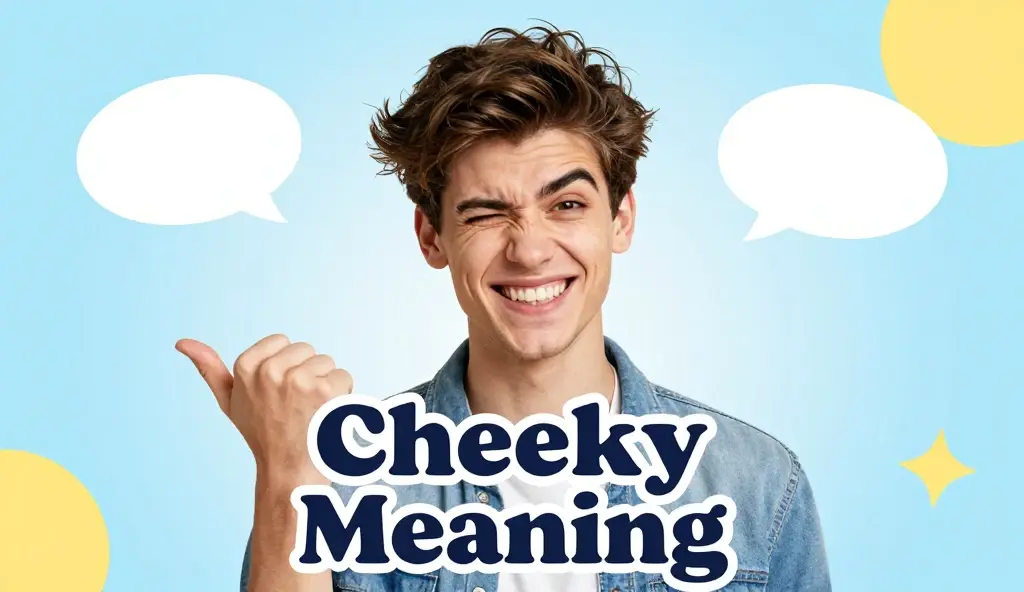
The cheeky meaning is usually slightly rude, playful, or disrespectful in a way that is often amusing rather than seriously offensive.
The word is especially common in British English and can describe someone who behaves boldly or says something they probably should not.
For example, if a child takes an extra cookie after being told not to, a parent might jokingly say, “You cheeky little thing!” Cheeky can be positive, negative, or playful depending on the situation and tone.
It can describe a person, comment, smile, action, or even a small indulgence, such as a “cheeky snack.”
In casual speech, it often suggests playful boldness rather than serious bad behavior.
If you are asking “What does cheeky mean?”, the simplest answer is: cheeky describes someone or something that is playfully bold, slightly naughty, or mildly disrespectful, often in an amusing way.
Quick Answer
Cheeky means slightly rude, bold, playful, or naughty in an amusing way. It is especially common in British English. For example, “You’re being cheeky” can mean someone is jokingly disrespectful or saying something a little too bold. The exact meaning depends heavily on the speaker’s tone and context.
Quick Meaning Table
| Term | Main meaning | Full form, if relevant | Pronunciation | Usage | Example |
| Cheeky | Playfully rude, bold, or naughty | Not an abbreviation | CHEE-kee | Casual, especially British English | “That was a cheeky comment.” |
What Does Cheeky Mean?
Cheeky describes behavior that is slightly rude, bold, mischievous, or disrespectful, but often in a playful or amusing way.
For example:
“That was a cheeky question.”
This could mean the question was a little too personal or bold, but the speaker may not be seriously angry about it.
Similarly:
“He gave me a cheeky smile.”
This suggests a playful or mischievous smile.
The word can be positive, negative, or somewhere in between. Tone and context matter a lot.
Cheeky Meaning in Simple Words
In simple English:
Cheeky means playfully naughty or a little rude.
For example:
“The child was being cheeky.”
This means the child was behaving in a slightly naughty or disrespectful but perhaps amusing way.
It can also describe adults:
“He made a cheeky joke.”
Here, the joke may be slightly bold or inappropriate, but it is intended to be funny.
Different Meanings of Cheeky
1. Playfully Naughty
This is common when talking about children.
“You’re a cheeky little boy!”
The speaker may be annoyed, but the phrase can also sound affectionate or humorous.
2. Slightly Rude
Someone can be cheeky when they say something that is a little disrespectful.
“Don’t get cheeky with me.”
This is more serious and means:
“Don’t speak to me in a disrespectful way.”
3. Bold or Mischievous
A person may do something slightly unexpected or daring.
“She gave him a cheeky grin.”
This suggests playful confidence or mischief.
4. A Small Indulgence
In informal British English, cheeky can describe doing or having something enjoyable that is slightly unexpected or perhaps not entirely sensible.
For example:
“Let’s have a cheeky dessert.”
This means having a dessert as a small treat or indulgence.
Cheeky Meaning in Texting
Cheeky is not a texting abbreviation.
In text messages, it usually has the same meaning as ordinary casual English.
For example:
“That was cheeky 😂”
This could mean:
“That was a little bold or naughty, but funny.”
The laughing emoji can make the meaning more playful.
Another example:
“You cheeky thing!”
This can be affectionate rather than genuinely angry, depending on the relationship and context.
Cheeky Meaning on Social Media
Cheeky does not have a special platform-specific meaning on TikTok, Instagram, Snapchat, WhatsApp, Reddit, or other major social platforms.
It is commonly used in captions and comments to describe something playful, bold, or slightly naughty.
For example:
“A cheeky little weekend trip.”
Here, cheeky suggests a fun or spontaneous treat.
You might also see:
“That was a cheeky move.”
This means someone did something bold, mischievous, or slightly unexpected.
How to Pronounce Cheeky
Cheeky is pronounced:
CHEE-kee
cheeky (/ˈtʃiːki/)
It rhymes approximately with “freaky” and “geeky.”
Origin of Cheeky
Cheeky comes from the noun cheek. English has long used cheek in expressions connected with boldness or disrespect, such as having the nerve to speak boldly.
The adjective cheeky developed from this idea and came to describe someone who is bold, impudent, or slightly disrespectful.
Over time, especially in British English, the word also developed warmer and more playful uses.
Cheeky in British vs. American English
Cheeky is strongly associated with British English, although American English speakers understand it and sometimes use it.
In British English, it is very common to hear expressions such as:
- “a cheeky comment”
- “a cheeky smile”
- “a cheeky child”
- “a cheeky drink”
- “a cheeky snack”
- “a cheeky pint”
In American English, words such as sassy, playful, mischievous, or bold may sometimes sound more natural depending on the context.
How to Use Cheeky in a Sentence
Here are 10 natural examples:
- “That was a cheeky comment.”
- “The child gave his mother a cheeky smile.”
- “Don’t get cheeky with me.”
- “She asked a cheeky question.”
- “He made a cheeky joke during dinner.”
- “The puppy was being cheeky again.”
- “That’s a cheeky thing to say.”
- “They had a cheeky dessert after dinner.”
- “He gave me a cheeky grin and walked away.”
- “We decided to take a cheeky weekend trip.”
Conversation Examples
Conversation 1: Playful
Alex: “Did you eat the last cookie?”
Sam: “Maybe…”
Alex: “You cheeky thing!”
Sam: “It was too good to leave!”
Here, cheeky is playful and affectionate.
Conversation 2: Slightly Rude
Manager: “Did you just tell me how to do my job?”
Employee: “I was only trying to help.”
Manager: “Don’t get cheeky with me.”
Here, cheeky means disrespectful or overly bold.
Synonyms and Similar Words
Playful
Describes behavior that is fun and not serious.
Mischievous
Describes someone who enjoys causing minor trouble or being naughty.
Sassy
Often means boldly confident or slightly disrespectful. It is particularly common in American English.
Naughty
Usually describes someone who behaves badly, especially children, but can also be playful.
Impudent
Means boldly disrespectful. This is more formal and usually more negative than cheeky.
Bold
Can mean confident or willing to take risks. Unlike cheeky, it does not necessarily imply rudeness.
Saucy
Can mean boldly playful or slightly suggestive, depending on context.
Common Confusions
Cheeky vs. Rude
Cheeky can mean rude, but it often has a playful or humorous quality.
Rude is more directly negative and means lacking politeness or respect.
“He made a cheeky comment.”
This may be funny.
“He made a rude comment.”
This usually sounds more seriously offensive.
Cheeky vs. Naughty
Naughty usually describes bad or mischievous behavior.
Cheeky often focuses more on boldness or mild disrespect.
A child can be both cheeky and naughty.
Cheeky vs. Sassy
These words overlap.
Sassy often suggests confident, bold, or disrespectful speech.
Cheeky can suggest similar behavior but often sounds more playful, particularly in British English.
Cheeky vs. Flirty
A cheeky comment can sometimes be flirty, but cheeky does not automatically mean romantic or sexual.
Context determines whether a comment is simply playful or also flirtatious.
Is Cheeky Offensive?
Cheeky is usually not strongly offensive.
It can be affectionate, humorous, mildly critical, or genuinely disapproving depending on how it is said.
For example:
“You cheeky little thing!”
may be affectionate.
But:
“Don’t get cheeky with me.”
is more serious and means “Don’t be disrespectful.”
Because tone matters, the same word can sound friendly in one situation and confrontational in another.
FAQs:
1. What does cheeky mean in simple English?
Cheeky means slightly rude, bold, mischievous, or naughty in a playful way. It often describes behavior that is not seriously bad but pushes the limits of what is polite or acceptable. The exact meaning depends on the speaker’s tone and context.
2. Is cheeky a British word?
Cheeky is especially common in British English, although it is also understood and used elsewhere. British speakers often use it for playful behavior, mildly rude comments, or small treats, such as “a cheeky dessert.”
3. Does cheeky mean rude?
Cheeky can mean slightly rude, but it is often softer and more playful than “rude.” Someone can make a cheeky joke without intending to offend anyone. In a more serious context, however, “don’t get cheeky” can mean “don’t be disrespectful.”
4. What does “cheeky” mean in texting?
In texting, cheeky usually means playfully bold, naughty, or slightly rude. For example, “That was cheeky 😂” often suggests that someone did or said something bold but amusing rather than seriously offensive.
5. What does “cheeky little thing” mean?
“Cheeky little thing” is usually a playful or affectionate expression for someone who is being mischievous, bold, or slightly naughty. Parents, friends, and romantic partners may use it jokingly depending on the relationship.
6. What does “cheeky” mean in British slang?
In British informal speech, cheeky can describe something playful, mildly naughty, bold, or indulgent. For example, “a cheeky snack” means a small treat, while “a cheeky comment” means a slightly bold or disrespectful comment.
7. What is the opposite of cheeky?
The opposite depends on the context. Possible opposites include polite, respectful, well-behaved, reserved, or serious. If cheeky means mischievous, then well-behaved is a particularly natural opposite.
8. Is cheeky a compliment?
Sometimes. Calling someone cheeky can be affectionate or complimentary when it means playful, confident, or amusing. However, it can also be criticism if the person is being disrespectful. Tone and the relationship between the speakers make a big difference.
9. Does cheeky mean flirty?
Not necessarily. Cheeky can describe a playful or bold comment, and that comment may sometimes be flirtatious. However, cheeky itself does not automatically mean romantic or sexual interest.
10. What does “a cheeky smile” mean?
A cheeky smile is a playful, mischievous, or slightly naughty-looking smile. It often suggests that the person knows they have done something bold or amusing and is enjoying the reaction.
Conclusion:
The cheeky meaning is usually playfully rude, bold, mischievous, or slightly naughty.
The word is especially common in British English and can be either positive or negative depending on context.
A “cheeky smile” may be playful, while “don’t get cheeky” can be a warning not to be disrespectful.
You may also hear cheeky used for small treats or indulgences, such as a “cheeky snack.”
When interpreting the word, always consider the speaker’s tone and the situation.

English Education Specialist creating informative content focused on language learning and communication.