
Last Updated:
Have you ever made a careful decision because you wanted to avoid unnecessary risks or future problems?
Perhaps you saved money instead of spending it all, thought carefully before accepting a job offer, or checked the facts before making an important choice.
These are examples of being prudent.
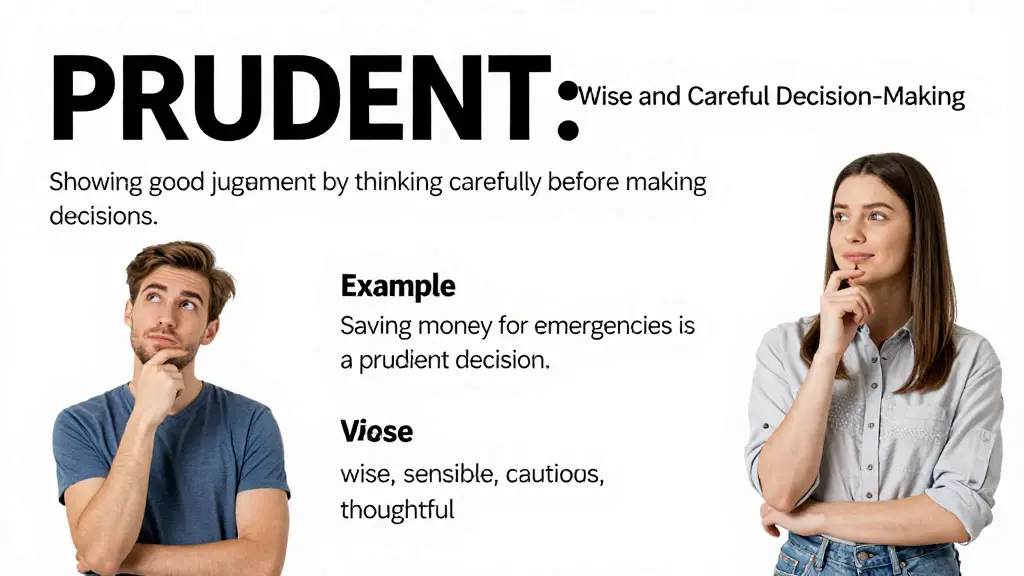
The prudent meaning is showing good judgment by thinking carefully about possible risks, consequences, and future needs before taking action.
A prudent person considers the situation and chooses a sensible, responsible course of action.
For example, if you save some money for emergencies instead of spending your entire paycheck, you are making a prudent financial decision.
The word prudent is commonly used when discussing money, business, relationships, health, planning, and everyday decisions.
It is generally a positive word because it suggests wisdom, caution, and responsibility.
In this article, you will learn what prudent means in simple English, how to pronounce it, its synonyms and antonyms, and how to use it correctly in everyday sentences.
Quick Answer: What Does Prudent Mean?
Prudent means careful, sensible, and wise when making decisions, especially when considering possible risks or future consequences.
For example: “It is prudent to save money for unexpected expenses.” This means it is wise to prepare financially for situations that may arise in the future.
Prudent Meaning at a Glance
| Detail | Meaning |
| Word | Prudent |
| Part of speech | Adjective |
| Simple meaning | Wise, careful, and sensible |
| Pronunciation | PROO-dunt |
| Synonyms | Sensible, wise, cautious, judicious |
| Antonyms | Reckless, imprudent, careless, rash |
| Noun form | Prudence |
| Adverb form | Prudently |
| Example | “She made a prudent decision to avoid unnecessary debt.” |
What Is the Meaning of Prudent?
The word prudent describes a person, decision, or action that demonstrates good judgment and careful consideration.
A prudent person does not usually rush into a decision without thinking about what might happen next. Instead, they consider the available information, weigh possible benefits and risks, and choose an appropriate course of action.
For example:
- “It was prudent to check the contract before signing it.”
- “The company took a prudent approach to spending.”
- “He made a prudent decision to keep some savings for emergencies.”
- “It would be prudent to confirm the appointment before traveling.”
In each example, prudent suggests that someone has considered the situation carefully rather than acting impulsively.
Being prudent does not mean avoiding every risk. Sometimes taking a risk is reasonable or necessary. Prudence means understanding the risks and making an informed decision rather than acting carelessly.
Prudent Meaning in Simple English
In simple English, prudent means thinking carefully and making a wise decision.
Imagine that you receive a bonus at work. You could spend all of it on expensive items, or you could use some of it to pay bills and save the rest for future needs.
Choosing to save part of the money may be a prudent decision because you are thinking about your future financial security.
Here are some simple examples:
- A prudent person checks the weather before going on a long hike.
- A prudent driver slows down when the road is slippery.
- A prudent student starts studying before the examination.
- A prudent business owner avoids spending more money than the business can afford.
- A prudent traveler checks their passport and travel documents before leaving.
The main idea is to think ahead, understand the consequences, and act sensibly.
How to Pronounce Prudent
The word prudent is pronounced PROO-dunt.
It has two syllables:
- Pru — sounds like “proo.”
- Dent — sounds approximately like “dunt.”
The stress falls on the first syllable: PRU-dent.
Example sentence:
“It is prudent to compare your options before making a decision.”
Practicing the word in a sentence can help you remember its pronunciation and meaning.
10 Examples of Prudent in Sentences
Here are ten everyday examples showing how to use prudent naturally.
1. In Personal Finance
“It is prudent to keep some money aside for emergencies.”
Meaning: It is wise to save money in case unexpected expenses arise.
2. In Business
“The company made a prudent decision to review its expenses before expanding.”
Meaning: The company carefully considered its financial situation before taking action.
3. In Driving
“It would be prudent to slow down because the roads are icy.”
Meaning: Slowing down is a sensible way to reduce risk.
4. In Education
“A prudent student begins preparing for exams several weeks in advance.”
Meaning: The student plans ahead instead of waiting until the last minute.
5. In Relationships
“It may be prudent to have an honest conversation before making a major commitment.”
Meaning: Talking through important issues can help people make a thoughtful decision.
6. In Travel
“Checking the visa requirements before booking the trip was a prudent move.”
Meaning: Checking the requirements helped prevent possible problems.
7. In Health and Safety
“Wearing protective equipment is a prudent precaution when working with machinery.”
Meaning: The precaution helps reduce the chance of injury.
8. In Career Decisions
“She took a prudent approach by researching the company before accepting the job offer.”
Meaning: She gathered information before making an important decision.
9. In Everyday Planning
“It is prudent to leave early when you have an important appointment.”
Meaning: Leaving early reduces the risk of arriving late.
10. In Investments
“The investor adopted a prudent strategy that matched their financial goals and tolerance for risk.”
Meaning: The investor carefully considered the possible risks and benefits before choosing a strategy.
Prudent Synonyms: Words With Similar Meanings
Synonyms are words that have similar meanings. Several English words can be used in place of prudent, depending on the situation.
| Synonym | Meaning |
| Wise | Showing good judgment |
| Sensible | Practical and reasonable |
| Cautious | Taking care to avoid danger or mistakes |
| Judicious | Showing careful judgment |
| Careful | Paying attention to possible problems |
| Thoughtful | Considering a situation before acting |
| Discerning | Able to judge situations well |
| Foresighted | Thinking ahead about future needs |
| Reasonable | Based on good sense and logic |
| Circumspect | Careful to consider possible risks before acting |
These words are related, but they have slightly different meanings.
For example, cautious emphasizes avoiding danger, while prudent emphasizes using good judgment to choose an appropriate course of action. Foresighted places greater emphasis on anticipating future needs or consequences.
Prudent Antonyms: Words With Opposite Meanings
Antonyms are words with opposite or contrasting meanings.
| Antonym | Meaning |
| Imprudent | Not showing good judgment |
| Reckless | Acting without enough concern for risks |
| Careless | Not paying enough attention |
| Rash | Acting too quickly without proper thought |
| Foolish | Lacking good judgment |
| Impulsive | Acting suddenly without careful consideration |
| Irresponsible | Failing to act responsibly |
| Unwise | Not sensible or well judged |
| Hasty | Done too quickly |
| Short-sighted | Failing to consider future consequences |
The most direct opposite of prudent is imprudent.
For example:
- Prudent: “She carefully reviewed the agreement before signing.”
- Imprudent: “She signed the agreement without reading it.”
The first action demonstrates careful judgment, while the second may expose the person to avoidable risks.
Prudent vs. Cautious: What Is the Difference?
The words prudent and cautious are closely related, but they are not exactly the same.
Prudent means making wise decisions by considering risks, benefits, and future consequences.
Cautious means taking care to avoid danger, mistakes, or unwanted outcomes.
For example:
- “It was prudent to compare several mortgage offers before choosing one.” This emphasizes careful judgment.
- “She was cautious while driving on the icy road.” This emphasizes care in a potentially dangerous situation.
A prudent person may sometimes decide that taking a calculated risk is worthwhile. A cautious person tends to emphasize avoiding potential danger.
Prudent vs. Wise
Prudent and wise both describe good judgment, but prudent often has a stronger connection to practical decisions and risk management.
Wise can refer to broad knowledge, understanding, experience, or good judgment.
Prudent usually emphasizes thinking ahead and making sensible choices based on possible consequences.
For example:
- “She gave me wise advice about choosing a career.” This emphasizes sound judgment and insight.
- “It was prudent to review the employment contract before accepting the position.” This emphasizes a careful, practical decision.
A decision can be both wise and prudent.
Prudent vs. Sensible
The words prudent and sensible often overlap.
Sensible describes something reasonable and practical. Prudent adds an emphasis on foresight, caution, and avoiding unnecessary risks.
For example:
- “Wearing a coat in cold weather is sensible.”
- “Keeping an emergency fund is prudent.”
Both words describe reasonable choices, but prudent is especially common when discussing money, investments, business decisions, and future planning.
What Does Prudent Mean in Finance?
In finance, prudent means making responsible financial decisions after considering risks, available resources, and future needs.
A prudent financial approach may include:
- Creating a realistic budget.
- Saving money for emergencies.
- Understanding the risks before investing.
- Avoiding debt that you cannot reasonably repay.
- Comparing financial products before choosing one.
- Considering long-term goals instead of focusing only on immediate rewards.
For example, a prudent investor does not automatically choose an investment simply because it promises high returns. They consider the potential losses, fees, time horizon, and whether the investment fits their circumstances.
Being prudent does not guarantee that a financial decision will succeed. It means that the decision was made thoughtfully using the information available at the time.
What Does Prudent Mean in Business?
In business, prudent describes decisions made with careful judgment and attention to potential risks and consequences.
A prudent business owner might review cash flow before hiring more employees, check the terms of a contract before signing it, or test a new product before investing heavily in production.
For example:
“The management team took a prudent approach to expansion by evaluating demand and costs first.”
This means the team considered whether expansion was financially and practically reasonable before committing resources.
Prudent business decisions can help organizations manage uncertainty, but they do not eliminate every risk or guarantee success.
What Does Prudent Mean in Law?
In legal contexts, prudent often describes conduct that demonstrates reasonable care and good judgment.
For example, a person might be advised to keep copies of important documents, review a contract carefully, or seek qualified legal advice before signing a complex agreement.
In some legal settings, related concepts such as the reasonable person standard or a prudent person standard may be used to assess conduct. The precise meaning depends on the relevant law and context.
In everyday legal writing, describing an action as prudent generally means that it was sensible and carefully considered under the circumstances.
What Is the Noun Form of Prudent?
The noun form of prudent is prudence.
Prudence means the quality of using good judgment and thinking carefully about possible consequences before acting.
Examples:
- “She showed prudence by saving money for emergencies.”
- “Prudence is important when making major financial decisions.”
- “His prudence helped the team avoid unnecessary expenses.”
The adverb form is prudently, which describes doing something in a prudent way.
Example: “The company invested prudently after reviewing its financial position.”
A useful way to remember the forms is:
- Prudent — adjective: “a prudent decision”
- Prudence — noun: “She showed prudence”
- Prudently — adverb: “He acted prudently”
FAQs:
1. What does prudent mean in simple words?
Prudent means being careful and wise when making decisions. It involves thinking about possible risks, benefits, and future consequences before taking action. For example, saving money for emergencies is a prudent choice because it prepares you for unexpected expenses.
2. What is an example of prudent?
An example is: “It was prudent to check the contract before signing it.” This means reviewing the agreement was a sensible decision that could help prevent misunderstandings or unwanted obligations later.
3. What is the synonym of prudent?
Common synonyms include wise, sensible, cautious, judicious, and careful. The best synonym depends on the context. Wise emphasizes good judgment, while cautious emphasizes avoiding danger or unnecessary risks.
4. What is the opposite of prudent?
The opposite of prudent is usually imprudent. Other antonyms include reckless, careless, rash, and unwise. These words describe decisions made without enough thought, preparation, or consideration of possible consequences.
5. Does prudent mean careful?
Yes, but it means more than simply paying attention. Prudent describes being careful in a way that demonstrates good judgment, especially when considering future consequences. A prudent person thinks about what might happen before deciding what to do.
6. What does prudent mean in finance?
In finance, prudent means managing money responsibly and considering potential risks. Examples include maintaining emergency savings, researching investments, comparing loan terms, and avoiding financial commitments that are unsuitable for your circumstances.
7. What is the difference between prudent and cautious?
Prudent emphasizes making a sensible decision after weighing risks and benefits. Cautious emphasizes taking care to avoid danger or mistakes. A prudent decision may involve accepting a reasonable risk when the potential benefits justify it.
8. What is the noun form of prudent?
The noun form is prudence. It refers to the quality of making wise, careful decisions. For example, “Her prudence helped her avoid unnecessary debt.” The adverb form is prudently, as in “He invested prudently.”
9. Is prudent a positive word?
Yes. Prudent is generally a positive word because it suggests responsible behavior, good judgment, and thoughtful planning. However, excessive caution can sometimes delay action, so the best decision depends on the situation and the risks involved.
10. How do you use prudent in a sentence?
You can use prudent to describe a person, decision, plan, or action. For example: “It would be prudent to make a backup of your files before updating the computer.” This means creating a backup is a sensible precaution.
Conclusion:
The meaning of prudent is wise, careful, and sensible when making decisions.
A prudent person considers possible risks, thinks about future consequences, and chooses a practical course of action rather than acting impulsively.
The word is especially useful when discussing money, business, travel, relationships, and important life decisions.
For example, saving for emergencies, checking a contract before signing it, and researching an investment are all examples of prudent behavior.
Remember that being prudent does not mean avoiding every risk.
It means using good judgment to understand risks and make informed choices.

Educational Writer committed to helping readers improve their English through simple, well-researched content.