
Last Updated:
Have you ever heard someone call a person by a special name and wondered what it means? The word moniker is often used when talking about names, nicknames, and the names people are known by.
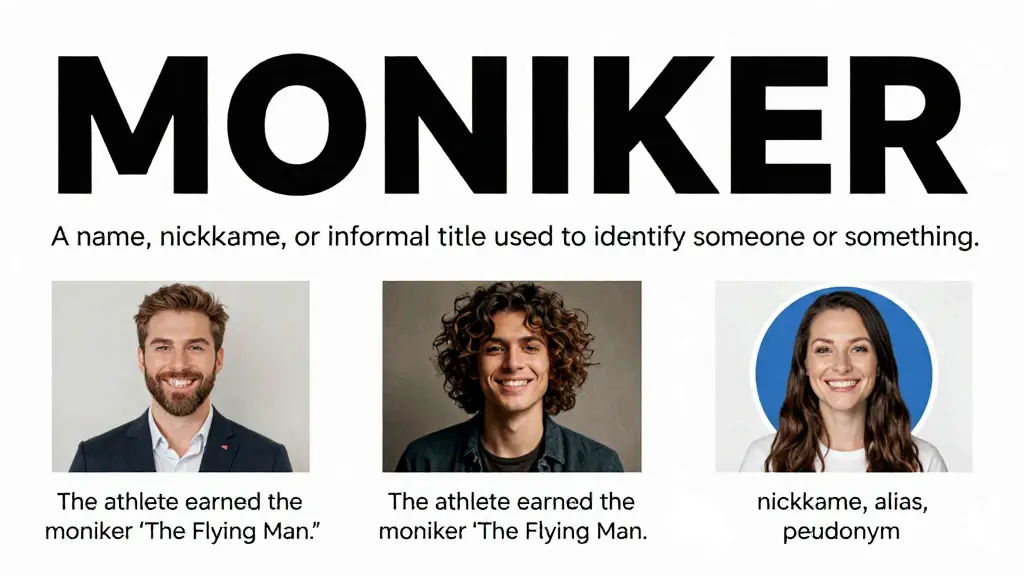
A moniker means a name, nickname, or label used to identify a person or thing.
For example, if a person named William is known as “Will,” that nickname can be called a moniker. A famous singer may also use a stage name as their moniker.
The word is common in everyday conversation, entertainment, social media, and writing.
It can sound a little more formal or playful than the simple word “name.”
In this guide, you will learn the meaning of moniker, its synonyms, its use in texting and social media, and how to use it correctly in sentences.
Quick Answer
Moniker means a name or nickname that someone or something is known by. For example, if a person is known as “The King of Pop,” that title is a moniker associated with Michael Jackson.
Quick Meaning Table
| Word or Phrase | Meaning |
| Moniker | A name or nickname |
| Simple meaning | What someone or something is called |
| Part of speech | Noun |
| Pronunciation | MON-ih-ker |
| Synonyms | Name, nickname, alias, title |
| Common use | Everyday speech, writing, media |
| Example | “The artist uses a new moniker.” |
| Tone | Neutral, informal, or slightly playful |
What Is the Simple Meaning of Moniker?
In simple English, a moniker is what you call a person or thing. It may be the person’s real name, a nickname, a professional name, or a name that other people give them.
For example:
- A person named Robert may use the moniker “Rob.”
- A musician may perform under a different name.
- A gamer may use a special username online.
- A famous athlete may be known by a popular nickname.
All these names can be described as monikers, depending on the context.
The word does not always mean a nickname. It can refer to almost any name by which someone or something is known.
Example: “The writer published the book under a different moniker.”
This means the writer used another name instead of their usual name.
What Does Moniker Mean in Texting and Messaging?
In texting, moniker usually means a name, nickname, or username. It is not a common texting abbreviation like “LOL” or “BRB.” Instead, it is a regular English word that someone might use while discussing names.
For example:
Text 1: “What’s your gaming moniker?”
Meaning: What name do you use when playing games?
Text 2: “Everyone knows him by his online moniker.”
Meaning: Everyone knows his online name.
Text 3: “She changed her moniker last week.”
Meaning: She changed the name she uses.
People may use this word when discussing online identities, gaming accounts, usernames, or nicknames. However, in casual messages, most people simply say “name” or “nickname.”
What Does Moniker Mean in Slang?
Moniker is not slang itself, but it can be used when talking about slang names and popular nicknames.
For example, a person might have a nickname that their friends use instead of their real name. That nickname can be called their moniker.
Consider these examples:
- “Big Mike” is a moniker for someone named Mike.
- “Speedy” might be a moniker for a person known for running fast.
- “The Boss” could be a moniker for someone who leads a group.
- A rapper may use a stage name as their moniker.
The meaning depends on the name and the situation.
Moniker can also sound humorous when used to describe a silly or unusual nickname.
Example: “His friends gave him the moniker ‘Professor’ because he always explains everything.”
Here, moniker means the nickname his friends gave him.
What Does Moniker Mean on Social Media?
On social media, moniker can refer to a username, display name, online nickname, or public identity.
People often use names on TikTok, Instagram, Snapchat, YouTube, and gaming platforms that differ from their real names.
For example:
- A creator uses a special name for their videos.
- A gamer chooses a unique username.
- A person uses a nickname on Instagram.
- An artist creates a public identity under a stage name.
These names may be called monikers.
Example: “The creator became popular under the moniker ‘Daily Explorer.’”
This means the creator became known by that name.
A moniker can help someone build a recognizable online identity. However, the word is broader than “username” because it can also describe nicknames, titles, and professional names outside the internet.
What Does Moniker Mean in Love and Relationships?
In relationships, moniker can mean a nickname or special name used for a partner.
Couples sometimes use affectionate names such as “Sweetheart,” “Honey,” or “Love.” These names may be described as monikers, although people usually call them pet names or nicknames.
For example:
- “Honey” is the moniker he uses for his partner.
- “Sunshine” became her nickname among her friends.
- “They have special monikers for each other.”
In these examples, moniker simply refers to the name someone is known by or called.
The word itself does not mean love or romance. The relationship context gives the name its emotional meaning.
What Does Moniker Mean in Everyday Conversation?
In everyday conversation, moniker is another way to say name or nickname. People may use it when discussing how someone became known by a particular name.
For example:
“He earned the moniker ‘The Teacher’ because he always helped his teammates.”
This means people started calling him “The Teacher” because of his helpful behavior.
Another example:
“The town has the moniker ‘The City of Roses.’”
This means the town is known by that name.
You may also see moniker in news stories, biographies, interviews, sports articles, and entertainment writing.
Although the word is easy to understand, it is less common than “name” or “nickname” in everyday speech.
10 Examples of Moniker in Sentences
Here are ten examples to help you understand how to use moniker correctly.
- He uses the moniker “Shadow” when playing online games.
Meaning: “Shadow” is his gaming name. - The singer became famous under a different moniker.
Meaning: The singer became famous using another name. - Her friends gave her the moniker “Sunshine.”
Meaning: Her friends gave her that nickname. - The writer published the story under a new moniker.
Meaning: The writer used another name for the publication. - Everyone knows him by his childhood moniker.
Meaning: People know him by the nickname he had as a child. - The athlete earned the moniker “The Rocket.”
Meaning: People started calling the athlete “The Rocket.” - She changed her online moniker to match her new brand.
Meaning: She changed her online name. - The character is known by the moniker “The Wanderer.”
Meaning: “The Wanderer” is the character’s known name or title. - His moniker became popular among his classmates.
Meaning: Many classmates started using his nickname. - The artist chose a memorable moniker for his music career.
Meaning: The artist selected a special name for his career.
Short Conversations Using Moniker
These short conversations show how the word can appear in natural English.
Conversation 1: Online Gaming
Alex: What’s your moniker in the game?
Sam: I use the name “Night Falcon.”
Alex: That’s a cool moniker!
Meaning: Alex is asking Sam about his gaming name.
Conversation 2: A Nickname
Mia: Why does everyone call you “Professor”?
Jack: It’s my old moniker because I always help people with homework.
Mia: Now I understand!
Meaning: Jack’s friends use “Professor” as a nickname because he helps others study.
Moniker Synonyms
Several English words have a meaning similar to moniker. However, they are not always interchangeable.
- Name: The general word for what someone or something is called.
- Nickname: An informal or additional name used instead of a person’s usual name.
- Alias: Another name someone uses, often instead of their real name.
- Title: A name or designation showing a role, position, or status.
- Handle: A name used to identify someone online.
- Pseudonym: A name used by someone instead of their real name, especially by a writer or artist.
- Sobriquet: A descriptive nickname, often given to a person.
- Label: A word or name used to describe or identify someone or something.
- Byname: An additional name used to identify a person.
- Appellation: A formal word for a name or title.
Best simple synonyms: Name, nickname, alias, and title.
Moniker vs. Nickname
Moniker and nickname have similar meanings, but there is a small difference.
A nickname is usually an informal or additional name given to someone. A moniker is a broader term that can refer to a nickname, stage name, online name, or other name someone is known by.
Examples:
- “Tom” is a nickname for Thomas.
- “The Rock” is a well-known moniker associated with Dwayne Johnson.
- “GamerPro” could be a person’s online moniker.
You can often use moniker instead of nickname, but nickname may sound more natural in casual conversation.
Moniker vs. Alias
An alias is another name someone uses, sometimes to keep their real identity private or to work under a different identity. A moniker is a broader term for a name someone is known by.
For example:
- A writer may use a pseudonym when publishing books.
- A person may use an alias in a particular situation.
- A musician may use a stage name as a moniker.
The words overlap, but alias often emphasizes the use of an alternative name, while moniker can simply mean a person’s familiar or recognized name.
Moniker vs. Pseudonym
A pseudonym is a name someone uses instead of their real name, especially when creating or publishing work.
For example, a novelist might publish books under a pen name. That name is a pseudonym and can also be described as a moniker.
The difference is that pseudonym has a more specific meaning, while moniker is more general.
Easy way to remember:
- Moniker = a name someone is known by.
- Pseudonym = a name used instead of a real name, often by a writer or artist.
Is Moniker Formal or Informal?
Moniker is a standard English word that can be used in both formal and informal writing. However, it often sounds more conversational or playful than the simple word “name.”
You may see it in:
- News articles
- Entertainment stories
- Sports writing
- Online discussions
- Biographies
- Casual conversations
For example, “The musician performs under the moniker Blue Star” sounds natural in an article.
In a simple conversation, however, “The musician uses the name Blue Star” may sound clearer.
Choose the word that best fits your audience and writing style.
Common Mistakes When Using Moniker
Here are some common mistakes to avoid.
1. Thinking moniker always means nickname
Moniker can mean a nickname, but it can also mean a stage name, online name, title, or another recognized name.
2. Confusing moniker with a person’s real name
A moniker does not have to be the name on someone’s official documents. It can be an additional or professional name.
3. Using moniker as a verb
Moniker is a noun, not a verb. You can say, “His moniker is Blue Fox,” but not “He monikered his friend” in ordinary standard English.
4. Assuming moniker is a texting abbreviation
Moniker is a regular English word, not an abbreviation like “LOL” or “IDK.”
5. Using it when a simpler word is better
Although moniker is correct, “name” or “nickname” may be easier for readers to understand.
How to Use Moniker Correctly
You can use moniker when you want to talk about the name by which a person or thing is known.
Common sentence patterns include:
- “Known by the moniker…”
- “Uses the moniker…”
- “Earned the moniker…”
- “Goes by the moniker…”
- “Adopted the moniker…”
Examples:
Known by the moniker: “The artist is known by the moniker Star Boy.”
Uses the moniker: “She uses the moniker Moonlight online.”
Earned the moniker: “He earned the moniker Speedy because he runs fast.”
Goes by the moniker: “The musician goes by the moniker DJ Nova.”
Adopted the moniker: “The writer adopted a new moniker for her books.”
These patterns can help you use the word naturally in conversation and writing.
FAQs:
1. What does moniker mean in simple words?
Moniker means a name or nickname that someone or something is known by. It can be a real name, online name, stage name, or informal nickname.
2. Is moniker another word for nickname?
Yes, moniker can mean nickname. However, it is broader and can also refer to a stage name, username, title, or other recognized name.
3. What is an example of a moniker?
“Speedy” is an example of a moniker for someone who runs fast. It is a name people use to identify that person.
4. What is the synonym of moniker?
Common synonyms include name, nickname, alias, handle, title, pseudonym, and sobriquet. The best synonym depends on the context.
5. What does moniker mean on social media?
On social media, moniker can mean a username, display name, or online nickname that someone uses to identify themselves.
6. Is moniker a slang word?
No, moniker is a standard English noun. It may appear in casual conversations, but it is not slang or a texting abbreviation.
7. What is the difference between a moniker and an alias?
A moniker is a general name someone is known by. An alias specifically refers to another name someone uses instead of their usual or real name.
8. Can a real name be a moniker?
Yes. Moniker can refer to a person’s name in general, although it is often used for an alternative name, nickname, or public identity.
9. How do you pronounce moniker?
Moniker is pronounced “MON-ih-ker.” The first syllable sounds like “mon” in “Monday.”
10. Is moniker positive or negative?
Moniker is generally neutral. It simply means a name or nickname. Whether it sounds positive or negative depends on the name and the situation.
Conclusion:
Moniker is a useful English word that means a name, nickname, or other name by which someone or something is known.
It can describe a person’s nickname, a musician’s stage name, or a username used online.
Words such as name, nickname, alias, and pseudonym have similar meanings, but each has its own use.
When you see the word moniker in a message, article, or conversation, think of it as another way to say “the name someone is known by.”

Julia Harrison is a U.S.-based writer passionate about English learning and vocabulary development. She writes accessible articles about words, phrases, and expressions. Her work is designed to help readers expand their vocabulary while developing a better understanding of practical English usage.