
Last Updated:
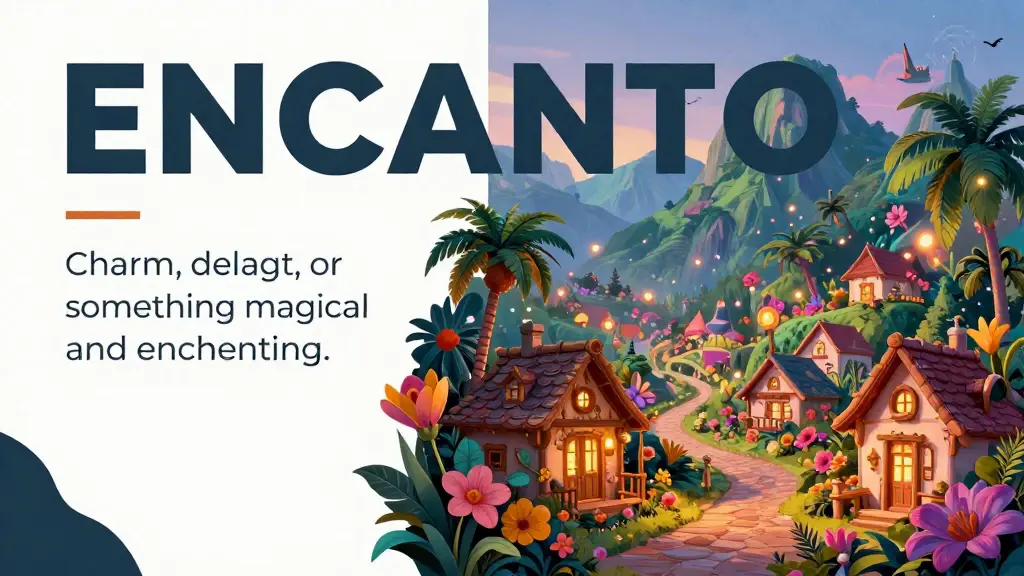
Have you heard the word “encanto” in a Spanish conversation, a romantic message, or the Disney movie Encanto? The word has a beautiful meaning that can refer to charm, delight, enchantment, or something that captivates you.
In Spanish, encanto is a noun commonly associated with something charming, magical, or delightful.
It can describe a person’s appealing personality, the beauty of a place, or the special feeling that makes something wonderful.
For example, if someone says, “¡Qué encanto!”, they may be expressing admiration for something or someone charming.
The expression “tiene mucho encanto” means “it has a lot of charm.”
The word became widely recognized internationally through Disney’s animated film Encanto, which tells the story of the magical Madrigal family in Colombia.
In this guide, you’ll learn the meaning of encanto in English, its Spanish usage, its meaning in the Disney movie, romantic expressions, pronunciation, synonyms, and examples of how to use it correctly.
Quick Answer: What Does Encanto Mean?
Encanto is a Spanish word that means “charm,” “enchantment,” or “delight.” Depending on the context, it can describe someone charming, something beautiful, or a magical quality that makes a person or place special.
Examples:
- “Tiene mucho encanto.” — “It has a lot of charm.”
- “Eres un encanto.” — “You’re a sweetheart” or “You’re delightful.”
- “El encanto de la ciudad.” — “The charm of the city.”
The exact translation depends on the sentence.
Encanto Meaning at a Glance
| Category | Meaning |
| Word | Encanto |
| Language | Spanish |
| Part of speech | Noun |
| English translations | Charm, enchantment, delight, appeal |
| Pronunciation | en-KAN-toh |
| Related verb | Encantar — to delight, enchant, or greatly please |
| Common expression | “Eres un encanto” — “You’re a sweetheart” |
| Popular reference | Disney’s animated film Encanto |
1. What Does Encanto Mean in English?
The Spanish word encanto has several related meanings in English. The most appropriate translation depends on the situation.
Charm
When describing a person, place, or thing, encanto can mean charm or appeal.
Example:
“Esta casa tiene mucho encanto.”
Translation: “This house has a lot of charm.”
The sentence suggests that the house has a special quality that makes it attractive or appealing.
Enchantment
Encanto can also refer to a magical or captivating quality.
Example:
“El encanto del bosque era increíble.”
Translation: “The enchantment of the forest was incredible.”
This meaning is especially appropriate in stories, fantasy, or descriptions of something that feels magical.
Delight
In some contexts, encanto expresses delight or something that brings pleasure.
Example:
“Fue un encanto conocerte.”
Translation: “It was a delight to meet you.”
More naturally, this can also be expressed as “It was lovely meeting you,” depending on the context.
A charming person
When used to describe someone, encanto can mean a sweetheart, a delightful person, or someone who is especially pleasant.
Example:
“Tu hermana es un encanto.”
Translation: “Your sister is a sweetheart.”
This is a warm compliment rather than a literal statement about magic.
2. What Does Encanto Mean in Spanish?
In Spanish, encanto is a masculine noun: el encanto.
It can describe attractiveness, charm, delight, or enchantment. The word is used in everyday conversations as well as in literature, descriptions, and affectionate expressions.
Here are a few common Spanish phrases:
| Spanish phrase | English meaning |
| Tiene mucho encanto. | It has a lot of charm. |
| Eres un encanto. | You’re a sweetheart. |
| El encanto de la naturaleza | The beauty or charm of nature |
| Una persona encantadora | A charming person |
| Me encanta. | I love it. |
| ¡Qué encanto! | How charming! / What a delight! |
One important distinction is that encanto and encantar are related but not identical.
- Encanto is a noun, often meaning charm or enchantment.
- Encantar is a verb, commonly meaning to delight or to love something in everyday Spanish.
For example, “Me encanta la música” means “I love music,” not literally “Music enchants me” in ordinary conversational English.
3. What Does Encanto Mean in the Disney Movie?
<AsyncImageGroup query={[“Disney Encanto 2021 Madrigal family magical Casita colorful house”,”Disney Encanto Mirabel Madrigal colorful animated character”,”Disney Encanto magical glowing house Colombia animation”]} aspectRatio=”5:4″ layout=”bento” numPerQuery={1} />
<Entity value=”Encanto” category=”movie” disambig=”2021 Disney animated musical fantasy film”/> is a 2021 animated musical fantasy film from Disney set in Colombia.
In the movie, the Madrigal family lives in a magical house called the Casita, and family members possess extraordinary gifts. Mirabel, the central character, is the only Madrigal child who does not receive a magical gift during the family’s ceremony.
The title Encanto reflects the story’s themes of magic, wonder, charm, and the special qualities that surround the family and their home.
The word also connects with the film’s broader message: a family’s value is not determined solely by extraordinary abilities. Love, acceptance, personal identity, and family relationships matter just as much.
In this context, translating Encanto simply as “charm” captures part of the meaning, but “enchantment” or “magic” also reflects the film’s atmosphere.
4. What Does Encanto Mean in a Romantic Context?
When used in romantic or affectionate conversation, encanto can describe someone who is charming, delightful, or lovable.
For example:
“Eres un encanto.”
This means “You’re a sweetheart,” “You’re delightful,” or “You’re charming.”
It is a compliment that can express affection, admiration, or appreciation. Depending on the relationship, it might be friendly or romantic.
Other examples include:
- “Eres un encanto de persona.” — “You’re a truly lovely person.”
- “Tienes mucho encanto.” — “You have a lot of charm.”
- “Tu sonrisa tiene encanto.” — “Your smile has a special charm.”
However, encanto does not automatically mean “love” or “I love you.” If someone uses the word toward you, they are generally saying something positive about your personality, appearance, or appeal.
The surrounding conversation helps determine whether the expression is flirtatious, friendly, or simply polite.
5. What Does “Eres un Encanto” Mean?
“Eres un encanto” is a common Spanish expression that translates naturally as “You’re a sweetheart” or “You’re such a lovely person.”
It is used to compliment someone who is kind, pleasant, thoughtful, charming, or delightful to be around.
Examples:
After someone helps you:
“Gracias por ayudarme. Eres un encanto.”
Translation: “Thanks for helping me. You’re a sweetheart.”
When complimenting someone’s personality:
“Tu amiga es un encanto.”
Translation: “Your friend is delightful.”
In a romantic conversation:
“Siempre sabes cómo hacerme sonreír. Eres un encanto.”
Translation: “You always know how to make me smile. You’re a sweetheart.”
The expression is warm and positive, but it is not necessarily romantic. It can be used with friends, family members, colleagues, or someone you are dating.
6. What Does “Me Encanta” Mean?
“Me encanta” is a very common Spanish expression meaning “I love it,” “I absolutely love it,” or “I really like it.”
Although it comes from the same word family as encanto, its grammar is different.
Examples:
- “Me encanta esta canción.” — “I love this song.”
- “Me encanta tu vestido.” — “I love your dress.”
- “Me encanta viajar.” — “I love traveling.”
- “Me encanta la comida colombiana.” — “I love Colombian food.”
The expression is usually stronger than a simple “I like it,” although its intensity depends on the speaker and context.
You may also hear “me encantan” when the thing being loved is plural.
For example:
“Me encantan los perros.”
Translation: “I love dogs.”
This distinction is useful because English speakers sometimes confuse encanto with me encanta. The first is a noun, while the second is a verb expression.
7. How Do You Pronounce Encanto?
Encanto is pronounced approximately en-KAN-toh.
A simple breakdown is:
- En — like “en” in “enter.”
- CAN — the strongest syllable.
- To — like “toh.”
The stress falls on the second syllable: can.
In Spanish, the word is generally pronounced with clear vowel sounds, and the final “o” sounds like the vowel in “go,” without the English-style glide.
The word is spelled e-n-c-a-n-t-o.
8. Examples of Encanto in Sentences
Here are ten examples showing how encanto and related Spanish expressions are used.
- “El pueblo tiene mucho encanto.”
Translation: “The village has a lot of charm.” - “Eres un encanto.”
Translation: “You’re a sweetheart.” - “Me encanta este libro.”
Translation: “I love this book.” - “La casa tiene un encanto especial.”
Translation: “The house has a special charm.” - “El encanto de Colombia es increíble.”
Translation: “Colombia’s charm is incredible.” - “Tu madre es un encanto.”
Translation: “Your mother is a lovely person.” - “Me encanta pasar tiempo contigo.”
Translation: “I love spending time with you.” - “La película está llena de magia y encanto.”
Translation: “The movie is full of magic and charm.” - “Tiene un encanto natural.”
Translation: “He or she has a natural charm.” - “Fue un encanto trabajar contigo.”
Translation: “It was a pleasure working with you.”
Notice that the English translations change slightly according to context. Sometimes “charm” is the best translation, while in other sentences “sweetheart,” “delight,” or “love” sounds more natural.
9. What Are the Synonyms of Encanto?
The best English synonym depends on the intended meaning.
| Spanish word | English meaning |
| Encanto | Charm, enchantment, delight |
| Encantador / encantadora | Charming |
| Magia | Magic |
| Atractivo | Appeal or attractiveness |
| Belleza | Beauty |
| Fascinación | Fascination |
| Maravilla | Wonder |
| Dulzura | Sweetness or gentleness |
For example, encanto and magia can overlap when describing something enchanting, but they are not exact synonyms in every sentence.
Likewise, encantador describes someone or something charming, while encanto is the noun referring to the charm itself or a charming person.
10. Encanto vs. Encantar vs. Encantador
These three Spanish words are related, but each serves a different grammatical purpose.
| Word | Part of speech | Meaning | Example |
| Encanto | Noun | Charm, enchantment, delight | “Tiene encanto.” — “It has charm.” |
| Encantar | Verb | To delight or to love something | “Me encanta.” — “I love it.” |
| Encantador / encantadora | Adjective | Charming or delightful | “Es encantadora.” — “She is charming.” |
Understanding this difference will help you recognize the words in conversation and use them correctly.
For instance, if you want to say that a person is charming, you might say “Es encantador” or “Es encantadora.” If you want to say that you love a song, you can say “Me encanta esta canción.”
FAQs:
1. What does Encanto mean in English?
Encanto is a Spanish noun that commonly means “charm,” “enchantment,” or “delight.” Depending on the context, it can also describe a charming person or something that captivates you.
2. What does Encanto mean in Spanish?
In Spanish, encanto refers to charm, appeal, enchantment, or delight. It is a masculine noun, as in “el encanto.” It can describe a person’s appealing personality, the beauty of a place, or a magical quality.
3. What does Encanto mean in the Disney movie?
The title Encanto refers to charm, enchantment, and magic. The 2021 Disney film follows the Madrigal family in Colombia, whose magical home and extraordinary gifts connect with themes of family, identity, and acceptance.
4. What does “Eres un encanto” mean?
“Eres un encanto” means “You’re a sweetheart,” “You’re delightful,” or “You’re a lovely person.” It is a compliment used to express appreciation for someone’s kindness, charm, or pleasant personality.
5. Does Encanto mean love?
Not directly. Encanto usually means charm, enchantment, or delight. However, it can be used affectionately to describe someone lovable or charming. The Spanish phrase “me encanta” means “I love it” or “I really like it.”
6. What does “Me encanta” mean in English?
“Me encanta” means “I love it” or “I really love it.” For example, “Me encanta la música” means “I love music.” The phrase is commonly used to express strong enjoyment or appreciation.
7. Is Encanto a romantic word?
It can be used romantically, but it is not exclusively romantic. Calling someone “un encanto” is a compliment that means they are charming or delightful. It may express romantic interest, friendship, or simple appreciation.
8. How do you pronounce Encanto?
Encanto is pronounced approximately “en-KAN-toh,” with the stress on the second syllable. It is a Spanish word, so its vowels are generally pronounced clearly and consistently.
9. What is another word for Encanto?
Depending on the context, possible English alternatives include charm, enchantment, delight, appeal, magic, and fascination. When describing a person, “sweetheart” or “charming person” may be more natural.
10. What is the difference between Encanto and Encantador?
Encanto is a noun meaning charm, enchantment, or delight. Encantador is an adjective meaning charming or delightful when describing a masculine noun or person. The feminine form is encantadora.
Conclusion:
Encanto is a Spanish word that means charm, enchantment, or delight. It can describe a beautiful place, a charming person, a magical atmosphere, or something you genuinely love.
In everyday Spanish, expressions such as “eres un encanto” mean “you’re a sweetheart,” while “me encanta” means “I love it.”
The word is also recognized worldwide through Disney’s animated movie Encanto, which explores magic, family, and belonging.
To understand its exact meaning, consider how the word is used in the sentence.

Lauren Edwards is a U.S.-based writer who focuses on English vocabulary, word meanings, phrases, and everyday expressions. She enjoys presenting language information in a clear and approachable format. Her work helps readers understand unfamiliar terms and learn how they are naturally used in different situations.