
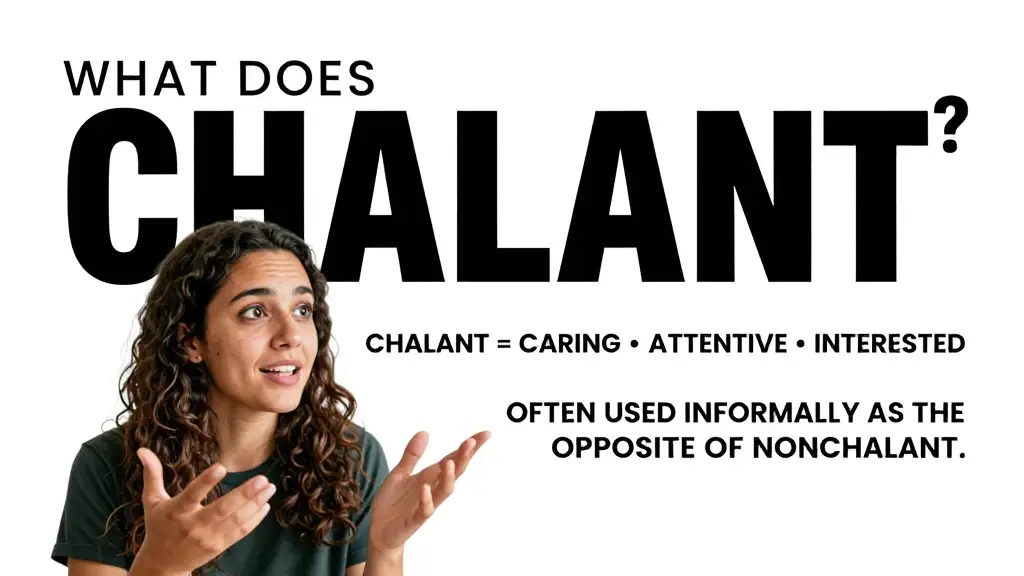
Chalant is a word that means showing concern, interest, or attention.
It is often used as the opposite of nonchalant, which means calm and seemingly unconcerned.
You may see “chalant” online when people talk about someone who clearly cares about something instead of acting indifferent.
The word is interesting because many English speakers know nonchalant but rarely use chalant by itself.
Online, especially on social media, people sometimes use “chalant” in a playful way to mean someone who is openly interested, caring, or emotionally involved.
For example, if someone always checks on their friend, pays attention to what they say, and clearly cares about their feelings, a person might jokingly call them chalant.
However, there is an important detail: chalant is uncommon in standard modern English.
It is sometimes described as a “back-formation” from nonchalant, but it is not as widely accepted or commonly used as nonchalant.
When people use it online, the meaning is usually clear from context.
Quick Answer
Chalant generally means showing concern, interest, or attention instead of appearing indifferent. It is commonly used online as a playful opposite of “nonchalant.” However, chalant is uncommon in standard English, so people are much more likely to use “nonchalant” or another phrase such as “caring” or “interested.”
Quick Meaning Table
| Term | Main meaning | Full form | Pronunciation | Usage | Example |
| Chalant | Caring, interested, or concerned | Not an abbreviation | Usually pronounced like “shuh-LAHNT” | Informal, uncommon, often playful | “He is very chalant about his friends.” |
What Does Chalant Mean?
The chalant definition is usually understood as showing interest, concern, or care.
For example, a person who is paying close attention to a conversation may be described as chalant in informal online language.
This meaning comes mainly from treating nonchalant as if it had a positive opposite:
- Nonchalant = seeming unconcerned or not bothered
- Chalant = seeming concerned or interested
But this simple opposite does not tell the whole story.
In modern English, chalant is uncommon. It is not a normal everyday word for most speakers. People may use it jokingly because “nonchalant” is familiar and “chalant” sounds like it should be its opposite.
So, if someone says:
“I want someone who is chalant.”
They may mean:
“I want someone who shows that they care.”
Chalant Meaning in Simple Words
In simple words, chalant means caring or showing interest.
Imagine two people receive the same message.
One person reads it and acts like they do not care.
That person might be called nonchalant.
The other person asks questions, pays attention, and shows concern.
Someone using “chalant” informally might describe that person as chalant.
A simple way to remember it is:
Chalant = showing you care.
However, remember that this is an uncommon word. In normal English, it is usually better to say caring, concerned, interested, attentive, or involved.
Different Meanings of Chalant
“Chalant” does not have many established meanings. Its most common modern use is based on the idea of being the opposite of nonchalant.
1. Caring or Concerned
Someone may use chalant to describe a person who clearly cares about something.
Example:
“She is very chalant about her friends.”
This means she shows that she cares about her friends.
2. Interested or Attentive
The word can also suggest that someone is paying attention and showing interest.
Example:
“He was surprisingly chalant during the discussion.”
The intended meaning is that he was attentive and involved rather than indifferent.
3. An Informal Opposite of Nonchalant
Online, “chalant” is often used as a playful opposite of nonchalant.
Example:
“I don’t want someone nonchalant. I want someone chalant.”
Here, the speaker means they want someone who openly shows interest and care.
Chalant Meaning in Texting
The chalant meaning in texting is usually caring, interested, or openly showing concern.
It may appear in casual messages, jokes, or conversations about relationships and friendships.
For example:
Person 1: “He always asks how my day went.”
Person 2: “Sounds pretty chalant to me.”
The second person is jokingly saying that the person clearly shows interest and care.
Because “chalant” is uncommon, people may use it intentionally as a playful word.
You should also remember that texting language changes quickly. Someone who uses “chalant” may simply be playing with the familiar word “nonchalant.”
Chalant Meaning on Social Media
On social media, chalant is generally used to mean showing interest, caring, attentive, or emotionally involved.
It can appear in posts, comments, memes, and casual conversations.
For example:
“He is not nonchalant. He is fully chalant.”
This means the person is openly showing that they care.
Another example:
“We need more chalant people.”
The writer is likely saying that they want people who communicate clearly, show interest, and do not act indifferent.
There is no special official meaning of “chalant” tied to TikTok, Instagram, Snapchat, or another specific platform. Its meaning comes from informal use and context.
How to Pronounce Chalant
Chalant is generally pronounced with the stress toward the second syllable, roughly like “shuh-LAHNT.”
The word is uncommon, so you may hear some variation in how people pronounce it.
It is also easy to confuse with nonchalant, which is much more common.
If you are learning the word, focus on the fact that it is usually used informally rather than treating it as a common everyday vocabulary word.
Origin of Chalant
The story of chalant is closely connected to the word nonchalant.
Nonchalant comes from French nonchalant, meaning unconcerned or indifferent. The French word is related to nonchaloir, meaning not to care or not to concern oneself with something.
In English, some speakers have treated chalant as though it were the positive opposite of nonchalant. This process is known as back-formation: a shorter word is created from a longer word that appears to contain it.
However, this does not mean that “chalant” is simply the normal positive form of “nonchalant.” Nonchalant is the established and much more common English word.
So, “chalant” is best understood as an uncommon or playful word rather than a standard everyday opposite.
How to Use Chalant in a Sentence
Here are some natural examples showing the informal use of chalant:
- “He is very chalant when it comes to his friends.”
- “I like people who are chalant about things they care about.”
- “She was so chalant during the conversation.”
- “He is definitely not nonchalant; he is completely chalant.”
- “I want someone who is chalant and honest.”
- “She showed a very chalant attitude toward the project.”
- “He actually seems pretty chalant about helping others.”
- “Stop acting nonchalant and be a little more chalant.”
- “Her chalant attitude made it clear that she cared.”
- “Some people online use chalant as the opposite of nonchalant.”
Because the word is uncommon, these examples fit informal or playful contexts better than formal writing.
Conversation Examples
Conversation 1
Alex: “He always remembers the little things I tell him.”
Sam: “He sounds pretty chalant.”
Alex: “Exactly. He actually pays attention.”
Here, “chalant” means caring and attentive.
Conversation 2
Mia: “I don’t like people who pretend they don’t care.”
Lena: “Same. Give me someone chalant.”
Mia: “Someone who actually shows interest?”
Lena: “Yes!”
Here, chalant is being used as a playful opposite of nonchalant.
Synonyms and Similar Words
Because chalant is uncommon, several ordinary English words are better choices in many situations.
Caring
Caring means showing kindness and concern for someone.
Example:
“She is a caring friend.”
Concerned
Concerned means worried or interested because something matters to you.
Example:
“He was concerned about his friend.”
Interested
Interested means wanting to know more about something or someone.
Example:
“She is interested in learning more.”
Attentive
Attentive means paying close attention.
Example:
“The student was attentive in class.”
Involved
Involved can mean actively taking part in something or showing interest in it.
Example:
“He is very involved in the project.”
Engaged
Engaged can mean interested and actively participating.
Example:
“The audience was engaged during the talk.”
These words are more natural and widely understood than “chalant.”
Common Confusions
Chalant vs. Nonchalant
This is the biggest source of confusion.
Nonchalant is a standard English adjective meaning calm and seemingly unconcerned.
Chalant is uncommon and is often used informally as its supposed opposite.
Example:
- Nonchalant: “He seemed nonchalant about the problem.”
- Chalant: “He seemed chalant about the problem.”
The second sentence is much less common.
Chalant vs. Caring
“Caring” is a normal English word. “Chalant” is much less common.
If you want your writing to be clear, caring is usually the better choice.
Chalant vs. Interested
Someone can be interested without being deeply concerned. “Chalant” is sometimes used online to suggest a stronger display of care or attention.
Is Chalant a Real Word?
This depends on what you mean by “real.”
People do use chalant, especially informally and online. However, it is uncommon and does not have the same established everyday status as nonchalant.
For formal writing, it is safer to use a clearer word such as caring, concerned, interested, or attentive.
Is Chalant Offensive?
Chalant is not offensive. It is generally a harmless informal word.
The main issue is not offensiveness but usage. Because the word is uncommon, some readers may find it unusual or may not know what it means.
If you are writing a formal email, school assignment, report, or professional document, use a more familiar word.
For example:
Instead of:
“He is very chalant.”
You could write:
“He clearly cares about the situation.”
This is easier for almost everyone to understand.
FAQs:
1. What does chalant mean?
Chalant is generally used to mean caring, interested, concerned, or attentive. It is often used as a playful opposite of “nonchalant.” However, chalant is uncommon in standard modern English, so people usually choose words such as caring, concerned, or interested instead.
2. Is chalant the opposite of nonchalant?
People sometimes use chalant as the opposite of nonchalant, especially online. Nonchalant is an established English word meaning unconcerned or seemingly indifferent. Chalant is much less common and is often treated as a playful back-formation rather than a normal everyday opposite.
3. What does chalant mean in texting?
nIn texting, chalant usually means someone is showing care, interest, or attention. It may be used jokingly when talking about a person who openly shows that they care instead of acting indifferent. The exact meaning depends on the conversation.
4. What does chalant mean on social media?
On social media, chalant is generally an informal word for someone who is caring, interested, attentive, or emotionally involved. People often use it as a playful opposite of nonchalant. It does not have a separate official meaning on platforms such as TikTok or Instagram.
5. Is chalant a real English word?
Chalant is used in English, but it is uncommon. Many people recognize it mainly because of the word “nonchalant.” It is often used informally or humorously. In formal writing, a clearer word such as caring, concerned, or attentive is usually a better choice.
6. What is the opposite of nonchalant?
Depending on the situation, possible opposites of nonchalant include caring, concerned, attentive, interested, involved, or enthusiastic. Although people sometimes use “chalant” as the opposite of nonchalant, it is much less common than these ordinary English words.
7. Is chalant a slang word?
Chalant can be described as an informal or playful word, especially in online communication. It is not a common slang abbreviation like “LOL” or “SMH.” Its modern use often comes from people creating a positive-sounding opposite to the familiar word “nonchalant.”
8. How do you pronounce chalant?
Chalant is generally pronounced with the main stress on the second syllable, roughly like “shuh-LAHNT.” Because the word is uncommon, pronunciation may vary among speakers. It should not be confused with the pronunciation of the more familiar word “nonchalant.”
9. What is another word for chalant?
Good alternatives include caring, concerned, interested, attentive, involved, and engaged. The best choice depends on the exact meaning. If you mean someone who shows concern, “caring” or “concerned” may work best. If you mean someone who pays attention, “attentive” is clearer.
10. Should I use chalant in formal writing?
Usually, no. Although people may understand chalant in casual conversations or online posts, it is uncommon enough that some readers may find it confusing. In formal writing, use a clear word such as caring, concerned, interested, attentive, or involved instead.
Conclusion:
Chalant is an uncommon word that is generally used to describe someone who shows care, interest, concern, or attention.
Online, people often use it playfully as the opposite of nonchalant.
While the meaning can be understood from context, chalant is not as common or established as nonchalant.
For everyday and formal English, words such as caring, concerned, interested, or attentive are usually clearer.
When you see chalant online, the writer most likely means that someone is openly showing that they care.

Natalie Carter is a U.S.-based contributor specializing in word meanings and everyday English. She enjoys researching confusing terms and explaining them in simple language. Her content often explores definitions, synonyms, examples, and contextual meanings to give readers a well-rounded understanding of vocabulary.