
Last Updated:
Have you ever felt worried about something and then received a little more time or a chance to rest?
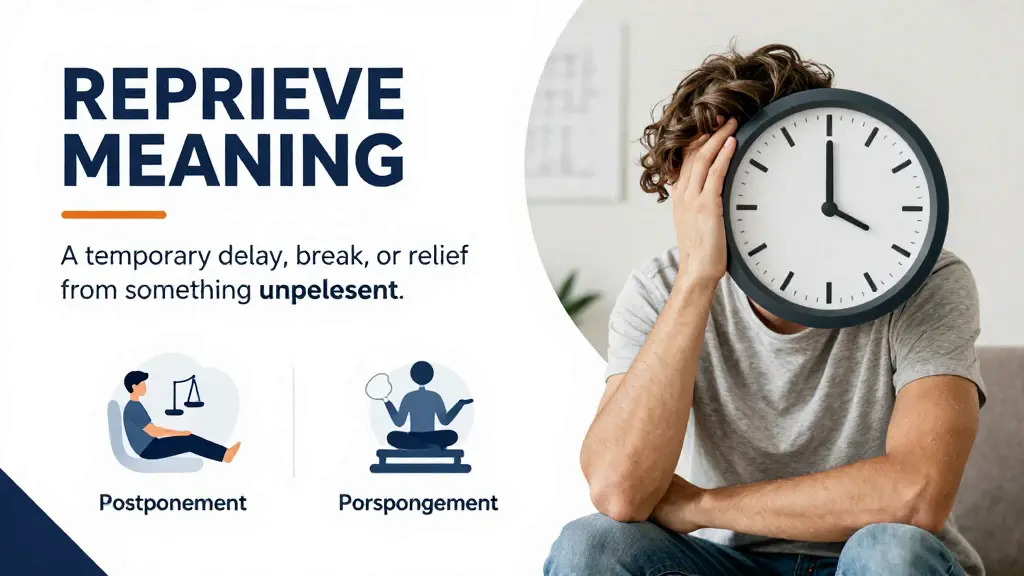
The word reprieve describes a situation like this. It means a short break from something difficult, painful, or unpleasant.
It can also mean delaying a punishment, especially in a legal case.
For example, if a student gets extra time to finish an assignment, that student may feel they have received a reprieve from the pressure.
In law, a person may receive a reprieve when a punishment is delayed.
The word is often used when someone gets temporary relief from a problem.
However, a reprieve does not always mean the problem is gone forever.
It may only provide more time or a short period of relief.
Quick Answer
Reprieve means a temporary break from something difficult or a delay in punishment. It gives someone more time or relief, but it does not always solve the problem completely.
Quick Meaning Table
| Feature | Meaning |
| Word | Reprieve |
| Part of speech | Noun and verb |
| Simple meaning | A short break or delay |
| Common use | Relief from trouble, stress, or punishment |
| Legal meaning | A delay in carrying out a punishment |
| Synonyms | Respite, relief, delay, postponement |
| Example | “The rain gave us a reprieve from the heat.” |
What Does Reprieve Mean in Simple English?
In simple English, a reprieve means getting a break from something unpleasant.
It may be a break from stress, work, pain, pressure, or punishment. The break can be short, and the original problem may still exist.
For example, imagine that you have been working all day and finally get a short rest. You could describe that rest as a reprieve from your busy schedule.
Another example is a person who must pay a bill but receives a few extra days to make the payment. Those extra days may provide a reprieve from immediate pressure.
Example sentence:
“The teacher gave the class a reprieve by moving the test to Friday.”
This means the students received more time before taking the test.
What Does Reprieve Mean in Law?
In law, a reprieve is a delay in carrying out a punishment. It does not necessarily cancel the punishment or change the final decision.
For example, a court or authorized official may delay a punishment for a legal reason. This delay gives more time before the punishment is carried out.
The word is often used in discussions about criminal justice, court decisions, and sentences.
Example:
“The prisoner received a reprieve, delaying the scheduled punishment.”
In this sentence, reprieve means the punishment was postponed.
A reprieve is different from a pardon. A pardon may forgive or reduce the legal consequences of an offense, depending on the law. A reprieve generally means a delay rather than forgiveness.
The exact legal meaning and process can vary by country and legal system.
What Does Reprieve Mean in Daily Life?
In everyday conversation, reprieve usually means a welcome break from a difficult or unpleasant situation.
People may use the word when they get temporary relief from work, family duties, bad weather, financial pressure, or other challenges.
Examples:
- “The weekend gave me a reprieve from work.”
- “The cool weather was a reprieve from the summer heat.”
- “The cancellation gave us a reprieve from a long journey.”
In each example, something difficult becomes easier for a short time.
The word often suggests that the relief is welcome but may not last forever.
What Does Reprieve Mean in Texting and Messaging?
Reprieve is not a common texting abbreviation. It is a regular English word that people may use in messages when talking about relief or extra time.
Someone might use it to explain that a stressful situation has become easier for a while.
Examples:
- “Finally got a reprieve from studying!”
- “The deadline moved, so we have a little reprieve.”
- “This quiet evening is a reprieve from my busy week.”
The word can make a message sound more formal than everyday slang. In casual texting, people may simply say “a break” or “some relief.”
What Does Reprieve Mean at Work or School?
At work or school, a reprieve means a temporary break from pressure, duties, or deadlines.
For example, a manager may move a deadline to a later date. Employees may feel relieved because they have more time to complete their work.
Likewise, a teacher may postpone an exam, giving students extra time to prepare.
Example:
“The extension gave the students a reprieve from exam pressure.”
This means the students had some temporary relief because the exam was delayed.
A reprieve does not mean that the task has been removed. It usually means the task or pressure has been delayed or eased for a while.
What Does Reprieve Mean in Literature?
In books, poems, and stories, reprieve often describes a moment of relief after fear, danger, sadness, or hardship.
A character may face a serious problem and then receive a short period of peace. This moment can be called a reprieve.
For example, a character lost in a forest may find a safe place to rest before continuing the journey.
Example sentence:
“The travelers found a reprieve from the storm inside a small cabin.”
The cabin gives them temporary shelter from the storm.
Writers often use this word to show a pause in a difficult experience. The pause may offer hope, but the challenge may return later.
What Is the Difference Between Reprieve and Relief?
Reprieve and relief are similar, but they are not always used in the same way.
| Reprieve | Relief |
| Often means temporary relief or a delay | Means the easing or removal of worry, pain, or difficulty |
| Can suggest that a problem may return | Does not always suggest that the problem will return |
| Common in formal and legal contexts | Common in everyday speech |
| “We got a reprieve from the deadline.” | “I felt relief after finishing the task.” |
Simple tip: Use reprieve when you want to stress a temporary break or delay. Use relief when you want to describe feeling better or having less trouble.
What Is the Difference Between Reprieve and Pardon?
A reprieve and a pardon are both used in legal contexts, but they have different meanings.
- Reprieve: A delay in carrying out a punishment.
- Pardon: An official act of forgiveness or relief from certain legal consequences, depending on the law.
Example of reprieve:
“The punishment was delayed after the reprieve was granted.”
Example of pardon:
“The official pardon changed the person’s legal situation.”
A reprieve does not automatically mean that someone has been forgiven or that a sentence has been cancelled.
10 Examples of Reprieve in Sentences
- “The rain gave us a reprieve from the hot weather.”
- “The teacher gave the students a reprieve by extending the deadline.”
- “The short holiday was a welcome reprieve from work.”
- “The delay offered a reprieve from the immediate pressure.”
- “The patient felt a reprieve from the pain for a few hours.”
- “The team received a reprieve when the match was postponed.”
- “The prisoner was granted a reprieve before the punishment was carried out.”
- “A quiet afternoon gave her a reprieve from her busy routine.”
- “The extra time provided a reprieve for the project team.”
- “The shade of the trees offered a reprieve from the afternoon sun.”
These examples show that reprieve can describe a short break, a delay, or temporary relief from a difficult situation.
Two Short Conversations Using Reprieve
Conversation 1: School
Ali: Did you finish preparing for the exam?
Sara: Not yet, but our teacher moved it to Monday.
Ali: That gives us a reprieve!
Sara: Yes, now we have more time to study.
Meaning: Reprieve means the students received extra time before the exam.
Conversation 2: Work
James: You look tired. Is your workload still heavy?
Mia: Yes, but my manager gave me a day off.
James: That must be a welcome reprieve.
Mia: It is. I can rest before starting again.
Meaning: Reprieve means a temporary break from work pressure.
Reprieve Synonyms and Antonyms
Synonyms of Reprieve
These words have similar meanings, depending on the sentence:
- Respite: A short period of rest or relief.
- Relief: A reduction in pain, worry, or difficulty.
- Break: A short pause from an activity.
- Delay: A situation in which something happens later than planned.
- Postponement: Moving something to a later time.
- Pause: A temporary stop.
- Breather: An informal word for a short rest.
- Stay: A legal term that can mean temporarily stopping or delaying a proceeding or action.
Antonyms of Reprieve
These words may express the opposite idea in some contexts:
- Continuation: Something keeps going without a break.
- Persistence: Something continues to exist or happen.
- Acceleration: Something happens faster or sooner.
- Enforcement: Carrying out a rule or legal order.
- Continuation of punishment: Punishment proceeds without a delay.
There is no single perfect antonym for reprieve in every context. The best choice depends on whether the word means relief, a pause, or a legal delay.
Common Misunderstandings About Reprieve
1. Reprieve does not always mean permanent relief.
It often describes a temporary break. The original problem may still exist.
2. Reprieve is not the same as pardon.
A reprieve generally delays punishment, while a pardon may forgive an offense or change legal consequences.
3. Reprieve is not only a legal word.
People also use it in everyday life when describing a break from stress, work, heat, or other difficulties.
4. Reprieve does not always mean a complete solution.
Getting extra time may make a problem easier to handle, but it may not remove the problem.
5. Reprieve is not an abbreviation.
It is a standard English word that can be used as both a noun and a verb.
FAQs:
1. What does reprieve mean in simple words?
Reprieve means a temporary break from something difficult or a delay in punishment. It gives someone extra time or relief.
2. What is an example of a reprieve?
If a teacher delays an exam, students receive a reprieve because they have more time to prepare.
3. What does reprieve mean in law?
In law, reprieve generally means delaying the carrying out of a punishment. It does not automatically cancel the punishment.
4. Is reprieve the same as relief?
They are similar, but reprieve often suggests a temporary break or delay. Relief more broadly means feeling less pain, worry, or difficulty.
5. What is a synonym for reprieve?
Common synonyms include respite, relief, break, delay, and postponement. The best synonym depends on the context.
6. What is the opposite of reprieve?
There is no single opposite for every use. Continuation or proceeding without a delay may express the opposite idea.
7. Can reprieve be used as a verb?
Yes. As a verb, reprieve means to postpone or delay a punishment or another difficult outcome.
8. Does reprieve mean a punishment is cancelled?
No. A reprieve generally means the punishment is delayed, not cancelled. A separate legal decision may be needed to change the punishment.
9. What does a reprieve from stress mean?
It means getting a temporary break from stress or pressure. For example, a quiet weekend may offer a reprieve from a busy workweek.
10. How do you use reprieve in a sentence?
You can say, “The cool breeze was a reprieve from the heat.” This means the breeze provided temporary relief from the hot weather.
Conclusion:
The word reprieve means a temporary break from something difficult or a delay in punishment.
It can describe relief from work, school pressure, bad weather, or a legal sentence.
The key idea is that the break may not last forever, and the original problem may still remain.
In everyday English, reprieve is similar to relief or respite.
In legal contexts, however, it has a more specific meaning related to delaying punishment.
Understanding the context helps you use the word correctly.

Lauren Edwards is a U.S.-based writer who focuses on English vocabulary, word meanings, phrases, and everyday expressions. She enjoys presenting language information in a clear and approachable format. Her work helps readers understand unfamiliar terms and learn how they are naturally used in different situations.