
Last Updated:
Have you ever seen someone agree with everything another person says just to gain their approval?
Or noticed a politician making promises simply to win votes?
These actions may be examples of pandering.
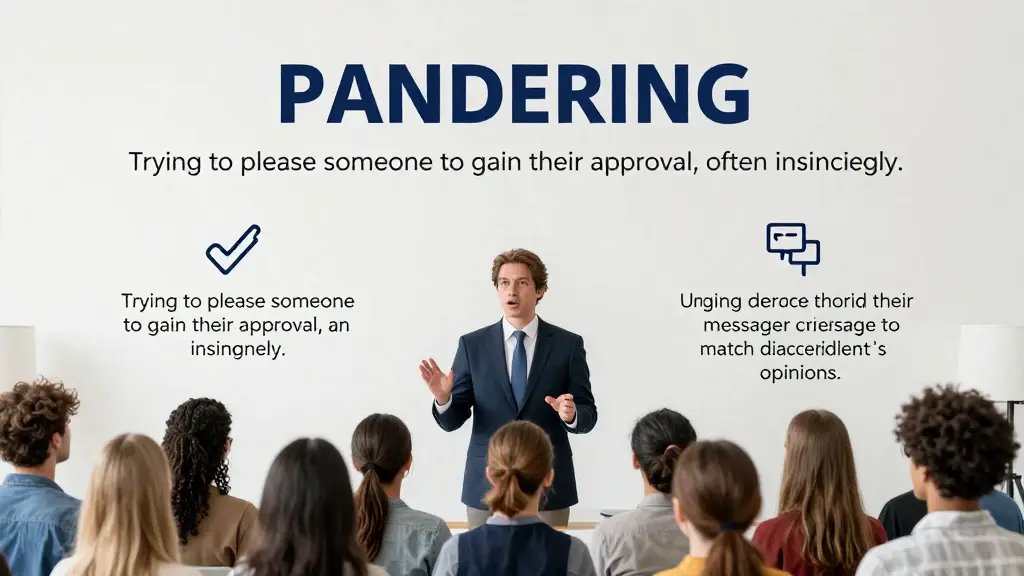
The pandering meaning is trying to please someone or gain their support by giving them what they want, often without being honest or sincere.
It can involve flattering people, telling them what they want to hear, or changing your behavior to win their approval.
For example, if a person praises their boss only because they want a promotion, someone might describe that behavior as pandering.
Pandering is often used in politics, social media, advertising, and everyday conversations.
It usually has a negative meaning because it suggests that someone is trying too hard to please others for personal gain.
Quick Answer
Pandering means trying to please someone or win their support by telling them what they want to hear or giving them what they want. It often suggests insincere behavior or an attempt to gain an advantage.
Quick Meaning Table
| Feature | Meaning |
| Word | Pandering |
| Part of speech | Noun or verb form |
| Simple meaning | Trying too hard to please someone |
| Common use | Politics, relationships, business, and social media |
| Tone | Usually negative |
| Synonyms | Appeasing, flattering, catering to, playing up to |
| Example | “The politician was pandering to voters.” |
1. Pandering Meaning in Simple English
In simple English, pandering means doing or saying things to make other people happy so that they will like you, support you, or give you something.
The important point is that pandering often involves trying to win approval rather than expressing an honest belief.
For example:
- “He is pandering to his boss.”
This means he is trying too hard to please his boss, possibly to gain a benefit. - “The politician is pandering to voters.”
This means the politician is saying or promising things to gain voters’ support. - “The company is pandering to its customers.”
This suggests that the company is focusing on what customers want, perhaps to gain sales or popularity.
Not every attempt to please someone is pandering. Being kind, listening carefully, and meeting people’s needs can be sincere. The word pandering is usually used when the effort seems excessive, insincere, or driven by personal gain.
2. Pandering Meaning in Texting and Messaging
In texting, pandering usually means trying to gain someone’s approval by agreeing with them, flattering them, or telling them what they want to hear.
For example:
Text: “You’re just pandering to him.”
Meaning: You’re only trying to make him happy or gain his approval.
Another example:
Text: “Stop pandering to everyone.”
Meaning: Stop trying so hard to please everyone.
People may use the word during discussions about friendships, online arguments, relationships, or public behavior.
It is not a texting abbreviation. It is a regular English word used in messages with the same general meaning it has in everyday conversation.
3. Pandering Meaning in Slang
Pandering is not originally a slang word, but it is often used in casual conversations and online discussions.
In informal speech, someone might say a person is pandering when they appear to change their opinions or behavior to become popular.
For example:
“ He’s pandering to his followers.”
This means he may be saying what his followers want to hear to keep their support.
Another example:
“She keeps agreeing with everyone just to fit in. It feels like pandering.”
This suggests that her agreement may not be genuine.
Online, people may also use the word to criticize celebrities, influencers, or public figures who seem to be trying too hard to win approval.
However, the word is an accusation about someone’s motives. It is not always possible to know whether a person is being insincere just by looking at their behavior.
4. Pandering Meaning in Politics
Politics is one of the most common settings in which people use the word pandering.
A politician may be accused of pandering when they make statements, promises, or public appearances mainly to gain votes or please a particular group.
For example:
“The candidate was accused of pandering to voters before the election.”
This means critics believed the candidate was saying or doing things to win support rather than acting from genuine beliefs.
Other examples include:
- Making promises mainly to gain popularity.
- Changing a public position to please a particular audience.
- Saying different things to different groups to win their support.
- Supporting a popular idea without showing genuine commitment to it.
However, listening to voters and responding to their concerns is not automatically pandering. Politicians are expected to understand public needs. The word is more appropriate when their actions seem insincere or motivated mainly by the desire for approval.
5. Pandering Meaning on Social Media
On platforms such as TikTok, Instagram, YouTube, and Facebook, pandering is often used when people believe a creator is trying to gain likes, views, or followers by appealing to an audience’s preferences.
For example:
“That video feels like pandering for likes.”
This means the speaker thinks the video was made mainly to win attention or approval.
Other examples include:
- A creator agreeing with a popular opinion just to gain followers.
- An influencer praising a brand mainly to attract attention.
- Someone posting a message they do not seem to believe because it is trending.
- A public figure making a popular statement to improve their image.
Social media users sometimes use pandering as criticism. Still, a creator making content that their audience enjoys is not automatically pandering. The word usually implies that the effort feels insincere or calculated.
6. Pandering Meaning in Relationships
In relationships, pandering can describe trying too hard to keep someone happy by agreeing with them or giving in to their wishes, even when you do not genuinely agree.
For example:
“He keeps pandering to his partner because he is afraid of disappointing them.”
This suggests that he may be prioritizing approval over honest communication.
Another example:
“She accused him of pandering instead of telling her how he really felt.”
This means she believed he was saying what she wanted to hear rather than sharing his true feelings.
Pandering can sometimes create problems because it makes honest communication more difficult. A healthy relationship allows people to be considerate while still expressing their own opinions and boundaries.
However, compromise is not the same as pandering. Making a sincere effort to understand another person’s needs can be a positive part of a relationship.
7. Pandering Meaning in Business and Advertising
In business, pandering can describe a company or brand that tries to win customers’ approval by appealing to their preferences in a way that seems insincere.
For example:
“The company was accused of pandering to customers with a trendy advertising campaign.”
This means critics believed the company was trying to gain attention or sales by appealing to popular opinions.
Pandering may occur when a brand:
- Uses a popular trend only to attract attention.
- Makes promises it does not genuinely intend to keep.
- Changes its message to appeal to different audiences.
- Uses emotional messages mainly to improve sales or public image.
However, adapting products to customer needs is a normal part of business. The term pandering is more critical because it suggests that the company is being opportunistic or insincere.
8. What Does Pandering to Someone Mean?
The expression “pandering to someone” means trying to please that person or gain their approval, often by giving them what they want to hear.
The word “to” identifies the person or group whose approval someone is trying to gain.
Examples:
“He is pandering to his manager.”
He is trying to please his manager, possibly to gain a benefit.
“The speaker is pandering to the audience.”
The speaker is saying or doing things to win the audience’s approval.
“Stop pandering to your friends.”
Stop trying so hard to please your friends at the expense of your own honest opinions.
The phrase often suggests that the person is being too eager to gain approval.
9. Pandering vs. Pleasing
Pandering and pleasing are related, but they have different meanings.
| Word | Meaning | Example |
| Pleasing | Making someone happy or satisfied | “She enjoys pleasing her customers.” |
| Pandering | Trying to win approval in a way that seems insincere or excessive | “He was pandering to customers to gain popularity.” |
Pleasing someone can be kind and genuine. For example, making your friend their favorite meal is a way to please them.
Pandering often carries a negative judgment about someone’s motives. It suggests that the person is trying to win approval rather than acting sincerely.
10. Pandering vs. Appeasing
Appeasing means trying to calm someone down, reduce conflict, or stop them from being angry.
Pandering means trying to please someone or win their approval, often by telling them what they want to hear.
For example:
Appeasing: “She apologized to appease the angry customer.”
This means she apologized to calm the customer down.
Pandering: “She agreed with every customer opinion to gain their support.”
This suggests that she was trying to win approval, perhaps without being sincere.
The two words can overlap, but they emphasize different motives.
11. Ten Examples of Pandering in Sentences
Here are ten examples showing how to use pandering correctly.
1. “The politician was accused of pandering to voters.”
Meaning: Critics believed the politician was trying to win votes by saying what people wanted to hear.
2. “He is pandering to his boss to get a promotion.”
Meaning: He is trying too hard to please his boss to gain an advantage.
3. “The celebrity was criticized for pandering to fans.”
Meaning: People believed the celebrity was trying too hard to win fans’ approval.
4. “Stop pandering to everyone and share your real opinion.”
Meaning: Stop trying to please everyone and speak honestly.
5. “The advertisement felt like pandering to young customers.”
Meaning: The advertisement seemed designed to win young customers’ approval in an insincere way.
6. “She accused him of pandering instead of being honest.”
Meaning: She believed he was telling her what she wanted to hear rather than expressing his real feelings.
7. “Some viewers thought the video was pandering for likes.”
Meaning: They believed the creator made the video mainly to gain attention and approval.
8. “The company was accused of pandering to public opinion.”
Meaning: Critics believed the company was changing its message to please the public.
9. “Pandering to every demand can make it hard to set boundaries.”
Meaning: Trying to satisfy every demand can make it difficult to maintain reasonable limits.
10. “The speaker avoided pandering and gave an honest answer.”
Meaning: The speaker did not simply say what the audience wanted to hear.
12. Short Conversations Using Pandering
Conversation 1: Between Friends
Ali: Why does Hamza agree with everything our group says?
Ahmed: Maybe he wants everyone to like him.
Ali: Do you think he really agrees?
Ahmed: I’m not sure. It sometimes feels like pandering.
Meaning: Ahmed thinks Hamza may be agreeing to gain approval rather than expressing his genuine views.
Conversation 2: About Social Media
Sara: Did you see that creator’s latest video?
Ayesha: Yes. It seemed like pandering to followers.
Sara: What makes you say that?
Ayesha: The creator suddenly changed their opinion to match a popular trend.
Meaning: Ayesha believes the creator changed their message to gain followers’ approval.
13. Pandering Synonyms and Antonyms
Synonyms of Pandering
These words have similar meanings, depending on the context:
- Appeasing — trying to calm or satisfy someone.
- Flattering — praising someone, sometimes to gain approval.
- Catering to — adjusting to someone’s wants or preferences.
- Placating — trying to make someone less angry.
- Indulging — allowing someone’s wishes or desires to be satisfied.
- Sucking up to — informal expression for trying too hard to please someone in authority.
- Playing up to — behaving in a way intended to gain someone’s favor.
- People-pleasing — trying hard to keep others happy, sometimes at personal cost.
- Courting approval — trying to gain someone’s support or acceptance.
- Seeking favor — trying to gain goodwill or an advantage.
These words are not exact replacements in every situation. For example, flattering focuses on praise, while appeasing focuses on reducing anger or conflict.
Antonyms of Pandering
Depending on the context, possible opposites include:
- Being sincere
- Being honest
- Speaking candidly
- Staying principled
- Being authentic
- Acting independently
- Expressing genuine opinions
- Refusing to flatter
Example:
Pandering: “He agreed with everyone to gain their approval.”
Opposite: “He shared his honest opinion, even when others disagreed.”
14. Is Pandering Always a Bad Thing?
Pandering usually has a negative meaning, but the context matters.
The word is often used when someone appears to be acting insincerely to gain popularity, money, votes, or personal benefits.
For example, a politician may be accused of pandering if they make promises mainly to win an election. A company may be accused of pandering if it changes its message only to attract attention.
However, listening to people and trying to meet their needs is not automatically pandering.
A teacher who changes a lesson to help students understand is responding to their needs. A business that improves a product after receiving customer feedback is being responsive.
The difference is often sincerity. Pandering suggests that pleasing people or gaining their approval has become more important than honesty or genuine purpose.
FAQs:
1. What does pandering mean in simple words?
Pandering means trying to please someone or win their support by giving them what they want or telling them what they want to hear. It often suggests that the person is being insincere.
2. What does pandering mean in texting?
In texting, pandering means trying to gain someone’s approval by agreeing with them, flattering them, or saying what they want to hear. For example, “You’re pandering to him” suggests that you’re trying too hard to please him.
3. Is pandering a negative word?
Yes, pandering usually has a negative meaning. It suggests that someone is trying to gain approval or an advantage in a way that seems insincere. However, its exact meaning depends on the situation.
4. What does pandering to someone mean?
Pandering to someone means trying to please that person or win their support, often by agreeing with them or giving them what they want. It can suggest that the behavior is motivated by personal gain.
5. What is an example of pandering?
A politician who makes promises mainly to gain votes may be accused of pandering. The criticism suggests that the politician is trying to win support rather than acting from genuine beliefs.
6. What is the difference between pandering and pleasing?
Pleasing means making someone happy or satisfied and can be sincere. Pandering usually means trying to gain approval in a way that seems excessive or insincere.
7. What is a synonym for pandering?
Depending on the context, synonyms include appeasing, flattering, catering to, placating, and playing up to someone. Each word has a slightly different meaning.
8. What does pandering mean in politics?
In politics, pandering means trying to win voters’ support by saying or promising things they want to hear. The term is usually critical and suggests that the politician may not be sincere.
9. What does pandering mean on social media?
} On social media, pandering can mean posting content or changing opinions mainly to gain likes, followers, or approval. It often suggests that the creator is appealing to an audience in an insincere way.
10. What is the opposite of pandering?
There is no single perfect opposite in every context. Being sincere, honest, authentic, and willing to express genuine opinions can be the opposite of pandering.
Conclusion:
Pandering means trying to please someone or gain their support, often by telling them what they want to hear.
It is commonly used in politics, relationships, business, and social media.
The word usually has a negative meaning because it suggests that someone is seeking approval or personal gain instead of acting sincerely.
For example, a politician who makes promises only to win votes may be accused of pandering.
Remember that being kind or listening to others is not automatically pandering.
The key idea is trying to gain approval in a way that seems excessive or insincere.

Natalie Carter is a U.S.-based contributor specializing in word meanings and everyday English. She enjoys researching confusing terms and explaining them in simple language. Her content often explores definitions, synonyms, examples, and contextual meanings to give readers a well-rounded understanding of vocabulary.