
Last Updated:
A name is one of the first things people learn about someone.
We use names to introduce ourselves, recognize others, and talk about people, places, and things.
But what does the word “name” mean, and how is it used in different situations?
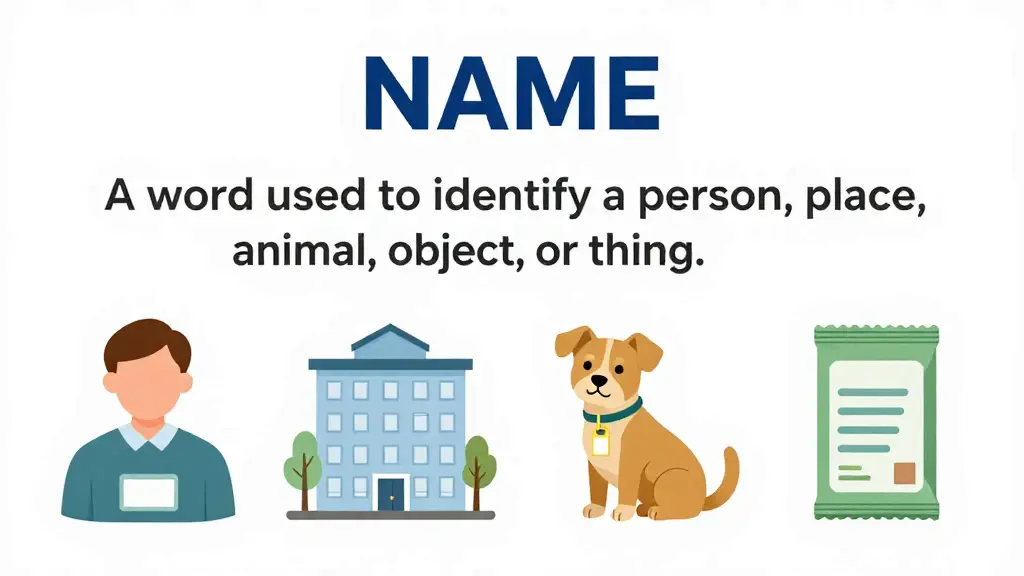
The name meaning is a word or group of words used to identify a person, place, animal, object, or thing.
For example, “Emma” is a person’s name, “London” is a city name, and “Rose” can be the name of a flower or a person.
The word “name” can also mean a person’s reputation or the title given to a product, business, or organization.
In some situations, it can be used as a verb, such as when someone names a new baby or names the winner of a competition.
Understanding this simple word can help you use it correctly in everyday English, conversations, messages, and writing.
Quick Answer
Name means a word or set of words used to identify a person, place, animal, object, or thing. It can also refer to someone’s reputation or the act of giving something a name.
Quick Meaning Table
| Feature | Meaning |
| Word | Name |
| Part of speech | Noun and verb |
| Simple meaning | A word used to identify someone or something |
| Common uses | People, places, businesses, products, and objects |
| Example as a noun | “My name is Alex.” |
| Example as a verb | “They will name the baby Noah.” |
| Synonyms | Title, label, designation |
| Related term | Full name |
1. Name Meaning in Simple English
In simple English, a name is what we call a person or thing so we can identify it.
For example, your name helps other people know who you are. A pet may have a name, a school has a name, and a company has a name.
Here are some simple examples:
- Person: Sarah is my friend.
- Place: Paris is a famous city.
- Animal: Max is the name of our dog.
- Object: The name of this phone is Galaxy.
- Business: The shop is called Green Market.
In each example, the name helps identify a particular person, place, animal, object, or business.
Names can be short or long. They may come from different languages and cultures, and some names have special meanings or historical backgrounds.
For example, a person’s name may mean “light,” “hope,” or “strength” in its original language. However, not every name has one clear or universally accepted meaning.
2. Name Meaning in English Grammar
In English grammar, the word “name” can be used as both a noun and a verb.
Name as a Noun
A noun is a word used to identify a person, place, thing, or idea.
Examples:
- “My name is Ali.”
- “What is the name of this book?”
- “The school changed its name.”
- “I know the name of that song.”
In these sentences, “name” refers to the word used to identify someone or something.
Name as a Verb
A verb describes an action. When “name” is used as a verb, it can mean to give something a name, identify someone or something, or mention a person or thing.
Examples:
- “They will name their baby Ayaan.”
- “Please name your favorite book.”
- “The teacher named three students for the award.”
- “Can you name five countries?”
The meaning changes slightly with the sentence, but the central idea is identification.
3. Name Meaning in Texting and Messaging
In texting, “name” usually refers to the name of a person, a contact, or an account.
For example:
“What’s your name?”
Meaning: The sender wants to know what to call you.
“Save my name in your contacts.”
Meaning: The sender wants you to store their name with their phone number.
“What name do you use on Instagram?”
Meaning: The sender is asking for your Instagram display name or username.
People may also ask someone to share their full name when they need to identify them more clearly.
Unlike abbreviations such as “LOL” or “BTW,” the word “name” is not a texting abbreviation. It has the same basic meaning in messages as it does in everyday English.
4. Name Meaning on Social Media
On social media platforms such as Instagram, TikTok, Facebook, and Snapchat, “name” can refer to different parts of a user’s profile.
These may include:
- Display name: The name shown on your profile.
- Username: The unique account identifier, often written with an @ symbol.
- Full name: A person’s complete name, which may include their first, middle, and last names.
- Nickname: An informal name used by friends, family, or followers.
For example, someone might use “Gulfam Bhatti” as a display name and a shorter version as their username.
These details are not always the same. A display name may be shared by many users, while a username usually identifies a particular account on that platform.
If someone asks, “What’s your name on TikTok?” they may be asking for your display name or username. The context helps explain which one they want.
5. Name Meaning in Love and Relationships
In relationships, names are often used to show recognition, affection, and closeness.
People may call their partner by their first name, a nickname, or a special name that has meaning to both of them.
For example:
- “What name do you have saved for me?”
- “She calls him by his nickname.”
- “He wrote her name on a birthday card.”
- “They chose a name for their future pet.”
Some couples use affectionate nicknames such as “dear” or “sweetheart.” These are not necessarily official names; they are informal ways of addressing someone.
A person’s name can also carry personal or family meaning. It may honor a relative, reflect a cultural tradition, or represent a quality that the family values.
However, a name alone does not tell you how someone feels about another person. The meaning of a nickname depends on the people using it and their relationship.
6. Name Meaning in Different Cultures
Names are an important part of many cultures. They can reflect family history, language, religion, traditions, or personal values.
For example, some families name children after grandparents or other relatives. Others choose names because of their meanings, sounds, or cultural importance.
Names may also follow different naming traditions around the world.
In some cultures, a person commonly uses a first name followed by a family name. In others, people may have several given names, patronymic names, or different family-name arrangements.
For example, a person’s full name might include:
- A given name
- A middle name
- A family name or surname
The order and use of these parts vary by culture and individual preference.
It is important to respect how people write, pronounce, and use their names. If you are unsure how to say someone’s name, politely asking them is usually the best choice.
7. First Name, Middle Name, and Last Name
A person’s full name may contain several parts. These parts help distinguish one person from another.
| Name Type | Meaning | Example |
| First name | A given name used to identify a person | Ali |
| Middle name | An additional given name, where used | Ahmed |
| Last name | Often the family name or surname | Khan |
| Full name | The complete name a person uses | Ali Ahmed Khan |
| Nickname | An informal or shortened name | Al |
Naming practices vary. Some people do not have a middle name, and the order of given names and family names can differ.
For example, when a form asks for your full name, it usually means the complete name requested by that form. You should follow the instructions provided rather than assuming that everyone’s name follows the same pattern.
8. Name Meaning in Business and Branding
In business, a name is the word or phrase used to identify a company, product, service, or organization.
For example:
- Apple is the name of a technology company.
- Nike is the name of a sportswear brand.
- A local bakery may use the name “Sweet Corner.”
- A new product may receive a special brand name.
A good business name is often easy to remember, pronounce, and recognize. Companies may choose names that describe their products, reflect their values, or create a particular impression.
For example, a business called “Fresh Garden” might suggest fresh food or plants, depending on what it sells.
However, a name does not always describe the product directly. Some company names are invented words, abbreviations, or names chosen for personal reasons.
9. What Does “In the Name of” Mean?
The phrase “in the name of” has several meanings depending on the sentence.
It can mean acting on behalf of someone, using someone’s authority, or giving a reason for an action.
Examples:
“She signed the letter in the name of her manager.”
This suggests she signed on behalf of her manager, although the exact meaning depends on the situation.
“They started the project in the name of education.”
This means they presented education as the purpose or reason for the project.
“Stop using my name without permission.”
This means someone is referring to or using the speaker’s identity without permission.
The phrase should be understood as a whole. Its meaning is not always the same as the ordinary meaning of the word “name.”
10. What Does “Make a Name for Yourself” Mean?
“Make a name for yourself” is a common English expression.
It means to become well-known or respected because of your skills, achievements, or work.
For example:
“She worked hard to make a name for herself in the music industry.”
This means she worked to become recognized for her music.
Another example:
“He wants to make a name for himself as a writer.”
This means he hopes to become known for his writing.
The expression is usually positive, but it can also refer to becoming famous for negative reasons. The surrounding sentence explains the intended meaning.
11. Name Examples in Everyday Sentences
Here are 10 examples showing how the word “name” is used in everyday English.
1. “My name is Ahmed.”
Meaning: Ahmed is the name used to identify the speaker.
2. “What is your name?”
Meaning: The speaker wants to know what to call the other person.
3. “Please write your name on the form.”
Meaning: The person should write the name used to identify them.
4. “We need to choose a name for our new puppy.”
Meaning: They need to decide what to call the puppy.
5. “Do you know the name of this movie?”
Meaning: The speaker wants to know the movie’s title.
6. “The company changed its name last year.”
Meaning: The company began using a different name.
7. “Can you name three famous athletes?”
Meaning: The speaker wants the other person to identify or mention three athletes.
8. “She uses a nickname with her close friends.”
Meaning: She has an informal name that her friends use.
9. “His name is well known in the local community.”
Meaning: Many people in that community recognize him or know about him.
10. “They named the school after a respected teacher.”
Meaning: They gave the school a name honoring that teacher.
12. Short Conversations Using the Word Name
Conversation 1: Meeting Someone
A: “Hi! What’s your name?”
B: “My name is Sara. What’s yours?”
A: “I’m Emma. Nice to meet you!”
B: “Nice to meet you, too!”
Meaning: The speakers introduce themselves and learn each other’s names.
Conversation 2: Choosing a Name
A: “Have you chosen a name for your new cat?”
B: “Not yet. Do you have any ideas?”
A: “What about Milo?”
B: “I like it! Let’s name him Milo.”
Meaning: The speakers discuss what to call their new pet. Here, “name” is used as a verb.
13. Name Synonyms and Related Words
The best synonym for “name” depends on how the word is used.
When “Name” Means an Identifier
- Title: The name of a book, film, or other work.
- Label: A word or phrase used to identify something.
- Designation: A formal term used to identify a person, role, or thing.
- Identifier: Something that helps distinguish a person or object.
- Appellation: A formal word for a name or title.
When “Name” Means Giving Something a Name
- Call: To refer to someone or something by a particular name.
- Label: To identify or classify something.
- Identify: To recognize or establish who or what something is.
- Designate: To officially select or identify someone or something.
These words are not interchangeable in every sentence. For example, “title” often works for a book, but it is not usually a direct replacement for a person’s first name.
FAQs:
1. What does name mean in simple English?
Name means a word or group of words used to identify a person, place, animal, object, or thing. For example, “Ali” can be a person’s name, while “London” is a city’s name.
2. What is the meaning of name in texting?
In texting, name usually means the name of a person, contact, or social media account. For example, “What’s your name?” asks someone to share what they are called.
3. What does name mean on social media?
On social media, name may refer to a profile’s display name or username. A display name is the name shown on the profile, while a username is the account identifier.
4. What is the difference between a name and a nickname?
A name is used to identify someone or something. A nickname is an informal or alternative name, often used by friends or family. For example, “Alexander” may be shortened to “Alex.”
5. What does full name mean?
A full name usually means the complete name a person uses or is asked to provide. It may include a first name, middle name, and last name, depending on the person’s naming tradition.
6. Is name a noun or a verb?
Name can be both a noun and a verb. As a noun, it identifies someone or something. As a verb, it can mean giving something a name or identifying a person or thing.
7. What does “make a name for yourself” mean?
It means becoming known or respected because of your work, skills, or achievements. For example, a writer may make a name for themselves by publishing popular books.
8. What does “in the name of” mean?
“In the name of” can mean on behalf of someone, under someone’s authority, or for a particular stated reason. The exact meaning depends on the sentence.
9. What are synonyms for name?
Depending on the context, similar words include title, label, designation, identifier, and appellation. When “name” is a verb, words such as call, identify, and designate may fit.
10. Why do names have meanings?
Many names come from words in older or modern languages and may reflect qualities, nature, family traditions, or cultural beliefs. However, not every name has one agreed meaning, and its origin can vary.
Conclusion:
The word “name” means a word or group of words used to identify a person, place, object, animal, or thing.
It can also refer to a title, reputation, or the act of giving something a name.
People use names in everyday conversations, text messages, social media, business, and writing.
Understanding related expressions such as “full name,” “nickname,” and “make a name for yourself” can also improve your English.
The exact meaning depends on how the word is used in a sentence.

Lexical Research Expert specializing in word origins, historical language development, and dictionary references.