
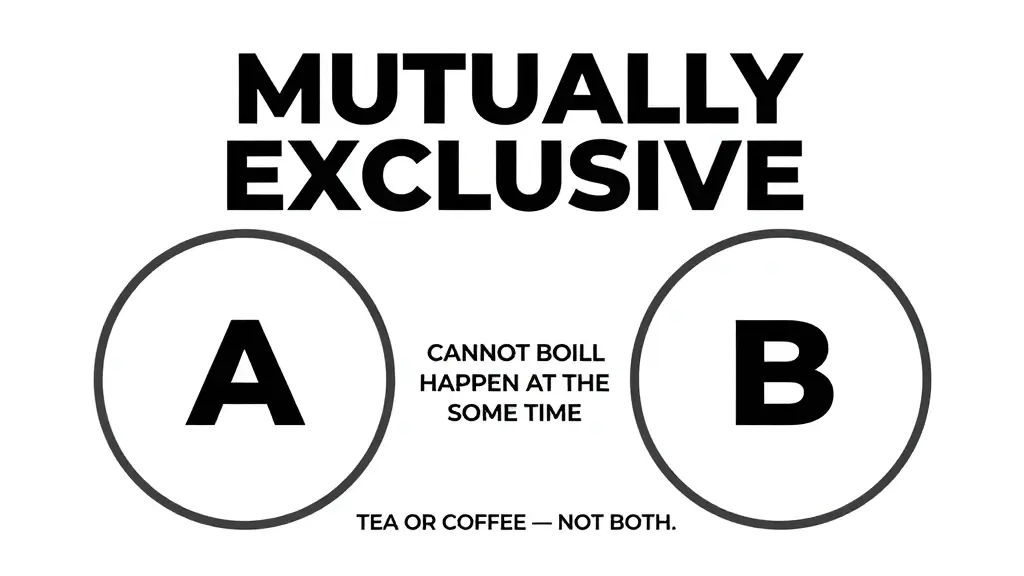
The phrase “mutually exclusive” means that two or more things cannot happen, exist, or be true at the same time.
If one thing happens, the other cannot happen under the same conditions.
The term is common in everyday English, mathematics, statistics, science, business, and decision-making.
For example, if a person can choose only one of two options, those options may be mutually exclusive.
In simple words, mutually exclusive means “one or the other, but not both.”
You may also see this phrase in sentences such as “These two choices are mutually exclusive” or “The events are mutually exclusive.” Understanding the phrase is useful because it describes situations where two possibilities do not overlap.
What Does Mutually Exclusive Mean?
Mutually exclusive means that two or more things cannot happen or be true at the same time.
If two events are mutually exclusive, the occurrence of one prevents the other from occurring in the same situation.
Example:
- You cannot be both completely asleep and completely awake at the same moment.
- When flipping a coin once, getting heads and getting tails are mutually exclusive outcomes.
The exact meaning can depend on the context, but the main idea is always no overlap between the possibilities.
Mutually Exclusive Meaning in Simple Words
In simple words, mutually exclusive means “they cannot both happen together.”
Think of it as:
A or B, but not A and B.
For example, if a contest allows you to choose either a red shirt or a blue shirt, and you can choose only one, the choices are mutually exclusive.
Quick Answer
Mutually exclusive means that two things cannot happen, exist, or be true at the same time. If one happens, the other cannot happen in the same situation. The phrase is often used in mathematics, statistics, science, business, and everyday conversations to describe choices or events that do not overlap.
Quick Meaning Table
| Term | Meaning |
| Mutually exclusive | Two things cannot happen or be true at the same time |
| Simple meaning | One or the other, but not both |
| Pronunciation | MYOO-choo-uh-lee ik-SKLOO-siv |
| Common use | Math, statistics, choices, science, everyday English |
| Example | “These two outcomes are mutually exclusive.” |
Different Meanings of Mutually Exclusive
The basic meaning stays the same, but the phrase is used in several areas.
1. Everyday Meaning
In everyday English, mutually exclusive describes two choices or situations that cannot exist together.
Example:
“You cannot choose both options because they are mutually exclusive.”
This means you must choose one option.
2. Mathematics and Statistics
In mathematics and probability, two events are mutually exclusive when they cannot occur during the same trial or situation.
For example, when rolling one standard die, you cannot roll both a 2 and a 5 on the same roll.
Therefore, getting a 2 and getting a 5 are mutually exclusive outcomes for that single roll.
3. Business
Businesses may use the phrase when discussing strategies, plans, or choices that cannot be used together.
Example:
“The two marketing plans are mutually exclusive.”
This means the company cannot use both plans under the stated conditions.
4. Science
In science, the phrase can describe conditions or outcomes that cannot occur together in a particular situation.
The important point is that one possibility rules out the other.
Mutually Exclusive in Probability
In probability, mutually exclusive events are events that cannot occur at the same time.
Suppose you roll one die.
Possible outcomes are:
1, 2, 3, 4, 5, 6
Getting a 3 and getting a 6 on the same roll are mutually exclusive because one roll cannot produce both numbers.
For mutually exclusive events, the probability of either event occurring can be found by adding their individual probabilities:
P(A or B) = P(A) + P(B)
This rule applies when the events cannot occur together.
Mutually Exclusive vs. Not Mutually Exclusive
The difference is whether the possibilities can overlap.
Mutually exclusive:
Two events cannot happen together.
Not mutually exclusive:
Two events can happen together.
For example, consider a group of students.
A student can be:
- a basketball player
- a student who likes music
A student could be both. Therefore, these two descriptions are not mutually exclusive.
But if a competition allows a person to receive only one of two awards, receiving Award A and Award B may be mutually exclusive.
Mutually Exclusive Meaning in Texting
“Mutually exclusive” is not mainly a texting slang term. It is a normal English phrase that people may use in texts, chats, or online discussions.
Someone might write:
“Those two options are mutually exclusive.”
They mean that both options cannot be selected or happen together.
In casual texting, people may use simpler phrases such as:
- “You can’t have both.”
- “It’s one or the other.”
- “They don’t overlap.”
- “You have to choose one.”
Mutually Exclusive Meaning on Social Media
On social media, people may use mutually exclusive when discussing choices, opinions, categories, or situations that cannot exist together.
For example:
“These two ideas aren’t mutually exclusive.”
This means that both ideas can be true at the same time.
This phrase is especially common in discussions where someone wants to explain that choosing one idea does not automatically reject another.
How to Pronounce Mutually Exclusive
Mutually exclusive is commonly pronounced:
MYOO-choo-uh-lee ik-SKLOO-siv
Break it into two parts:
- Mutually: MYOO-choo-uh-lee
- Exclusive: ik-SKLOO-siv
Origin of Mutually Exclusive
The phrase combines two English words.
Mutually comes from mutual, meaning something shared or involving two or more sides.
Exclusive comes from a word meaning to exclude, leave out, or prevent something from being included.
Together, mutually exclusive describes things that exclude each other from happening or being true at the same time.
How to Use Mutually Exclusive in a Sentence
Here are some natural examples:
- These two choices are mutually exclusive.
- The events are mutually exclusive.
- You must choose one because the options are mutually exclusive.
- Being inside and outside at exactly the same place and time can be mutually exclusive conditions.
- The two plans are mutually exclusive under the current rules.
- Getting a 1 and getting a 6 on one die roll are mutually exclusive outcomes.
- The categories are not mutually exclusive because a person can belong to both.
- These two ideas are not mutually exclusive.
- The options may appear different, but they are not necessarily mutually exclusive.
- The two results are mutually exclusive in this experiment.
Conversation Examples
Conversation 1
A: Can I choose both options?
B: No. They are mutually exclusive, so you have to choose one.
Conversation 2
A: Does supporting one idea mean you cannot support the other?
B: Not necessarily. Those ideas are not mutually exclusive.
Synonyms and Similar Words
Depending on the context, words and phrases similar to mutually exclusive include:
- Cannot coexist
- Cannot happen together
- One or the other
- Non-overlapping
- Separate
- Incompatible
- Contradictory
- Exclusive
- Opposing
However, these words are not always exact replacements. Mutually exclusive specifically emphasizes that two or more possibilities cannot occur or be true together.
Common Confusions
Mutually Exclusive vs. Exclusive
Exclusive can mean limited to one person or group, or not including others.
Mutually exclusive specifically means that two or more things cannot occur or be true together.
Mutually Exclusive vs. Contradictory
These terms are related but not identical.
Mutually exclusive means two possibilities cannot occur together.
Contradictory means two statements or ideas conflict with each other.
Mutually Exclusive vs. Independent
In probability, these are very different concepts.
Mutually exclusive events cannot happen together.
Independent events can happen together, and the occurrence of one does not affect the probability of the other.
For example, getting heads on one coin toss and getting heads on another coin toss can be independent events. They are not mutually exclusive.
Are Mutually Exclusive and Opposite the Same?
Not always.
Two things can be mutually exclusive without being exact opposites.
For example, rolling a 2 and rolling a 5 on one die are mutually exclusive, but neither number is the “opposite” of the other.
The key idea is simply that both cannot occur in the same situation.
FAQs
1. What does mutually exclusive mean?
Mutually exclusive means that two or more things cannot happen, exist, or be true at the same time. If one happens, the other cannot happen under the same conditions.
2. What is mutually exclusive in simple words?
In simple words, mutually exclusive means “one or the other, but not both.” It describes choices or events that cannot occur together.
3. What is an example of mutually exclusive?
A simple example is getting heads and tails on the same single coin toss. You can get heads or tails, but you cannot get both on one toss.
4. What does mutually exclusive mean in probability?
In probability, mutually exclusive events are events that cannot occur at the same time. For example, when rolling one die, getting a 2 and getting a 4 on the same roll are mutually exclusive.
5. What is the opposite of mutually exclusive?
A related opposite idea is not mutually exclusive, meaning two things can happen or be true at the same time. Such events or categories can overlap.
6. Are mutually exclusive and independent the same?
No. Mutually exclusive events cannot happen together, while independent events can happen together and one does not affect the probability of the other.
7. What does “not mutually exclusive” mean?
“Not mutually exclusive” means that two or more things can happen, exist, or be true at the same time. They can overlap.
8. What does mutually exclusive mean in a relationship?
In general conversation, it means two conditions or choices cannot exist together. It does not necessarily mean that the people involved are enemies or opposites.
9. Can two ideas be mutually exclusive?
Yes. Two ideas can be mutually exclusive if accepting or applying one means the other cannot also be true under the same conditions.
10. How do you use mutually exclusive in a sentence?
You can say, “These choices are mutually exclusive because we can select only one.” This clearly shows that the options cannot be chosen together.
Conclusion:
Mutually exclusive means that two or more things cannot happen, exist, or be true at the same time.
In simple words, it means “one or the other, but not both.”
The phrase is common in everyday English as well as mathematics, probability, science, and business.
Remember that mutually exclusive does not always mean opposite; it simply means that the possibilities do not overlap under the stated conditions.

English Education Specialist creating informative content focused on language learning and communication.