
Last Updated:
Have you ever seen someone use the word “indeed” in a message, conversation, or online post?
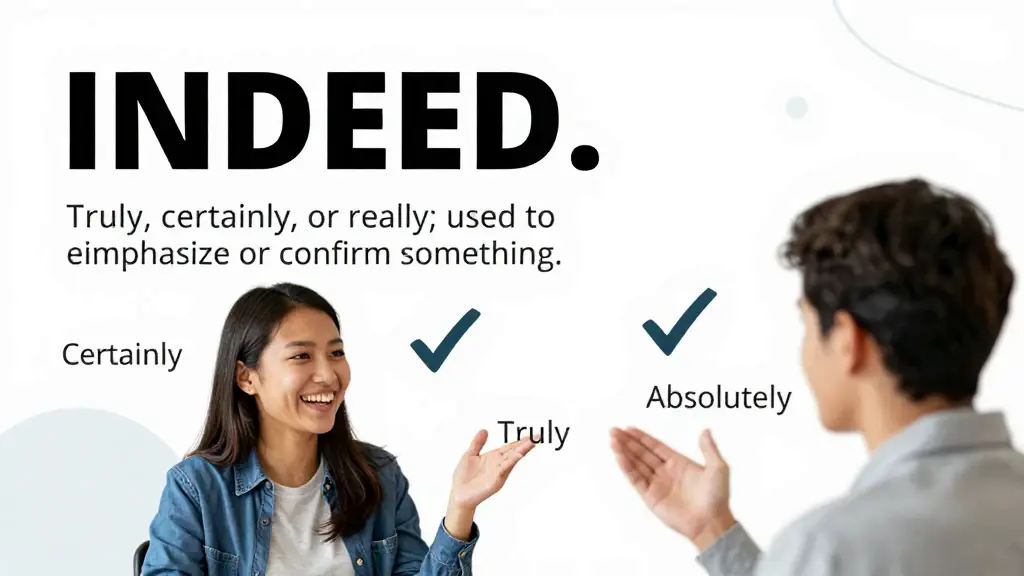
The word indeed means “really,” “certainly,” or “in fact.”
People use it to show that something is true, agree with a statement, or add emphasis to what they are saying.
For example, if someone says, “This is a beautiful place,” you might reply, “Indeed!” This means you agree that the place is beautiful.
Indeed is a common English word used in everyday conversations, books, news reports, and formal writing.
It can sound polite, thoughtful, or formal, depending on the sentence.
In this guide, you will learn the meaning of indeed, how to use it in texting and conversation, and how it differs from similar words.
Quick Answer
Indeed means really, certainly, or in fact. It is used to agree with someone, confirm that something is true, or emphasize a statement.
Quick Meaning Table
| Feature | Meaning |
| Word | Indeed |
| Part of speech | Adverb |
| Simple meaning | Really, certainly, or in fact |
| Pronunciation | in-DEED |
| Tone | Neutral, polite, or formal |
| Common use | Agreement, confirmation, and emphasis |
| Example | “Indeed, you are right.” |
What Does Indeed Mean in Simple English?
In simple English, indeed means that something is true or that you strongly agree with an idea.
It can be used in different ways.
1. To agree with someone
Example: “That was a great movie.”
Reply: “Indeed!”
Here, indeed means “Yes, I agree.”
2. To show that something is true
Example: “She is indeed a talented singer.”
This means she really is a talented singer.
3. To add emphasis
Example: “It was indeed a difficult test.”
This means the test was truly difficult.
The exact meaning depends on the sentence. However, the word usually adds agreement, certainty, or emphasis.
Indeed Meaning in Texting and Messaging
In texting, indeed is often used to agree with a message or confirm that something is true.
For example:
Friend 1: “Today was a long day.”
Friend 2: “Indeed!”
The second friend means, “Yes, it really was.”
People may also use indeed when they want to sound polite, calm, or slightly formal. Compared with words such as “yep,” “yeah,” and “totally,” indeed can sound more serious or thoughtful.
Here are some common examples:
- “Indeed, that makes sense.”
- “You are indeed correct.”
- “Indeed! I enjoyed the event.”
- “That is indeed a good idea.”
Indeed is not a special texting abbreviation or internet acronym. It is a regular English word that people also use in digital conversations.
Indeed Meaning in Casual Conversation
In everyday speech, indeed can show agreement or emphasize an opinion.
For example, imagine two friends talking about the weather.
Ali: “It is very hot today.”
Hamza: “Indeed, it is.”
Hamza agrees that the weather is hot.
However, people do not always use indeed in casual conversation. Many speakers prefer simpler expressions such as “yes,” “really,” “definitely,” or “that’s true.”
Indeed may sound natural when someone wants to emphasize a point, but using it in every reply can make a conversation sound overly formal.
Examples of Indeed in Conversation
- “Indeed, you have worked hard.”
- “That is indeed surprising.”
- “Indeed, we should leave early.”
- “You are indeed a good friend.”
Each sentence uses indeed to confirm or emphasize an idea.
Indeed Meaning in Formal English
Indeed is common in formal writing, speeches, reports, and professional conversations.
Writers use it to confirm a point, strengthen a statement, or introduce information that supports an earlier idea.
For example:
“The results were indeed impressive.”
This sentence emphasizes that the results were impressive.
Another example:
“The new plan is useful. Indeed, it may help the entire team.”
Here, indeed introduces a stronger supporting point. It is similar to saying “in fact.”
Indeed can make writing sound clear and professional when used naturally. However, it is usually unnecessary when a simpler word would communicate the same idea.
Indeed Meaning in Love and Relationships
In conversations about love and relationships, indeed can express agreement, affection, or emphasis. Its emotional meaning depends on the surrounding words.
For example:
Person 1: “You mean a lot to me.”
Person 2: “You are indeed special to me, too.”
The second person uses indeed to emphasize their feelings.
Another example:
“You are indeed someone I can trust.”
This means the person truly feels that the other person is trustworthy.
However, indeed does not automatically express love or romantic interest. It is simply an adverb. The rest of the sentence tells you what the speaker means.
Indeed Meaning on Social Media
On social media platforms such as TikTok, Instagram, Facebook, and Snapchat, indeed can appear in comments, captions, and direct messages.
People may use it to agree with a post, confirm an opinion, or emphasize a reaction.
Examples include:
- “Indeed, this is the truth.”
- “Indeed! Hard work matters.”
- “That is indeed a beautiful view.”
- “Indeed, we all need a break.”
Sometimes, people use indeed humorously because it sounds more formal than everyday internet language.
For example, someone might comment “Indeed, my friend” under a funny post. The formal wording may make the comment feel playful.
The meaning still depends on the context, not the platform.
10 Examples of Indeed in Sentences
Here are ten examples showing how to use indeed correctly.
1. “You are indeed correct.”
Meaning: You are truly right.
2. “It was indeed a wonderful day.”
Meaning: The day really was wonderful.
3. “Indeed, I agree with your opinion.”
Meaning: I certainly agree with you.
4. “She is indeed a talented artist.”
Meaning: She really has artistic talent.
5. “That is indeed good news.”
Meaning: The news is truly good.
6. “He did indeed finish the project.”
Meaning: He really completed the project.
7. “Indeed, we should help those in need.”
Meaning: The speaker strongly agrees that helping people is important.
8. “The book was indeed interesting.”
Meaning: The book really was interesting.
9. “You have indeed improved your English.”
Meaning: Your English has truly improved.
10. “Indeed! That is exactly what I meant.”
Meaning: The speaker strongly agrees that the other person understood the point.
Two Short Conversations Using Indeed
Conversation 1: Between Friends
Sara: “The food at that restaurant was delicious.”
Ayesha: “Indeed! I would love to go there again.”
Meaning: Ayesha agrees that the food was delicious.
Conversation 2: At School
Teacher: “Practice can help you improve your English.”
Student: “Indeed, I have noticed that.”
Meaning: The student agrees and confirms that practice has helped.
Synonyms of Indeed
Synonyms are words with similar meanings. The best synonym for indeed depends on how it is used.
| Synonym | Meaning |
| Certainly | Without doubt |
| Really | Truly or actually |
| Truly | In a genuine or real way |
| Definitely | Without uncertainty |
| Actually | In fact or in reality |
| Surely | With confidence or expectation |
| Absolutely | Completely or without doubt |
| Undoubtedly | Without reasonable doubt |
| In fact | Used to confirm or add information |
| Clearly | In a way that is easy to understand |
For example, “She is indeed talented” can be rewritten as “She is certainly talented” or “She is truly talented.”
Not every synonym fits every sentence. Choose the word that best matches the intended meaning.
Antonyms of Indeed
Indeed does not have one exact opposite in every context. However, some words express the opposite idea of certainty or truth.
- Perhaps: Possibly, but not certainly.
- Maybe: It may be true, but it is not confirmed.
- Possibly: Something could happen or be true.
- Uncertainly: Without confidence or certainty.
For example:
“Indeed, he will attend the meeting” expresses confidence.
“Perhaps he will attend the meeting” expresses uncertainty.
These words are not direct opposites in every sentence, but they can show a contrast in meaning.
Indeed vs. Really
Indeed and really are similar, but they can sound different.
Indeed often sounds more formal or emphatic.
Example: “The presentation was indeed helpful.”
Really is more common in everyday speech.
Example: “The presentation was really helpful.”
Both sentences say that the presentation was helpful. Really is usually more natural in casual conversation, while indeed can sound more formal or deliberate.
Indeed vs. Definitely
Both words can express certainty, but they are not always interchangeable.
Indeed can confirm a fact or add emphasis.
Example: “She is indeed an excellent teacher.”
Definitely expresses strong certainty or confidence.
Example: “I will definitely attend the meeting.”
You could say, “I will indeed attend the meeting,” but the tone may sound more formal. Definitely is often more natural when talking about a firm decision.
Common Mistakes When Using Indeed
Although indeed is a simple word, some learners use it in ways that sound unnatural.
1. Using Indeed in Every Reply
Instead of replying “Indeed” to every message, use words that fit the conversation, such as “yes,” “exactly,” or “that’s true.”
2. Confusing Indeed With Indeed.com
Indeed is an English word meaning really, certainly, or in fact.
Indeed.com is a job-search website where people can look for jobs and employers can post job listings.
The meaning depends on whether the word appears in a sentence or refers to the website.
3. Using Indeed When You Are Unsure
Indeed usually confirms or emphasizes something. If you are unsure, words such as “maybe” or “perhaps” may be more appropriate.
4. Forgetting the Sentence Context
Indeed can express agreement, confirmation, or emphasis. Always read the full sentence to understand its exact meaning.
FAQs:
1. What does indeed mean in simple words?
Indeed means really, certainly, or in fact. People use it to agree with someone, confirm a fact, or emphasize a statement.
2. What does indeed mean in texting?
In texting, indeed usually means “yes,” “really,” or “I agree.” It can also emphasize a message or make a reply sound more formal.
3. Is indeed a positive word?
Indeed is a neutral word. It can be used in positive, negative, or neutral sentences. For example, “It was indeed a wonderful day” is positive, while “It was indeed a difficult day” is negative.
4. What is another word for indeed?
Common alternatives include certainly, really, truly, definitely, and in fact. The best choice depends on the sentence.
5. Does indeed mean yes?
Sometimes. When someone replies “Indeed!” to a statement, they often mean “Yes, I agree.” In other sentences, indeed may mean “really” or “in fact.”
6. What does indeed mean in a relationship?
In a relationship, indeed can emphasize a feeling or confirm a statement. For example, “You are indeed important to me” means the person truly matters.
7. Is indeed formal or informal?
Indeed can be used in both formal and informal settings. However, it often sounds more formal than everyday words such as “yeah,” “really,” or “totally.”
8. What does indeed mean in a sentence?
In “She is indeed a good friend,” indeed means “truly” or “really.” It emphasizes that she is a good friend.
9. What is the difference between indeed and actually?
Indeed often confirms or emphasizes a statement. Actually often introduces a fact, corrects an assumption, or explains what is true. Their meanings sometimes overlap.
10. Does indeed mean the same as definitely?
They can have similar meanings when expressing certainty. However, definitely is often used for firm decisions, while indeed is frequently used to confirm or emphasize a statement.
Conclusion:
Indeed is a useful English word that means really, certainly, or in fact.
It can show agreement, confirm information, and add emphasis to a sentence.
You may see it in text messages, everyday conversations, formal writing, and social media comments.
Although it can sound more formal than words such as “really” or “yes,” it is easy to understand when you look at the full sentence.
Learning how to use indeed can help you improve your English vocabulary and communicate more clearly.

Professional Language Consultant with expertise in vocabulary building and academic writing resources.