
It can also describe someone who feels deeply abandoned by another person or even by God, especially in religious or literary writing.
For example, “He felt forsaken by his friends” means he felt that his friends had abandoned him.
Forsaken is the past participle of the verb forsake, which means to abandon or leave behind.
The word has a serious, emotional, and sometimes old-fashioned tone. If you are asking “What does forsaken mean?”, the simple answer is: forsaken means abandoned, deserted, or left without help, support, or companionship.
Quick Meaning Table
| Term | Main Meaning | Word Type | Pronunciation | Usage | Example |
| Forsaken | Abandoned or deserted, often painfully | Adjective (past participle of “forsake”) | for-SAY-kuhn | Literature, formal writing, religious texts, everyday speech | “The old house stood forsaken at the edge of town.” |
What Does Forsaken Mean?
Forsaken means abandoned, deserted, or left completely alone. It’s the past participle of the verb “forsake,” which means to give up on or leave someone or something, often permanently.
The word carries emotional weight.
Forsaken Meaning in Simple Words
It’s a stronger, more emotional word than just saying someone “left” or “went away.”
Different Meanings and Uses of Forsaken
- Describing a person: “She felt forsaken by her closest friends during that difficult year.” This describes emotional abandonment.
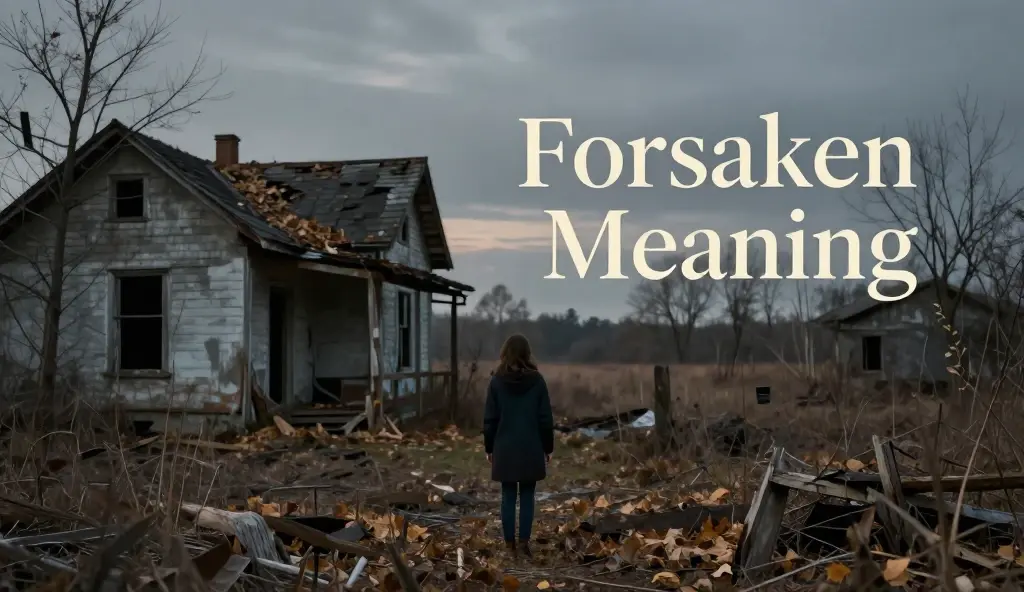
- Describing a place: “The forsaken town had been empty for decades.” This describes physical desertion.
- Religious or spiritual context: “My God, my God, why have you forsaken me?” This famous line, found in the Bible (Psalm 22 and later repeated in the Gospels), reflects a feeling of spiritual abandonment.
- Describing an idea or belief: “He forsook his old beliefs entirely.” This uses the verb form to describe abandoning something intangible, like a belief or commitment.
Forsaken vs. Forsake: Verb and Adjective Forms
“Forsake” is the base verb, meaning to give up or abandon someone or something.
- “He forsook his hometown.” (past tense verb)
- “The forsaken hometown sat quiet and empty.” (adjective describing a state)
Origin of Forsaken
Forsaken comes from Old English “forsacan,” meaning to renounce or deny. It’s related to the prefix “for-,” often used to intensify or reverse a meaning, combined with “sacan,” meaning to dispute or object. Over time, the word evolved into its modern sense of complete abandonment. It’s an old word, with religious texts like the Bible playing a significant role in keeping it in common use through the centuries.
How to Use Forsaken in a Sentence
- “The forsaken village hadn’t seen a visitor in years.”
- “She refused to feel forsaken, even after everyone else had left.”
- “He forsook his old friends once he moved to the city.”
- “The forsaken garden was overgrown and untouched.”
- “They felt forsaken by the very people who promised to help.”
- “The soldier vowed never to leave a comrade forsaken on the battlefield.”
- “Her forsaken dreams still lingered in the back of her mind.”
- “The forsaken building had broken windows and no roof left.”
- “He forsook everything familiar to start over somewhere new.”
- “The dog looked forsaken, sitting alone by the empty road.”
Synonyms and Similar Words
- Abandoned — the closest and most common synonym, though slightly less emotionally intense than “forsaken”
- Deserted — often used specifically for places, similar to forsaken’s use for towns or buildings
- Renounced — closer to the verb form “forsake,” specifically about giving up a belief or claim
Forsaken tends to carry more emotional or literary weight than simpler alternatives like “abandoned,” which is why it shows up more often in writing, poetry, and religious texts than in casual conversation.
Common Confusions
- Forsaken vs. forsook: “Forsook” is the simple past tense of “forsake” (“he forsook his home”), while “forsaken” is the past participle, typically used as an adjective or with helping verbs (“he has forsaken his home”).
- Forsaken vs. abandoned: These are close synonyms, but “forsaken” often carries a stronger emotional or literary tone.
FAQs:
What does forsaken mean in simple terms?
Forsaken means abandoned or left behind, often in a way that feels painful, permanent, or emotionally significant.
Is forsaken a verb or an adjective?
It’s also the past participle of the verb “forsake.”
Where does the phrase “why have you forsaken me” come from?
This phrase originates from Psalm 22 in the Bible and is later repeated by Jesus in the Gospels of Matthew and Mark, expressing a feeling of deep spiritual abandonment.
What is the difference between forsaken and forsook?
“Forsook” is the simple past tense form (“he forsook his job”), while “forsaken” is the past participle, often used as an adjective or paired with helping verbs (“he has forsaken his job”).
What is a synonym for forsaken?
Common synonyms include abandoned, deserted, and forlorn, though “forsaken” typically carries more emotional or literary weight than these alternatives.
How do you pronounce forsaken?
Forsaken is pronounced “for-SAY-kuhn,” with stress on the second syllable.
Can forsaken describe a place, not just a person?
Yes. It’s commonly used to describe deserted or abandoned places, such as “a forsaken town” or “a forsaken building.”
Is forsaken an old-fashioned word?
It’s an older word rooted in Old English, and it appears more often in literature, poetry, and religious texts than in everyday casual conversation, though it’s still widely understood.
What is the root word of forsaken?
It comes from Old English “forsacan,” meaning to renounce or deny, which evolved over time into the modern meaning of complete abandonment.
Is forsaken always used in a negative or sad context?
Almost always, yes. The word inherently carries a tone of loss, abandonment, or emotional pain, even when used to describe a physical place rather than a person.
Conclusion:
Forsaken means abandoned or deserted, often carrying a deeper emotional weight than simpler words like “left” or “abandoned.”
It can describe a person, a place, or even a belief that’s been given up on.
if you come across it in a novel, a religious text, or everyday writing, the meaning stays consistent: something or someone left behind, often painfully.

English Education Specialist creating informative content focused on language learning and communication.