
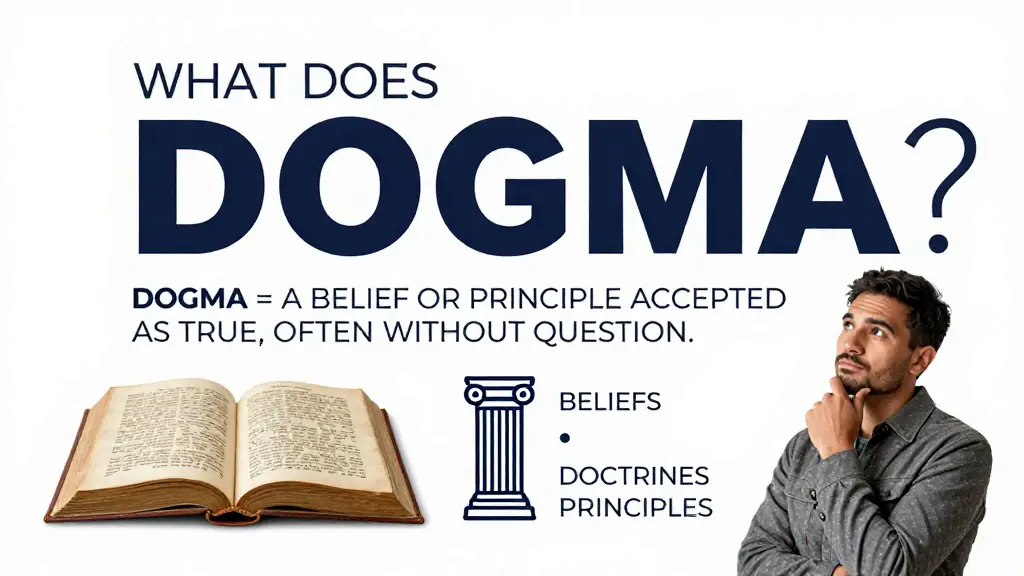
Have you ever heard someone say, “That is just dogma,” and wondered what they meant?
The word dogma is often used when people talk about religion, beliefs, rules, or ideas that are accepted without question.
Dogma means a belief or set of beliefs that people are expected to accept as true, often without questioning them.
It is commonly linked to religious teachings, but it can also describe fixed ideas in politics, education, science, or everyday life.
For example, if someone follows a rule simply because “that is how we have always done it,” without considering other ideas, another person might describe that belief as dogmatic.
Dogma is not always used as an insult. In religion, it can refer to official teachings that members are expected to accept.
In everyday speech, however, it often suggests that people are too strict about their beliefs or unwilling to consider other views.
In this guide, you will learn the dogma meaning in simple English, its pronunciation, examples, synonyms, and how it differs from related words.
Quick Answer
Dogma is a belief or set of beliefs accepted as true, often without being questioned. The word is commonly used for official religious teachings, but it can also describe fixed ideas in politics, society, or everyday life. Its meaning and tone depend on the context.
Quick Meaning Table
| Term | Meaning |
| Term | Dogma |
| Main meaning | A belief accepted as true, often without question |
| Full form | Not an abbreviation |
| Pronunciation | DOG-muh |
| Word type | Noun |
| Usage | Religion, philosophy, politics, and daily life |
| Example | “He follows the rules without questioning the dogma.” |
What Does Dogma Mean?
Dogma refers to a belief or teaching that is treated as true and is not usually open to question within a particular group or system.
The word is often used in religion. A religious community may have official teachings that its members are expected to accept. These teachings may be called religious dogma.
However, dogma is not limited to religion. It can also describe ideas that people follow simply because they believe those ideas must be right.
For example:
- “The group follows its old dogma.”
- “She questioned the political dogma of her time.”
- “Good leaders should not let dogma stop them from considering new ideas.”
In the first example, dogma refers to established beliefs. In the second, it refers to political ideas treated as unquestionable. In the third, the word suggests that fixed beliefs can prevent people from thinking openly.
Dogma can be neutral when describing official teachings. It can sound negative when it suggests that people refuse to consider evidence or other viewpoints.
Dogma Meaning in Simple Words
In simple words, dogma is a belief that people accept as true and are expected not to question.
Imagine a group that follows a rule because its members believe the rule is always right. Even when someone asks whether the rule still makes sense, the group refuses to discuss it. Someone might describe that rule as dogma.
Here is another example:
“Never change the old way of doing things” can become dogma if people treat it as an unquestionable rule.
The key idea is not simply having a strong belief. It is treating a belief as something that should not be challenged.
People can have strong opinions without following dogma. Dogma is more closely linked to fixed teachings or beliefs that a group accepts as settled truth.
Different Meanings of Dogma
The word dogma can be used in several settings. Its central idea remains a belief or teaching treated as established truth, but the context changes how it is understood.
1. Religious Dogma
Religious dogma refers to official teachings or beliefs that a religious tradition regards as authoritative.
For example:
“Religious dogma plays an important role in the group’s teachings.”
This sentence refers to the beliefs that guide the religious community.
The word does not automatically mean that a religion is wrong. It describes the status of certain teachings within a religious tradition.
2. Political Dogma
Political dogma refers to political beliefs or principles that people treat as unquestionable.
Example:
“The leader refused to reconsider his political dogma.”
This suggests that the leader held firmly to his political ideas and was unwilling to review them.
3. Social Dogma
Social dogma describes beliefs or rules that a community treats as unquestionable.
Example:
“The writer challenged the social dogma that everyone must follow the same path in life.”
Here, dogma refers to an established social belief that the writer wants people to examine.
4. Personal Dogma
People sometimes use dogma to describe a personal belief that they refuse to reconsider.
Example:
“His dogma about success left no room for different opinions.”
This means that he held a fixed idea about success and did not easily accept other viewpoints.
In everyday conversation, this use is often critical. It suggests that a person may be too rigid in their thinking.
Dogma in Religion
Religion is one of the most common contexts in which people use the word dogma.
In religious discussions, dogma can refer to teachings that a religious community formally accepts as true. These teachings may guide its understanding of faith, worship, or spiritual life.
For example:
“The teacher explained the religious dogma to the students.”
This means that the teacher explained an established religious teaching.
It is important to understand that different religions and traditions have different ways of defining and accepting their teachings. The word dogma does not mean exactly the same thing in every religious tradition.
It is also not always an accusation. A person may use the term simply to describe a formal belief within a religion.
However, in a critical discussion, someone may use dogmatic to describe a person who insists that their beliefs are correct and refuses to listen to others.
Dogma Meaning in Philosophy
In philosophy, dogma often refers to a belief or principle that is accepted without sufficient questioning.
Philosophers frequently examine assumptions, ask difficult questions, and look for reasons to support a claim. Because of this, the word dogma can be used negatively when an idea is treated as unquestionable.
Example:
“Philosophy encourages people to examine their ideas instead of accepting every claim as dogma.”
This means people should think carefully about what they believe rather than automatically accepting every idea as true.
Dogma is not the same as knowledge or a well-supported conclusion. A belief may be supported by strong reasons and still be open to further discussion. Dogma usually emphasizes the authority or unquestioned acceptance of a belief.
Dogma Meaning in Everyday Life
Although dogma is often linked to religion and philosophy, people also use it when discussing daily habits, family rules, workplaces, and social expectations.
For example:
- “The company needs fresh ideas instead of outdated dogma.”
- “She questioned the dogma that success only comes from money.”
- “His dogma about education made him reject every new teaching method.”
These sentences describe beliefs that people follow too rigidly.
However, not every rule is dogma. A safety rule, for example, may be supported by clear evidence. The word is more suitable when a belief or principle is treated as unquestionable, especially when people refuse to consider reasonable alternatives.
How to Pronounce Dogma
Dogma is pronounced DOG-muh.
It has two syllables:
- DOG — the first syllable receives the main stress.
- muh — the second syllable is unstressed.
The word is a noun, so it names a belief, teaching, or set of principles.
Related forms include dogmatic, which describes someone or something that insists on fixed beliefs, and dogmatism, which refers to the practice or attitude of treating beliefs as unquestionable.
Origin of Dogma
The word dogma comes from the Greek word dogma, which referred to an opinion, belief, or decision. It entered English through Latin and later use in religious and philosophical writing.
Over time, the word became strongly associated with official teachings and principles that people accept as established truth.
Today, dogma can describe formal religious teachings or, more critically, ideas that people refuse to question.
The word’s history helps explain why it appears in discussions about religion, philosophy, politics, and fixed ways of thinking.
How to Use Dogma in a Sentence
Here are 10 original examples showing how to use dogma naturally.
- “The teacher encouraged students to question old dogma.”
- “He followed the group’s dogma without asking why.”
- “The writer challenged the political dogma of the time.”
- “Religious dogma can shape how a community understands its faith.”
- “We should examine our beliefs instead of treating every idea as dogma.”
- “The company was held back by outdated dogma.”
- “She refused to accept the dogma that success means becoming rich.”
- “The discussion focused on science, evidence, and dogma.”
- “His dogma made it difficult for him to accept new ideas.”
- “The book questions the social dogma that everyone must live the same way.”
These examples show both neutral and negative uses. In religious writing, dogma may describe established teachings. In other situations, it may suggest that someone is unwilling to reconsider a belief.
Conversation Examples
Conversation 1: At School
Ali: Why does our teacher ask us to explain our answers?
Hamza: I think she wants us to understand the reasons, not just memorize rules.
Ali: So we should not accept every idea as dogma?
Hamza: Right. We should learn the reasons behind an idea.
In this conversation, dogma refers to beliefs that are accepted without being examined.
Conversation 2: At Work
Sara: Our team always uses the same method, even when it does not work well.
Mina: Maybe we are following old dogma instead of looking for a better solution.
Sara: We should compare a few new ideas.
Mina: Agreed. We can keep what works and change what does not.
Here, dogma refers to a fixed way of thinking that may prevent improvement.
Synonyms and Similar Words
Dogma has several related words, but they are not all exact replacements.
| Word | Meaning | Difference |
| Belief | Something a person accepts as true | A belief does not have to be unquestionable |
| Doctrine | An established set of teachings or principles | Often used for formal religious or political teachings |
| Principle | A basic rule or idea that guides behavior | May be based on reasoning and evidence |
| Creed | A statement or set of beliefs | Often linked to religious faith |
| Orthodoxy | Accepted or traditional beliefs within a group | Focuses on what is considered correct or traditional |
| Ideology | A connected system of ideas and beliefs | Often relates to politics or society |
| Dogmatism | The attitude of treating beliefs as unquestionable | Describes an approach to beliefs rather than a specific belief |
For example, a person may have a belief without being dogmatic. But if they refuse to consider any challenge to that belief, their attitude may be described as dogmatism.
Dogma vs. Doctrine
Dogma and doctrine are closely related, but they do not always mean the same thing.
Dogma often refers to a belief accepted as authoritative or unquestionable. It may also suggest rigid thinking, especially in everyday criticism.
Doctrine usually means an established teaching, principle, or set of beliefs followed by a group.
For example:
- “The church teaches its religious doctrine.”
- “He refused to question the political dogma.”
The first sentence simply describes a set of teachings. The second suggests that someone treats political beliefs as unquestionable.
The words can overlap, particularly in religious contexts, so their precise meaning depends on how they are used.
Dogma vs. Dogmatic
These words come from the same word family, but they have different grammatical uses.
Dogma is a noun. It names a belief or teaching.
Example: “The group follows a strict dogma.”
Dogmatic is an adjective. It describes a person, statement, or attitude that treats beliefs as unquestionable.
Example: “He is dogmatic about his political views.”
A related noun is dogmatism, which describes the attitude of insisting that one’s beliefs are correct without being willing to reconsider them.
Is Dogma a Negative Word?
Dogma is not always negative. In religious or historical writing, it may be used neutrally to describe official teachings accepted by a particular tradition.
However, in everyday conversation, the word often carries a negative tone. It may suggest that people are too rigid, do not think independently, or refuse to consider other views.
For example:
- Neutral: “The book explains the dogma of the religious tradition.”
- Negative: “His dogma prevents him from listening to anyone else.”
If you want to describe a set of beliefs without criticizing it, words such as teachings, doctrine, or principles may be more suitable.
FAQs:
1. What does dogma mean in simple words?
Dogma means a belief or teaching that people accept as true, often without questioning it. It is commonly used for religious teachings but can also describe fixed ideas in politics, society, or everyday life.
2. What is an example of dogma?
An example of dogma is the belief that an old rule must always be followed simply because it has existed for a long time. If people refuse to consider whether the rule still makes sense, it may be described as dogma.
3. Is dogma always related to religion?
No. Dogma is often used in religious discussions, but it can also refer to political beliefs, social expectations, philosophical ideas, or personal views. Its central meaning is a belief or teaching treated as established truth.
4. Is dogma a positive or negative word?
Dogma can be neutral when describing official teachings within a religious or philosophical tradition. In everyday speech, it often sounds negative because it may suggest rigid thinking or an unwillingness to consider other opinions.
5. What is the difference between dogma and doctrine?
Dogma often suggests a belief accepted as authoritative or unquestionable. Doctrine usually refers to an established set of teachings or principles. The meanings overlap, especially in religion, but dogma can carry a stronger suggestion of fixed belief.
6. What does dogmatic mean?
Dogmatic describes a person or attitude that treats beliefs as unquestionably correct. For example, a dogmatic person may refuse to listen to other viewpoints. The word is an adjective, while dogma is a noun.
7. What is the opposite of dogma?
There is no single perfect opposite, but open-mindedness, critical thinking, and willingness to question ideas are useful contrasts. These terms describe an approach in which people consider evidence and other viewpoints rather than treating beliefs as unquestionable.
8. How do you pronounce dogma?
Dogma is pronounced DOG-muh. It has two syllables, with the main stress on the first syllable. It is a noun used to describe an established belief, teaching, or set of principles.
9. Can dogma be used in a sentence?
Yes. For example, “The students were encouraged to question old dogma.” This means they were encouraged to examine established beliefs instead of accepting them without thought. Dogma is suitable for discussions about religion, politics, philosophy, and society.
10. What is dogmatism?
Dogmatism is the attitude of treating beliefs as unquestionable or insisting that one’s views are correct without considering other perspectives. Dogma refers to the belief or teaching itself, while dogmatism describes the attitude toward beliefs.
Conclusion:
Dogma means a belief or set of beliefs accepted as true, often without question.
It commonly appears in religious discussions but can also describe fixed ideas in politics, philosophy, and everyday life.
The word may be neutral when referring to official teachings, or negative when it suggests rigid thinking.
Understanding the context helps you know which meaning applies.
Remember that dogma is not simply a strong belief; it often involves treating a belief as something that should not be challenged.

Senior Content Editor producing trusted educational materials for students, professionals, and language learners.