
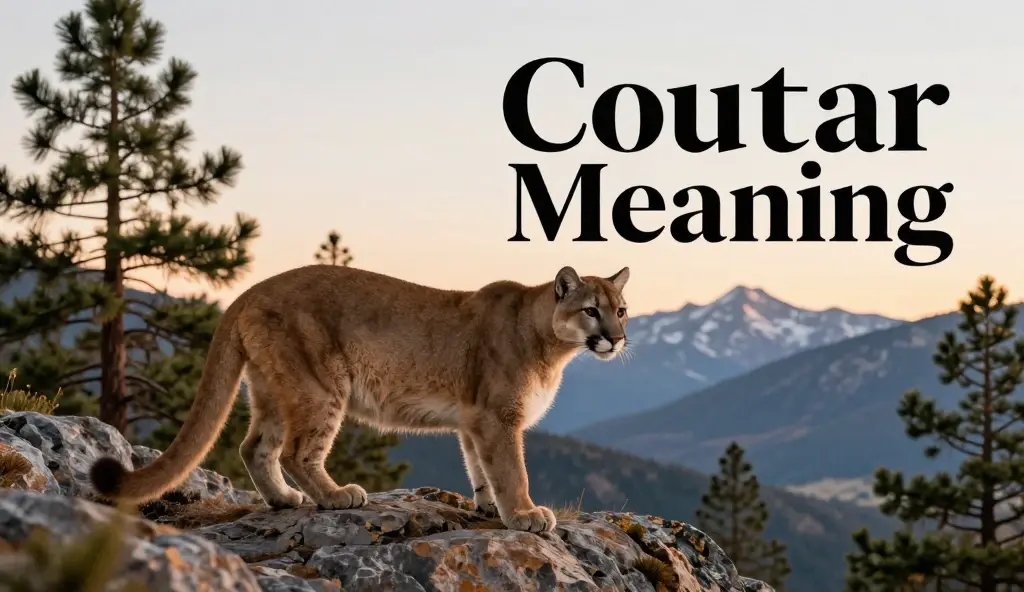
What does cougar mean? Cougar has two main meanings: a large wild cat found in the Americas, and an informal term for an older woman who is romantically or sexually interested in younger men.
The meaning depends entirely on context.
In nature or wildlife discussions, a cougar is the animal also known as a mountain lion or puma.
In dating and popular culture, cougar is slang describing a woman, usually older than her male partner, who dates or is attracted to younger men.
The animal meaning is neutral.
The dating meaning is informal and can sometimes sound judgmental or stereotypical, so context and the person’s own preferences matter.
Quick Answer
Cougar has two very different meanings. Literally, it refers to a large wild cat, also known as a mountain lion or puma, native to the Americas. As slang, “cougar” describes an older woman, typically in her 40s or beyond, who dates or pursues significantly younger men. The slang meaning is the more common use in casual, social conversation today.
Quick Meaning Table
| Term | Main Meaning | Related Terms | Pronunciation | Usage | Example |
| Cougar | (1) A large wild cat; (2) slang for an older woman who dates younger men | Mountain lion, puma, panther | KOO-ger | Wildlife, casual slang, pop culture | “She jokingly called herself a cougar after her last few relationships.” |
What Does Cougar Mean?
Cougar has two distinct, unrelated meanings depending on context.
Literally, a cougar is a large, solitary wild cat found throughout North and South America, also commonly known as a mountain lion, puma, or panther, depending on the region.
As slang, “cougar” refers to an older woman, generally over 40, who is romantically or sexually interested in significantly younger men. This slang usage became especially popular in the early-to-mid 2000s through television, movies, and pop culture.
Cougar Meaning in Simple Words
If someone uses “cougar” in a wildlife or nature context, they’re talking about the actual animal — a big cat similar in size to a leopard, known for its strength and wide range across the Americas.
If someone uses “cougar” in a social or dating context, they mean an older woman who’s romantically interested in much younger men. It’s almost always used about dating dynamics, not in any literal sense.
Cougar Meaning in Dating and Pop Culture
The slang use of “cougar” became widely popular in American pop culture in the 2000s, especially through TV shows and media that used the term to describe older women dating younger men, often framed humorously or as a confident, empowered dynamic. It gained mainstream visibility partly through shows like Cougar Town and general 2000s dating culture commentary.
The term is sometimes used self-referentially and light-heartedly by women themselves, though it can also be viewed as reductive or stereotypical, since it reduces a person to an age-based dating pattern rather than an individual relationship dynamic. Reactions to the term vary — some embrace it playfully, while others find it outdated or overly simplistic.
Cougar in Nature
As an animal, the cougar (Puma concolor) is one of the most widely distributed wild cats in the Western Hemisphere, found from Canada down through South America. It’s known by many regional names, including mountain lion, puma, panther, and catamount, despite all referring to the same species. Cougars are solitary, highly adaptable, and typically avoid human contact, though sightings occasionally make local news in areas where human development overlaps with their habitat.
Related Slang Terms
A few related, newer slang terms have emerged alongside “cougar” to describe similar age-gap dating dynamics.
- MILF — a more sexualized slang term for an attractive older mother, sometimes used in overlapping contexts with “cougar,” though not identical in meaning
- Silver fox — typically used for an attractive older man, functioning as a rough male counterpart in tone, though without the specific age-gap dating implication
- Manther — a less common, informal male equivalent to “cougar,” describing an older man pursuing younger women
- Sugar mama — describes an older woman financially supporting a younger partner, which overlaps with but isn’t identical to the “cougar” concept
How to Pronounce Cougar
Cougar is pronounced “KOO-ger,” with the stress on the first syllable.
How to Use Cougar in a Sentence
- “A cougar was spotted near the hiking trail last week.”
- “She jokingly referred to herself as a cougar after her last relationship.”
- “The documentary followed a family of cougars in the mountains.”
- “He joked that dating her made him feel like her latest cougar conquest.”
- “Cougars are known for their wide territorial range.”
- “The show became famous for its portrayal of cougar dating culture.”
- “Wildlife officials confirmed cougar sightings in the area.”
- “She didn’t love being called a cougar, feeling it oversimplified her relationship.”
- “The cougar is also known as a mountain lion in many parts of the U.S.”
- “Their age gap led some friends to jokingly call her a cougar.”
Synonyms and Similar Words
For the animal:
- Mountain lion
- Puma
- Panther
- Catamount
For the slang meaning:
- Older woman (plain, neutral description)
- “Dating younger” (a more neutral phrase, avoiding the label altogether)
Common Confusions
- Cougar vs. panther: These often refer to the same species (Puma concolor) depending on regional naming, not two different animals.
- Cougar (slang) vs. MILF: These overlap in some casual usage, but “cougar” specifically emphasizes an age-gap dating dynamic, while “MILF” is a more explicitly sexualized term unrelated to dating age gaps specifically.
- Cougar vs. manther: These are gendered counterparts of a similar concept — “cougar” for women, “manther” for men — though “manther” is far less commonly used.
Is “Cougar” Offensive?
The slang use of “cougar” isn’t considered a slur, but it can come across as reductive or stereotypical to some, since it frames a woman’s dating life around age rather than individual choice or personality. Some women embrace the term playfully, while others find it dismissive. As with many informal slang terms, tone, context, and the relationship between the people using it matter significantly.
FAQs:
What does cougar mean in slang?
In slang, cougar refers to an older woman, typically over 40, who is romantically or sexually interested in significantly younger men.
What is a cougar in nature?
A cougar is a large wild cat native to the Americas, also known as a mountain lion, puma, or panther, depending on the region.
Is “cougar” an offensive term?
It’s not considered a slur, but it can be viewed as reductive or stereotypical by some, since it reduces a person’s dating life to an age-based label.
Where did the slang meaning of cougar come from?
It became widely popularized in American pop culture during the 2000s, particularly through television and media discussing older women dating younger men.
Is cougar and mountain lion the same animal?
Yes. “Cougar,” “mountain lion,” “puma,” and “panther” typically all refer to the same species, Puma concolor, though regional naming varies.
What is the male equivalent slang term to cougar?
“Manther” is sometimes used informally as a male counterpart, describing an older man pursuing younger women, though it’s much less commonly used than “cougar.”
How do you pronounce cougar?
Cougar is pronounced “KOO-ger,” with stress on the first syllable.
Is “cougar” used the same way everywhere?
The slang meaning is widely recognized in American English and much of Western pop culture, though awareness and use of the term can vary elsewhere.
Do people use “cougar” to describe themselves?
Yes, sometimes. Some women use the term playfully and self-referentially, while others avoid or dislike the label.
Is a cougar dangerous to humans?
As an animal, cougars generally avoid human contact and attacks are rare, though they are large predators and caution is recommended in areas where sightings occur.
Conclusion:
Cougar has two very different meanings: a large wild cat native to the Americas, and slang for an older woman who dates significantly younger men.
The slang use became especially popular through 2000s pop culture and remains common today, though opinions vary on if the label feels playful or overly reductive.
Context almost always makes clear which meaning is intended.

Professional Language Consultant with expertise in vocabulary building and academic writing resources.