
Last Updated:
Have you come across the word “coda” in a conversation, a song, a movie, or an online post and wondered what it means? CODA has several meanings depending on the context.
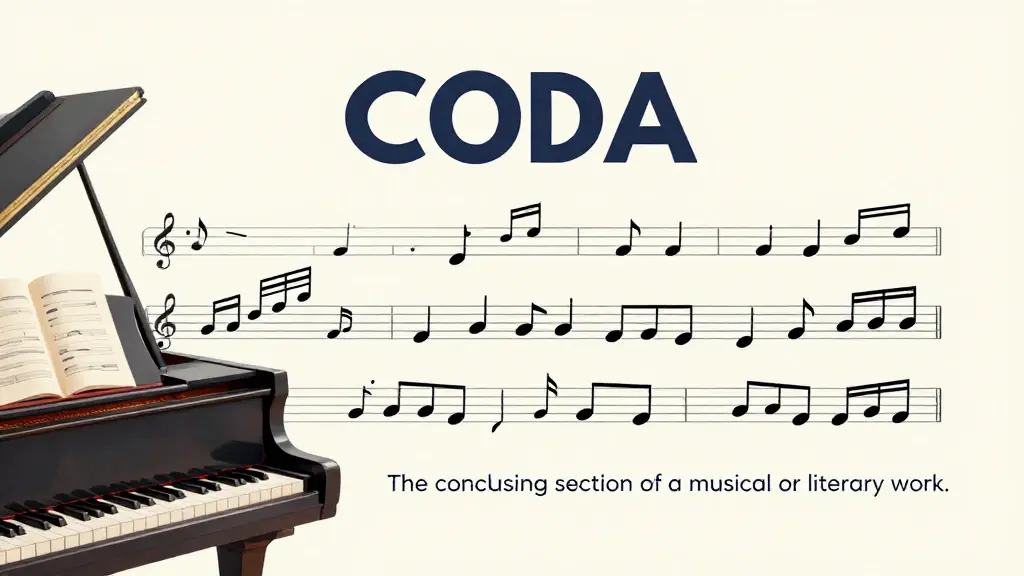
In music, a coda is the concluding section of a composition. As an acronym, CODA stands for “Child of Deaf Adults,” referring to a hearing person who has one or more Deaf parents.
The word can also describe an ending or final part of a story, speech, or experience.
For example, a composer might add a coda to give a piece of music a satisfying ending.
A person who grew up with Deaf parents might describe themselves as a CODA.
The term became more widely recognized through the 2021 film CODA, which tells the story of a hearing teenage girl in a Deaf family.
Understanding the context is essential because CODA can refer to music, family identity, storytelling, or a specific film.
In this guide, you will learn the different meanings of CODA, how to pronounce it, and how to use it correctly.
Quick Answer: What Does CODA Mean?
CODA most commonly means either the concluding section of a musical composition or “Child of Deaf Adults.” In music, a coda brings a piece to its ending. In Deaf culture, CODA refers to a hearing person who has one or more Deaf parents. The intended meaning depends on whether the conversation is about music, family, culture, or entertainment.
Examples:
- “The symphony ends with a powerful coda.” — The music has a concluding section.
- “She is a CODA.” — She is a hearing person with one or more Deaf parents.
- “The final chapter acts as a coda to the novel.” — It provides a closing section.
CODA Meaning at a Glance
| Category | Meaning |
| Word | Coda / CODA |
| Pronunciation | KOH-duh |
| Part of speech | Noun; acronym when referring to a Child of Deaf Adults |
| Music | A concluding section of a musical composition |
| Deaf culture | Child of Deaf Adults |
| Literature and storytelling | A final section that brings a story or experience to a close |
| Film | CODA, a 2021 drama film |
| General idea | An ending, conclusion, or connection to Deaf family identity |
1. What Does Coda Mean in Music?
In music, a coda is a concluding section added to the end of a composition. The Italian word coda literally means “tail,” which reflects its function as a final section following the main musical material.
A coda may repeat familiar themes, introduce new musical ideas, or build toward a strong final moment. Its purpose is to help bring the piece to a satisfying conclusion.
For example:
- “The pianist played the coda beautifully.”
- “The symphony’s coda builds to a dramatic finish.”
- “The composer added a short coda to the final movement.”
A coda is not necessarily present in every piece of music. When one is included, it may make the ending feel more complete, powerful, or memorable.
Coda vs. Ending in Music
A coda is more specific than simply saying “the ending.” It refers to a section that functions as a concluding passage, often extending or reinforcing the musical ideas heard earlier.
In musical notation, the word coda may also appear as a sign that directs performers to a particular ending section when following certain repeat instructions.
2. What Does CODA Mean in Deaf Culture?
In Deaf culture, CODA stands for “Child of Deaf Adults.” It commonly describes a hearing person who has one or more Deaf parents.
Many CODAs grow up navigating both Deaf and hearing communities. Some learn sign language from an early age and may help communicate between their family and hearing people in everyday situations.
For example:
- “She is a CODA who grew up using American Sign Language.”
- “The conference included a discussion about CODA experiences.”
- “He describes his identity as a CODA.”
Being a CODA does not mean every person has the same upbringing or experiences. Some CODAs are fluent in a sign language, while others may have different levels of language access or connection to Deaf culture.
The term is generally used as an identity label, and individual preferences can vary. It is important to respect how people describe themselves.
Is CODA the Same as Being Deaf?
No. CODA usually refers to a hearing person with one or more Deaf parents. A Deaf person and a hearing CODA may share aspects of Deaf culture or family life, but the terms describe different experiences.
A person who has Deaf parents may also be Deaf themselves. In that case, the acronym CODA, as commonly used to mean a hearing child of Deaf adults, may not be the term that best describes their identity.
3. What Does CODA Mean in the Movie CODA?
<text> <italic>CODA</italic> is also the title of a 2021 coming-of-age drama film written and directed by Sian Heder.</text>
<AsyncImageGroup query={[“CODA 2021 film official poster Emilia Jones”,”CODA 2021 film family Ruby Rossi still”]} aspectRatio=”5:4″ layout=”bento” />
The film follows Ruby Rossi, a hearing teenager who is the only hearing member of her immediate family. Her parents and brother are Deaf, and she helps with the family’s fishing business while discovering her passion for singing.
The title has a double meaning:
- It refers to Ruby as a Child of Deaf Adults.
- It also evokes the musical meaning of a coda, a concluding passage.
The film explores family relationships, communication, independence, and the challenge of pursuing personal ambitions while supporting loved ones.
The movie won the Academy Award for Best Picture at the 94th Academy Awards in 2022. Its success brought wider public attention to the acronym CODA and the experiences of hearing children in Deaf families.
4. What Does Coda Mean in Literature and Storytelling?
In literature, storytelling, and other creative work, a coda is a final passage that gives a story or experience a sense of closure.
It may explain what happens after the main events, reflect on a character’s journey, or show the lasting consequences of the story.
Examples:
- “The final chapter serves as a coda to the novel.”
- “The documentary ends with a reflective coda.”
- “Her closing speech was a fitting coda to the ceremony.”
A coda is similar to an epilogue, but the terms are not identical. An epilogue is a distinct section after the main story, often showing what happens later. A coda is a broader term for a concluding passage or element that brings something to a close.
The word can also be used metaphorically to describe the final stage of an experience, relationship, career, or historical period.
5. What Does Coda Mean in Everyday English?
In everyday English, coda can describe a final moment, closing event, or concluding part of something.
For example:
- “The farewell dinner was a coda to her career.”
- “His final letter became a coda to their friendship.”
- “The last scene served as a coda to the story.”
This usage is more literary than everyday slang. People are more likely to say “ending” or “conclusion” in casual conversation, but coda can sound thoughtful or expressive when describing a meaningful final moment.
A coda does not always mean that something ends permanently. It can simply provide a final reflection or a sense of completion.
6. What Does CODA Mean in Texting and on Social Media?
In texting and online conversations, CODA can have different meanings, but it is not a universally common texting abbreviation like LOL or BRB.
Its meaning depends on the topic.
If the conversation is about Deaf culture or family identity: CODA probably means “Child of Deaf Adults.”
If the conversation is about music: coda likely means the concluding musical section.
If the conversation is about a film: CODA may refer to the 2021 movie.
If someone uses the word metaphorically: They may mean a final chapter, closing moment, or conclusion.
For example:
- “I’m a CODA and grew up signing at home.” — A hearing person describing their family identity.
- “That last scene was the perfect coda.” — The scene provided a meaningful ending.
- “Have you watched CODA yet?” — The person may be referring to the film.
Unlike some internet slang, CODA usually has a specific cultural, musical, or creative meaning rather than one standard informal definition.
7. What Is the Difference Between Coda, Epilogue, and Conclusion?
These terms all relate to endings, but they are used differently.
| Term | Meaning | Typical use |
| Coda | A final passage that brings something to a close | Music, literature, speeches, and metaphorical endings |
| Epilogue | A section after the main story, often showing later events | Novels, plays, and films |
| Conclusion | The final part that summarizes or completes something | Essays, reports, arguments, and general writing |
| Finale | The final part of a performance or event | Concerts, shows, and celebrations |
| Postscript | An additional note after a letter or completed message | Letters, emails, and written communication |
For example, a novel might have a conclusion that resolves its central conflict and an epilogue showing what happens to the characters years later. A coda might provide a reflective final passage that gives the story emotional closure.
8. How Do You Pronounce Coda?
Coda is pronounced KOH-duh.
The word has two syllables:
- KO — sounds like “co” in “coat.”
- DUH — a short, unstressed second syllable.
The pronunciation is generally the same whether the word refers to a musical ending or the acronym CODA.
In ordinary conversation, the acronym may be spoken as the word “coda” rather than as the individual letters C-O-D-A. Usage can vary depending on the speaker and context.
9. Examples of Coda in Sentences
Here are ten examples showing how coda can be used in different contexts.
- “The concerto ends with an energetic coda.”
Meaning: The musical composition finishes with a concluding section. - “She is a CODA who grew up in a Deaf family.”
Meaning: She is a hearing child of Deaf adults. - “The final chapter works as a coda to the novel.”
Meaning: The chapter provides a closing passage. - “The orchestra performed the coda with great emotion.”
Meaning: The orchestra performed the concluding part of the music expressively. - “His retirement speech was a fitting coda to his career.”
Meaning: The speech provided a meaningful ending to his professional life. - “I watched CODA with my family last weekend.”
Meaning: The speaker watched the film. - “The director added a brief coda after the main story.”
Meaning: The director included a final section after the main narrative. - “The last song acted as a coda to the concert.”
Meaning: The song brought the performance to a close. - “The essay ends with a coda reflecting on the author’s childhood.”
Meaning: The final passage looks back on earlier experiences. - “The conference featured a panel about CODA identity.”
Meaning: The panel discussed the experiences of hearing children of Deaf adults.
FAQs:
1. What does CODA stand for?
In Deaf culture, CODA stands for “Child of Deaf Adults.” It commonly refers to a hearing person who has one or more Deaf parents. In music, coda is a term for the concluding section of a composition and is not an acronym.
2. What does coda mean in music?
In music, a coda is a concluding section that brings a composition to an end. It may repeat themes, introduce new material, or create a dramatic finish. Not every musical piece contains a separate coda.
3. What does CODA mean in Deaf culture?
CODA means “Child of Deaf Adults.” The term commonly describes a hearing person raised by one or more Deaf parents. Some CODAs grow up using sign language and participating in both Deaf and hearing communities, although experiences vary.
4. What does CODA mean in the movie?
In the 2021 film CODA, the title stands for “Child of Deaf Adults” and also references the musical term for a concluding passage. The story follows a hearing teenager who is part of a Deaf family and wants to pursue singing.
5. Is CODA an acronym or a regular word?
It can be either. CODA is an acronym when it means “Child of Deaf Adults.” Coda is an ordinary word in music and storytelling, referring to a concluding section. Capitalization often signals the acronym, but it is not a perfect rule.
6. What does coda mean in a story?
In a story, a coda is a final passage that provides closure, reflection, or a sense of completion. It may describe the consequences of the main events or give the reader a final perspective on the characters and their experiences.
7. Is a coda the same as an epilogue?
Not exactly. An epilogue is a distinct section that follows the main story, often showing later events. A coda is a broader term for a concluding passage that gives a work a sense of closure. The terms can overlap in some works.
8. How do you pronounce coda?
Coda is pronounced “KOH-duh,” with emphasis on the first syllable. The pronunciation is generally the same whether the term refers to a musical passage or a person who identifies as a Child of Deaf Adults.
9. Does CODA mean the same thing in texting?
Not always. CODA is not a standard texting abbreviation with one universal meaning. In an online conversation, it may refer to Deaf family identity, a musical ending, the film, or a metaphorical conclusion. The surrounding conversation helps clarify its meaning.
10. What is the opposite of a coda?
There is no single exact opposite of coda. In music and storytelling, the closest contrasting concept is an opening or introduction, which begins a work rather than concluding it. Terms such as prelude, introduction, and prologue may be suitable depending on the context.
Conclusion:
CODA has several important meanings. In music and storytelling, a coda is a concluding passage that brings a composition or narrative to a close.
In Deaf culture, CODA stands for “Child of Deaf Adults,” commonly describing a hearing person with one or more Deaf parents.
The term is also the title of an award-winning 2021 film that explores family, identity, and music.
To understand which meaning applies, consider if the conversation concerns music, family experiences, literature, or entertainment.

Lauren Edwards is a U.S.-based writer who focuses on English vocabulary, word meanings, phrases, and everyday expressions. She enjoys presenting language information in a clear and approachable format. Her work helps readers understand unfamiliar terms and learn how they are naturally used in different situations.