
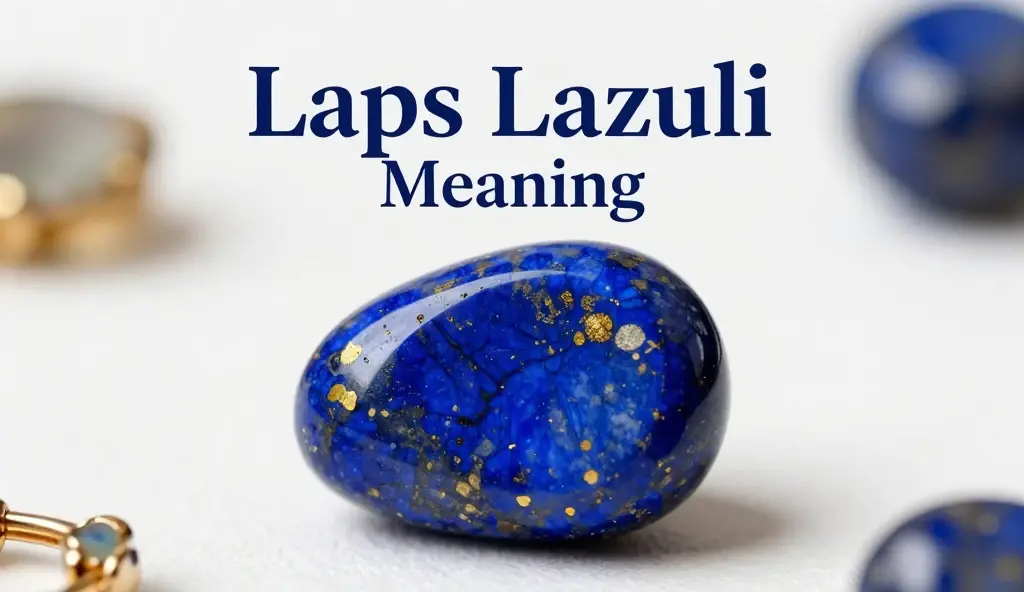
Lapis lazuli is a deep blue gemstone that is often associated with wisdom, truth, communication, protection, and inner peace.
Its meaning can be both cultural and spiritual.
For centuries, people have valued lapis lazuli for its rich blue color and its use in jewelry, art, decoration, and religious objects.
Today, you may see lapis lazuli discussed in crystal healing, meditation, jewelry, astrology, and spiritual communities.
In these settings, it is often said to represent truth, self-expression, confidence, and wisdom.
These are symbolic or traditional beliefs, not scientifically proven effects.
SEO Title Options
- Lapis Lazuli Meaning: Symbolism, Uses & Spirituality
- What Does Lapis Lazuli Mean? Meaning & Symbolism
- Lapis Lazuli Meaning: Healing, Love & Protection
Meta Description
Learn the lapis lazuli meaning, symbolism, spiritual beliefs, history, uses, color, benefits, and what this famous blue gemstone represents.
H1
Lapis Lazuli Meaning: What Does Lapis Lazuli Symbolize?
Quick Answer
Lapis lazuli is commonly associated with wisdom, truth, protection, communication, and inner peace. The deep-blue stone has been valued for thousands of years in art, jewelry, and culture. In modern spiritual practices, it is often considered a stone of self-expression and clarity, although claims about healing or supernatural effects are not scientifically established.
Quick Meaning Table
| Term | Meaning |
| Lapis lazuli | A deep-blue gemstone and rock |
| Symbolism | Wisdom, truth, protection, communication |
| Color | Deep blue, often with golden pyrite flecks |
| Pronunciation | LAP-iss LAZ-oo-lee |
| Common uses | Jewelry, art, decoration, spiritual practices |
| Example | “She wore a lapis lazuli necklace for its symbolic meaning.” |
What Does Lapis Lazuli Mean?
Lapis lazuli is commonly seen as a symbol of wisdom, truth, and inner knowledge.
Its meaning comes from a mixture of its long cultural history and modern spiritual traditions.
The stone has been admired for its striking blue color for thousands of years. In ancient cultures, blue was sometimes connected with the heavens, royalty, and the sacred.
Today, different people may associate lapis lazuli with:
- Wisdom
- Truth
- Self-expression
- Communication
- Inner peace
- Protection
- Spiritual awareness
- Confidence
These meanings are symbolic traditions, rather than proven properties of the stone.
Lapis Lazuli Meaning in Simple Words
In simple English:
Lapis lazuli represents wisdom, truth, and clear self-expression.
Someone may wear or keep lapis lazuli because they like its symbolism or simply because they enjoy its rich blue color.
For example:
“She chose lapis lazuli because it symbolizes truth and wisdom.”
Different Meanings of Lapis Lazuli
1. Wisdom
Lapis lazuli is often associated with wisdom and knowledge.
This symbolism may appeal to people who are studying, learning, or seeking personal understanding.
“He keeps lapis lazuli on his desk as a reminder to keep learning.”
2. Truth
Another common association is truth.
The stone is sometimes used symbolically to represent honesty, authenticity, and being truthful with yourself and others.
“She gave him lapis lazuli as a symbol of honesty.”
3. Communication
In modern crystal traditions, lapis lazuli is often linked with communication and self-expression.
People may associate it with speaking honestly and expressing their thoughts clearly.
“Lapis lazuli is often chosen as a symbol of clear communication.”
4. Protection
Lapis lazuli has also been associated with protection in various cultural and spiritual traditions.
Some people wear it as a symbolic protective stone.
This is a matter of belief rather than a scientifically demonstrated effect.
5. Inner Peace
The stone’s deep blue color is also associated with calmness and peace.
Someone might use lapis lazuli during meditation or keep it in a quiet space as a reminder to slow down.
Lapis Lazuli Spiritual Meaning
In modern spiritual and crystal practices, lapis lazuli is often associated with spiritual awareness, intuition, wisdom, truth, and communication.
Some spiritual traditions connect the stone with the third-eye chakra and sometimes the throat chakra.
These chakra associations come from modern spiritual traditions and are not scientific findings.
For people who use crystals symbolically, lapis lazuli may represent:
- Inner wisdom
- Spiritual growth
- Honest communication
- Intuition
- Self-awareness
- Personal truth
Lapis Lazuli Meaning in Love
Lapis lazuli is sometimes associated with honesty, trust, communication, and emotional understanding in relationships.
For this reason, some people choose lapis lazuli jewelry as a romantic or meaningful gift.
For example:
“He gave her a lapis lazuli bracelet as a symbol of trust.”
The stone does not scientifically create love or improve relationships. Its meaning comes from cultural and personal symbolism.
Lapis Lazuli Meaning for Protection
In spiritual and cultural traditions, lapis lazuli is sometimes considered a protective stone.
People may carry it, wear it as jewelry, or place it in their homes because they associate it with protection from negative energy.
There is no scientific evidence that lapis lazuli provides supernatural protection. Its protective meaning is best understood as symbolic or traditional.
Lapis Lazuli Meaning in Ancient Egypt
Lapis lazuli had a particularly important place in ancient Egyptian culture.
It was used in jewelry, decorative objects, and artwork. Its intense blue color was highly valued, and it was associated with ideas of status and the sacred.
Lapis lazuli was also used in funerary objects and other important items.
One famous example is the use of lapis lazuli in the burial mask of Tutankhamun, where the blue stone forms part of the mask’s striking decoration.
Lapis Lazuli Meaning in Art
Lapis lazuli has an important history in art because its blue pigment could be processed into ultramarine.
Natural ultramarine made from lapis lazuli was highly valued by artists. It was especially prized because of its rich blue color.
For centuries, the pigment was used in paintings, including important religious artworks.
This history helped give the color blue associations with importance, beauty, and the sacred in certain artistic traditions.
What Is Lapis Lazuli?
Despite often being called a gemstone, lapis lazuli is technically a rock rather than a single mineral.
It is mainly composed of minerals from the lazurite group, along with other minerals such as calcite and pyrite.
Its famous blue color comes mainly from lazurite.
Many pieces contain small golden-colored flecks of pyrite, which can create a starry appearance against the blue background.
How to Pronounce Lapis Lazuli
A common English pronunciation is:
LAP-iss LAZ-oo-lee
You can break it into:
LAP-iss / LAZ-oo-lee
Pronunciation can vary somewhat between English speakers and languages.
Lapis Lazuli Color Meaning
The most recognizable feature of lapis lazuli is its rich blue color.
Blue is commonly associated with ideas such as:
- Calm
- Trust
- Wisdom
- Depth
- Stability
- Spirituality
Lapis lazuli itself is especially associated with wisdom and truth in modern symbolic traditions.
Golden pyrite flecks can add a contrasting appearance that makes the stone especially popular for jewelry and decorative objects.
Lapis Lazuli vs. Sodalite
Lapis lazuli and sodalite can look similar because both can have a strong blue color.
However, they are different materials.
Lapis lazuli often contains golden pyrite flecks and may contain white calcite.
Sodalite is a different mineral and often has white veining.
Because their appearance can overlap, they are sometimes confused.
Lapis Lazuli vs. Sapphire
These stones are also very different.
Lapis lazuli is an opaque blue rock made from several minerals.
Sapphire is a variety of the mineral corundum and is typically transparent to translucent when gem-quality.
Both can be blue, but their physical properties, composition, and appearance are different.
Synonyms and Similar Terms
Lapis lazuli does not have a true synonym because it is the name of a specific material.
Related terms include:
- Lazurite
- Ultramarine
- Blue gemstone
- Blue rock
- Crystal — commonly used in spiritual communities, although lapis lazuli is technically a rock
These terms should not be treated as exact equivalents.
How to Use Lapis Lazuli in a Sentence
Here are 10 natural examples:
- She bought a lapis lazuli necklace.
- Lapis lazuli is known for its deep blue color.
- The stone is often associated with wisdom and truth.
- He gave her a lapis lazuli bracelet as a meaningful gift.
- The artist used ultramarine made from lapis lazuli.
- The ancient object was decorated with lapis lazuli.
- She chose lapis lazuli because she liked its symbolism.
- The golden pyrite flecks made the lapis lazuli look like a night sky.
- Many spiritual traditions associate lapis lazuli with communication.
- The museum displayed an ancient object containing lapis lazuli.
Conversation Examples
Conversation 1
Alex: Why did you choose lapis lazuli for your necklace?
Sam: I like its deep blue color, and I also like its symbolism.
Alex: What does it symbolize?
Sam: Wisdom and truth, mainly.
Conversation 2
Mia: What stone is that?
Lena: Lapis lazuli.
Mia: Why do you carry it?
Lena: I like what it represents. It reminds me to communicate honestly.
Common Confusions
Is Lapis Lazuli a Crystal?
Lapis lazuli is commonly called a crystal in spiritual communities, but technically it is a rock made of several minerals.
Is Lapis Lazuli a Gemstone?
It is widely used as a gemstone or ornamental stone, although technically it is a rock rather than a single mineral.
Does Lapis Lazuli Really Have Healing Powers?
There is no good scientific evidence that lapis lazuli has supernatural or medical healing powers. Claims about emotional, physical, or energetic healing belong to spiritual or traditional belief systems.
What Does Lapis Lazuli Symbolize?
It is commonly associated with wisdom, truth, communication, protection, and inner peace. Different cultures and spiritual traditions may give it different meanings.
Is Lapis Lazuli Rare?
High-quality lapis lazuli can be valuable, but the material varies considerably in quality. Color, uniformity, pyrite, calcite, and overall appearance can affect its desirability.
Is Lapis Lazuli Meaning Religious?
It can have religious and spiritual associations, but lapis lazuli is not limited to one religion.
The stone has been used by different cultures throughout history. Ancient Egypt is especially well known for its use of lapis lazuli.
Modern spiritual communities also give it symbolic meanings involving wisdom, truth, communication, and protection.
FAQs:
1. What does lapis lazuli mean?
Lapis lazuli is commonly associated with wisdom, truth, communication, protection, and inner peace. These meanings come from cultural, historical, and spiritual traditions rather than scientifically proven properties.
2. What does lapis lazuli symbolize?
Lapis lazuli commonly symbolizes wisdom, truth, self-expression, and spiritual awareness. Some people also associate it with protection and inner peace. Its symbolism can vary depending on culture and personal beliefs.
3. What does lapis lazuli mean spiritually?
Spiritually, lapis lazuli is often associated with wisdom, intuition, truth, communication, and spiritual growth. Some modern crystal traditions connect it with the third-eye and throat chakras.
4. What does lapis lazuli mean in love?
In symbolic traditions, lapis lazuli can represent honesty, trust, communication, and emotional understanding in relationships. It is sometimes given as a meaningful gift, but its effects on relationships are not scientifically proven.
5. Is lapis lazuli a healing stone?
Lapis lazuli is often called a healing stone in crystal-healing traditions, but there is no reliable scientific evidence that it can treat medical conditions or produce supernatural healing effects.
6. What does the blue color of lapis lazuli represent?
Blue is often associated with calmness, wisdom, trust, and spirituality. Lapis lazuli’s deep blue color has also contributed to its historical associations with royalty, sacred objects, and artistic importance.
7. What chakra is lapis lazuli associated with?
Modern crystal traditions commonly associate lapis lazuli with the third-eye chakra and sometimes the throat chakra. These are spiritual beliefs and are not established scientific concepts.
8. Why was lapis lazuli important in ancient Egypt?
Lapis lazuli was highly valued in ancient Egypt for its intense blue color and use in jewelry, decoration, and important objects. It was associated with prestige and sacred symbolism and appears in famous ancient Egyptian artifacts.
9. Is lapis lazuli good for protection?
Some spiritual traditions consider lapis lazuli a protective stone. People may wear or keep it as a symbolic reminder of protection. However, supernatural protective effects have not been scientifically demonstrated.
10. What is lapis lazuli made of?
Lapis lazuli is a rock made of several minerals. Its blue color comes mainly from lazurite, while pieces can also contain minerals such as calcite and pyrite. The exact composition varies from specimen to specimen.
Conclusion:
Lapis lazuli is a deep-blue rock traditionally associated with wisdom, truth, communication, protection, and inner peace.
Its rich history includes important uses in ancient Egypt, jewelry, decoration, and art.
Today, many people appreciate it for both its beauty and its spiritual symbolism.
Claims about healing or supernatural powers are matters of belief rather than established science.
if you choose lapis lazuli for its history, appearance, or symbolic meaning, its deep blue color makes it one of the most recognizable ornamental stones.

English Education Specialist creating informative content focused on language learning and communication.