
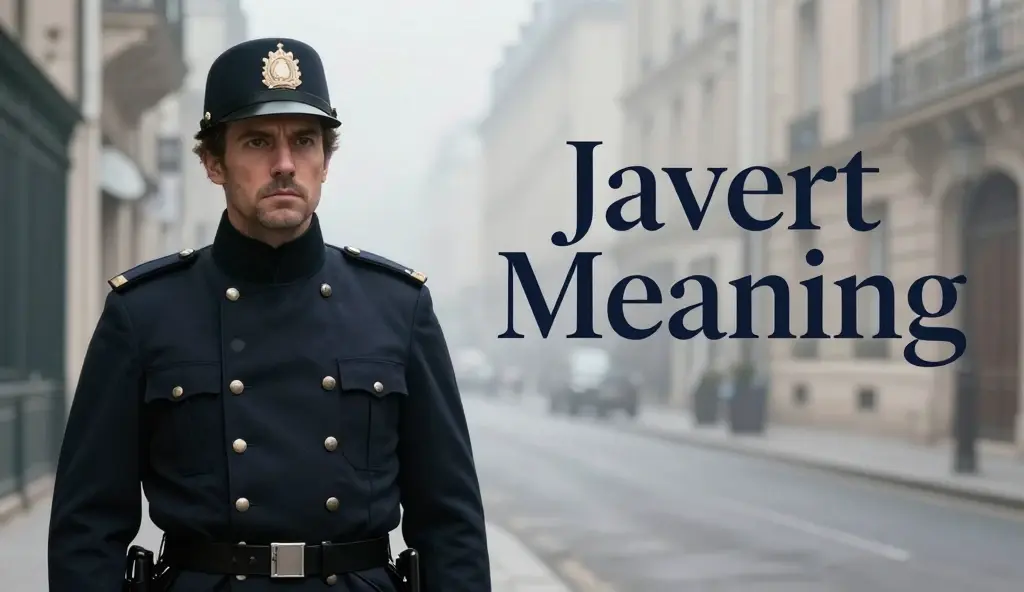
What does Javert mean? Javert is the name of a fictional police inspector in Victor Hugo’s novel Les Misérables.
Javert is one of the main characters and antagonists in Les Misérables.
His character represents a harsh view of justice that leaves little room for mercy or compassion.
So, if you see someone described as “a Javert” outside a discussion of the novel, the speaker is usually comparing that person to Javert’s strict and uncompromising personality.
Quick Answer
Javert is the name of a police inspector from Victor Hugo’s novel Les Misérables, known for his relentless, rule-obsessed pursuit of the story’s protagonist, Jean Valjean.
Quick Meaning Table
| Term | Main Meaning | Origin | Pronunciation | Usage | Example |
| Javert | A rigid, relentless enforcer of rules or justice | Character from Les Misérables by Victor Hugo | zhah-VAIR | Literary allusion, commentary, everyday speech | “He pursued the case with almost Javert-like intensity.” |
Who Is Javert?
Javert is a central character in Victor Hugo’s 1862 novel Les Misérables.avert believes deeply in the letter of the law, viewing Valjean as permanently and irredeemably a criminal, regardless of the years Valjean spends trying to live an honest, redemptive life.
Javert’s defining trait is his rigid, black-and-white view of justice — he doesn’t believe in second chances, context, or moral nuance.
Javert Meaning in Simple Words
When people refer to someone as “a real Javert” or describe behavior as “Javert-like,” they mean that person is pursuing something — often justice, rules, or an idea of right and wrong — with an obsessive, unforgiving intensity that leaves no room for compassion, context, or forgiveness.
It’s usually not a compliment.
How “Javert” Is Used as an Allusion
The character’s name has become a literary and cultural shorthand, used in a few common ways.
- Describing an obsessive pursuer: “The detective pursued the case with Javert-like obsession, refusing to consider any other explanation.”
- Describing rigid moral thinking: “His Javert-style view of right and wrong left no room for context or circumstance.”
- Describing relentless enforcement: “The new manager enforced the rules with a Javert-level intensity that made everyone uncomfortable.”
- Literary and political commentary: Writers sometimes use “Javert” as shorthand in essays or criticism to describe rigid, punitive approaches to justice or law enforcement.
Javert’s Role in the Story
Javert serves as the novel’s central antagonist, though Hugo wrote him with genuine moral conviction rather than simple villainy — he believes he’s doing what’s right. His pursuit of Jean Valjean spans decades and represents the novel’s larger themes about the difference between law and true justice, and between rigid rule-following and genuine moral growth.
Javert’s arc ends in tragedy: when Valjean spares his life despite having every reason not to, Javert is unable to reconcile this act of mercy with his rigid worldview, ultimately leading to his own demise.
Javert in “Les Misérables” Adaptations
Javert remains a prominent character across the many adaptations of Les Misérables, including the widely known stage musical and its film adaptations.
How to Use “Javert” in a Sentence
- “He chased down every minor rule violation with Javert-like determination.”
- “Her Javert-style approach to grading left no room for extenuating circumstances.”
- “The film critiques a justice system full of modern-day Javerts.”
- “He’s become something of a Javert about office dress code enforcement.”
- “The prosecutor’s relentless pursuit of the case felt distinctly Javert-esque.”
- “She warned him not to become a Javert, chasing the mistake forever.”
- “The novel’s true villain isn’t Javert himself, but the rigid system he represents.”
- “His unwillingness to forgive even minor mistakes made him seem like a modern Javert.”
- “Being a Javert about small infractions can damage trust within a team.”
Synonyms and Similar Words
- Zealot — describes intense, uncompromising devotion, similar to Javert’s rigid moral code
- Stickler — a milder, more everyday term for someone obsessed with rules
- Relentless pursuer — a plain-language description of Javert’s central trait
- Inflexible — describes the rigid, black-and-white thinking associated with the character
Common Confusions
- Javert vs. Jean Valjean: These are the novel’s two central characters — Valjean is the protagonist seeking redemption, while Javert is the inspector pursuing him.
- Javert as villain vs. Javert as tragic figure: While Javert functions as the story’s antagonist, Hugo wrote him with genuine, if misguided, moral conviction, making him more tragic than purely villainous.
FAQs:
Who is Javert in Les Misérables?
Javert is a police inspector who relentlessly pursues the novel’s protagonist, Jean Valjean, over decades, driven by a rigid, uncompromising belief in law and punishment.
What does it mean to call someone “a Javert”?
It means describing someone as obsessively rule-bound or relentless in pursuing justice or punishment, often without room for mercy, context, or forgiveness.
Is Javert the villain of Les Misérables?
He functions as the story’s antagonist, though Victor Hugo portrays him with genuine moral conviction rather than as a purely evil character.
How do you pronounce Javert?
Javert is pronounced “zhah-VAIR,” reflecting its French origin.
What happens to Javert at the end of the story?
After Jean Valjean spares his life, Javert is unable to reconcile this act of mercy with his rigid worldview, which leads to his tragic downfall.
Why is Javert used as a modern allusion?
His name has become shorthand for describing rigid, obsessive rule enforcement or pursuit of justice, especially in literary, political, or everyday commentary.
Is “Javert” always used negatively?
Almost always, yes. Comparing someone to Javert typically implies criticism of their inflexibility or lack of compassion, rather than praise.
What does Javert represent thematically in the novel?
He represents rigid law and punishment in contrast to Jean Valjean’s arc of redemption and moral growth, highlighting the novel’s broader themes about justice versus mercy.
Is Javert a real historical figure?
No. Javert is a fictional character created by Victor Hugo for his 1862 novel Les Misérables.
Where does the term “Javert-like” typically appear?
It’s commonly used in literary criticism, political commentary, and everyday conversation to describe someone pursuing rules or justice with obsessive rigidity.
Conclusion:
Javert is the relentless police inspector from Victor Hugo’s Les Misérables, whose name has become a cultural shorthand for rigid, uncompromising pursuit of rules or justice.
Calling someone “a Javert” or describing behavior as “Javert-like” typically means they’re prioritizing strict rule-following over mercy, context, or nuance a trait that, in the novel itself, ultimately leads to the character’s own tragic downfall.

Lexical Research Expert specializing in word origins, historical language development, and dictionary references.