
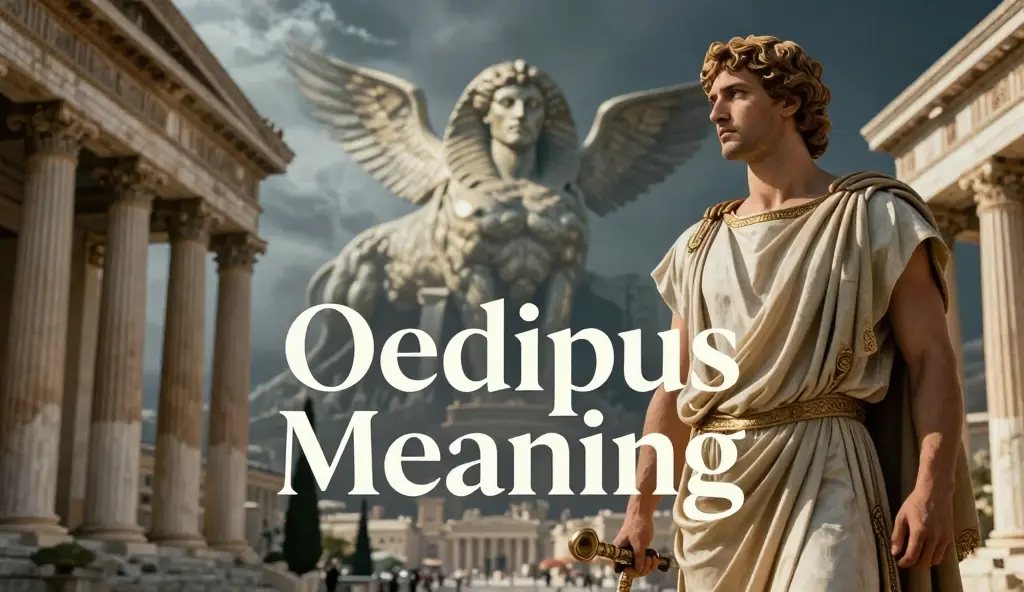
What does Oedipus mean? Oedipus is the name of a famous figure from Greek mythology who unknowingly killed his father and married his mother.
His story is best known through Sophocles’ tragedy Oedipus Rex (also called Oedipus the King).
The story is about fate, identity, prophecy, and the painful discovery of the truth.
The name Oedipus can also appear in psychology and everyday language because Sigmund Freud used the story as the basis for the term Oedipus complex.
That psychological term describes a theory about a child’s unconscious attraction toward a parent of the opposite sex and rivalry with the other parent. Today, the term is mainly discussed in the history of psychology and psychoanalytic theory.
Quick Answer
Oedipus is a figure from Greek mythology who unknowingly killed his father and married his mother. His tragic story appears most famously in Sophocles’ Oedipus Rex. The name is also connected to the Oedipus complex, a term from Freudian psychology.
Quick Meaning Table
| Term | Main meaning | Full form, if relevant | Pronunciation | Usage | Example |
| Oedipus | A tragic Greek mythological king | Not an abbreviation | EE-di-pus | Mythology, literature, psychology | “Oedipus discovered the truth about his past.” |
What Does Oedipus Mean?
Oedipus is primarily the name of a tragic hero in Greek mythology.
According to the myth, Oedipus was destined to kill his father and marry his mother. His parents tried to prevent the prophecy, but their actions ultimately helped bring it about.
Oedipus later became king of Thebes. He eventually discovered the terrible truth about his identity and his actions.
His story became famous because it explores major themes such as:
- Fate
- Free will
- Truth
- Family
- Identity
- Guilt
- Prophecy
- Human limitations
The story is especially famous through Sophocles’ play Oedipus Rex.
Oedipus Meaning in Simple Words
In simple English, Oedipus refers to a tragic character from Greek mythology whose life was shaped by a prophecy he tried to escape.
He did not know that the people involved in his actions were his biological parents.
The story shows the irony of trying to escape a fate that ultimately comes true.
The Story of Oedipus
Oedipus was the son of Laius, king of Thebes, and Jocasta, queen of Thebes.
A prophecy warned Laius that his own son would eventually kill him.
Because of this prophecy, Oedipus was separated from his parents as a baby.
However, he survived and was raised by another royal family.
When Oedipus grew older, he learned of a prophecy saying that he would kill his father and marry his mother.
Believing that the people who raised him were his biological parents, he left them to prevent the prophecy from happening.
During his journey, Oedipus got into a conflict with an older man and killed him.
He did not know that the man was actually Laius, his biological father.
Later, Oedipus solved the riddle of the Sphinx and became king of Thebes. He married Jocasta, not knowing that she was his biological mother.
Eventually, Oedipus discovered the truth.
The revelation destroyed his life and brought the tragedy to its conclusion.
Oedipus in Greek Mythology
Oedipus is one of the best-known characters in Greek mythology.
His story is part of the larger mythological tradition surrounding the royal family of Thebes.
The central prophecy creates the tragedy:
Oedipus tries to avoid his fate, but his attempts to escape it help lead him toward it.
This makes Oedipus an important example of dramatic irony. The audience may understand something that the character does not yet know.
Oedipus Rex
Oedipus Rex is the best-known literary version of the story.
The play was written by the ancient Greek playwright Sophocles.
It is also known as:
- Oedipus the King
- Oedipus Tyrannus
The play begins after Oedipus has already become king of Thebes.
A terrible plague has struck the city. Oedipus promises to discover the cause and punish the person responsible for an earlier murder.
His investigation gradually leads him toward the truth about his own identity.
This structure makes the play a classic example of a tragedy built around discovery and reversal.
Oedipus Complex Meaning
The name Oedipus is also used in the term Oedipus complex.
The term comes from Sigmund Freud, who connected the Greek myth with his theory of childhood psychological development.
In Freudian theory, the Oedipus complex refers to an unconscious attraction toward the mother and rivalry with the father during a particular stage of childhood development.
The concept is part of psychoanalytic theory and is not generally treated as a simple established fact about all children.
The name comes directly from the Oedipus myth.
Oedipus Meaning in Psychology
In psychology, you are most likely to encounter Oedipus in phrases such as:
- Oedipus complex
- Oedipal
- Oedipal conflict
Oedipal is an adjective related to Oedipus or the Oedipus complex.
For example:
“The novel contains an Oedipal conflict.”
This usually means that the work involves themes related to the psychological idea associated with the Oedipus complex.
How to Pronounce Oedipus
Oedipus is commonly pronounced:
EE-di-pus
A simple pronunciation guide is:
EE-duh-pus
The spelling can look confusing because Oedipus comes from the Greek name Oidipous.
Oedipus Name Meaning
The Greek name Oedipus is traditionally connected with the idea of “swollen foot.”
The name relates to the story of how Oedipus was exposed as an infant with his feet injured or bound.
The exact details of the myth vary between ancient sources, but the connection between his name and his feet is an established part of the traditional story.
How to Use Oedipus in a Sentence
Here are 10 natural examples:
- “Oedipus is one of the most famous figures in Greek tragedy.”
- “The story of Oedipus centers on fate and identity.”
- “Oedipus unknowingly killed his father.”
- “Oedipus later discovered the truth about his family.”
- “Sophocles wrote Oedipus Rex.”
- “The story of Oedipus is full of dramatic irony.”
- “The Oedipus myth influenced Freud’s theory.”
- “The student wrote an essay about Oedipus and fate.”
- “Oedipus tried to escape the prophecy.”
- “The tragedy of Oedipus shows the danger of hidden truths.”
Conversation Examples
Conversation 1: Literature
Alex: Who is Oedipus?
Sam: He’s a tragic figure from Greek mythology.
Alex: Isn’t he the character who killed his father and married his mother?
Sam: Yes. That’s the central tragedy of his story.
Conversation 2: Psychology
Emma: What does “Oedipus complex” mean?
Liam: It’s a term from Freud’s psychoanalytic theory.
Emma: Is it connected to the Greek myth?
Liam: Yes. Freud named the concept after Oedipus.
Synonyms and Similar Words
Oedipus does not have a true synonym because it is a proper name.
However, these related terms may appear in similar discussions:
Oedipal
Related to Oedipus or the Oedipus complex.
Tragic Hero
A central character whose actions or circumstances lead to a tragic downfall.
Greek Tragedy
A type of ancient Greek drama dealing with serious conflicts and often ending in suffering or disaster.
Oedipus Complex
A Freudian psychological concept named after the mythological character.
Sophocles
The ancient Greek playwright who wrote Oedipus Rex.
Common Confusions
Oedipus vs. Oedipal
Oedipus is the name of the mythological character.
Oedipal is an adjective related to Oedipus, especially the Oedipus complex.
Oedipus vs. Oedipus Complex
They are related but not identical.
Oedipus → the mythological character.
Oedipus complex → a concept associated with Freudian psychoanalysis.
Oedipus vs. Oedipus Rex
Oedipus is the character.
Oedipus Rex is the famous tragedy by Sophocles about him.
Is Oedipus Offensive?
No. Oedipus is not normally considered an offensive word.
It is a name from Greek mythology and is commonly used in literature, mythology, theater, philosophy, and discussions of psychology.
However, references to the Oedipus complex can involve sensitive topics about family and sexuality, so the context matters.
FAQs:
1. What does Oedipus mean?
Oedipus is the name of a famous character in Greek mythology. He unknowingly kills his biological father and marries his biological mother after trying to escape a prophecy that predicted these events. His story is best known through Sophocles’ Oedipus Rex.
2. Who was Oedipus?
Oedipus was a legendary king of Thebes and a tragic hero in Greek mythology. He became famous for solving the Sphinx’s riddle but later discovered that he had unknowingly killed his father and married his mother.
3. What is Oedipus famous for?
Oedipus is famous for the prophecy that he would kill his father and marry his mother. He tried to avoid this fate but unknowingly fulfilled the prophecy. His story became one of the best-known tragedies in Greek literature.
4. What does Oedipus Rex mean?
Oedipus Rex is the Latin title commonly used for Sophocles’ tragedy about Oedipus. The title is often translated into English as Oedipus the King. The play focuses on Oedipus’ investigation into the truth about his identity and past.
5. What does Oedipus mean in psychology?
In psychology, Oedipus is mainly associated with the Oedipus complex, a concept developed by Sigmund Freud. It describes a proposed unconscious attraction toward a mother and rivalry with a father during childhood.
6. What is the Oedipus complex?
The Oedipus complex is a concept in Freudian psychoanalytic theory. Freud used the Greek story of Oedipus as a model for a proposed childhood conflict involving parental attachment and rivalry.
7. How do you pronounce Oedipus?
Oedipus is commonly pronounced “EE-di-pus” or approximately “EE-duh-pus.” The spelling comes from the Greek name and can look different from its English pronunciation.
8. What does the name Oedipus mean?
The name Oedipus is traditionally associated with “swollen foot.” This meaning is connected with the story of Oedipus as an infant, whose feet were injured or bound.
9. Who wrote Oedipus Rex?
Sophocles, one of ancient Greece’s major tragedians, wrote Oedipus Rex. The play is one of his best-known works and is a major example of Greek tragedy.
10. Why is Oedipus a tragic hero?
Oedipus is considered a tragic hero because he is a powerful and respected figure whose determination to discover the truth ultimately leads to his downfall. His story also combines fate, personal choices, dramatic irony, and a painful recognition of the truth.
Conclusion:
Oedipus is a famous figure from Greek mythology who unknowingly killed his father and married his mother after trying to escape a prophecy.
His tragic story became famous through Sophocles’ Oedipus Rex and has influenced literature, theater, and psychology.
The name is also connected to Freud’s Oedipus complex.
When you see the word “Oedipus,” the meaning usually depends on context: it may refer to the mythological king, Sophocles’ tragedy, or the psychological concept derived from his story.

Educational Writer committed to helping readers improve their English through simple, well-researched content.