
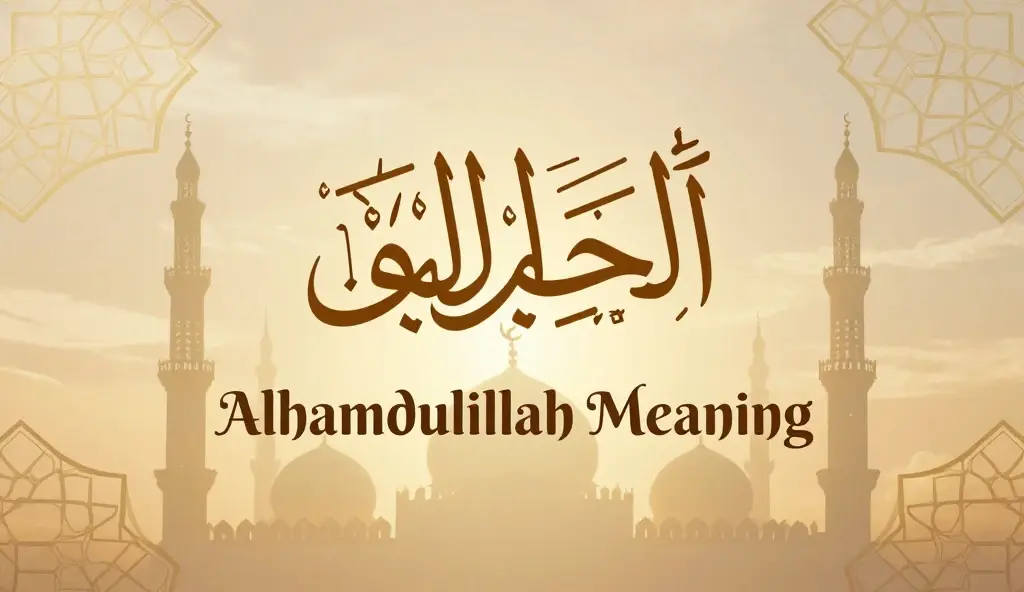
The Alhamdulillah meaning is “praise be to Allah” or, in a natural English sense, “all praise and thanks belong to Allah.”
It is a common Arabic expression used by Muslims around the world to show gratitude to God, praise Him, or acknowledge a blessing.
People may say Alhamdulillah after receiving good news, completing something successfully, recovering from difficulty, or simply when expressing thankfulness for everyday blessings.
The phrase can also be used after a question such as “How are you?” as a way of saying that one is well and grateful.
Alhamdulillah is written الحمد لله in Arabic.
Although it is strongly associated with Islam, its meaning is best understood in the context of Muslim belief and everyday religious expression.
If you are asking “What does Alhamdulillah mean?”, the simple answer is: it means “praise be to Allah” and expresses gratitude and praise to God.
Quick Answer
Alhamdulillah means “praise be to Allah” or “all praise and thanks belong to Allah.” Muslims commonly say it to express gratitude to God for blessings, good news, health, success, or everyday things. It can also be used when answering “How are you?” to express thankfulness.
Quick Meaning Table
| Term | Main meaning | Full form, if relevant | Pronunciation | Usage | Example |
| Alhamdulillah | Praise and thanks be to Allah | Arabic phrase, not an abbreviation | al-ham-doo-li-lah | Islamic speech, prayer, everyday conversation | “Alhamdulillah, I’m feeling better.” |
What Does Alhamdulillah Mean?
Alhamdulillah is an Arabic phrase meaning “praise be to Allah.”
It is written in Arabic as:
الحمد لله
The phrase expresses praise and gratitude to Allah, the Arabic word for God.
A Muslim might say:
“Alhamdulillah, I passed my exam.”
This means that the person is expressing gratitude to Allah for the good result.
The phrase can be used for major blessings and ordinary everyday moments.
Alhamdulillah Meaning in Simple Words
In simple English:
Alhamdulillah means “Thank God” or “Praise be to Allah.”
However, “praise be to Allah” is closer to the literal meaning.
For many Muslims, the expression is more than simply saying “thank you.” It acknowledges Allah as the source of blessings and expresses praise and gratitude toward Him.
For example:
“Alhamdulillah, my family is safe.”
The speaker is expressing gratitude to Allah that their family is safe.
Different Meanings of Alhamdulillah
1. Praise Be to Allah
This is the most direct meaning.
“Alhamdulillah.”
It can simply be an expression of praise and gratitude toward Allah.
2. Thank God
In everyday English, “Thank God” is often a useful translation.
For example:
“Alhamdulillah, we arrived safely.”
means roughly:
“Thank God, we arrived safely.”
3. Gratitude for a Blessing
Someone may say Alhamdulillah after receiving something good.
“I got the job, Alhamdulillah.”
The speaker is expressing gratitude to Allah for the opportunity or result.
4. Gratitude During Everyday Life
The phrase does not have to be reserved for major events.
Someone might say:
“Alhamdulillah, I had a good day.”
It expresses thankfulness for the good things in everyday life.
Alhamdulillah Full Form
Alhamdulillah is not an abbreviation, so it does not have a “full form” in the same way that texting abbreviations do.
It is an Arabic phrase:
الحمد لله
It is commonly transliterated into English as:
Alhamdulillah
The phrase is made up of words expressing praise and gratitude to Allah.
Alhamdulillah Meaning in Texting
People often use Alhamdulillah in texts and online messages in the same way they use it when speaking.
For example:
“How are you?”
“Alhamdulillah, I’m doing well.”
Here, the phrase communicates that the person is doing well with gratitude to Allah.
Someone might also text:
“Alhamdulillah! I passed!”
This expresses happiness and gratitude after good news.
It is common to see different spellings, including Alhamdulillah, Alhamdu lillah, Alhamdulilah, and Alhamdulillah. Transliteration from Arabic can vary.
Alhamdulillah Meaning on Social Media
On social media, Alhamdulillah generally keeps its religious meaning of praise and gratitude to Allah.
Muslims may use it in:
- Instagram captions
- TikTok comments
- WhatsApp messages
- Facebook posts
- Reddit discussions
- Personal messages
For example:
“New chapter of my life. Alhamdulillah.”
This expresses gratitude to Allah.
It does not have a separate TikTok, Instagram, Snapchat, or WhatsApp-specific meaning.
How to Pronounce Alhamdulillah
Alhamdulillah is commonly pronounced approximately:
al-ham-doo-lil-LAH
The final part refers to Allah.
Alhamdulillah (/al.ham.duː.lilˈlaːh/)
Because Arabic pronunciation can vary slightly by speaker and dialect, this is a practical English-oriented guide rather than a full description of Arabic pronunciation.
Origin of Alhamdulillah
Alhamdulillah comes directly from Arabic and is an important expression in Islam.
The phrase appears in the Qur’an, including at the beginning of Surah Al-Fatihah, which begins with praise of Allah.
The Arabic phrase is:
الحمد لله رب العالمين
It is commonly translated as:
“Praise be to Allah, Lord of the worlds.”
Alhamdulillah is therefore both a religious expression and a common part of everyday Muslim speech.
Alhamdulillah vs. Mashallah
These two Arabic expressions are often confused because both are commonly used by Muslims when discussing blessings.
The two expressions can sometimes appear together, but they have different functions.
Alhamdulillah vs. Inshallah
Alhamdulillah
Refers to praise and gratitude to Allah, often about something that has happened or currently exists.
“Alhamdulillah, I’m feeling better.”
Inshallah
Means “if Allah wills” and is commonly used when talking about something hoped for or planned in the future.
“Inshallah, I’ll see you tomorrow.”
So, broadly:
Alhamdulillah = gratitude/praise
Inshallah = hope for the future
How to Use Alhamdulillah in a Sentence
Here are 10 natural examples:
- “Alhamdulillah, everyone arrived safely.”
- “I passed my exam, Alhamdulillah.”
- “Alhamdulillah, my family is doing well.”
- “How are you? — Alhamdulillah, I’m good.”
- “Alhamdulillah, we finally finished the project.”
- “I woke up feeling better today, Alhamdulillah.”
- “Alhamdulillah, we found a solution.”
- “The journey was long, but Alhamdulillah, we made it.”
- “Alhamdulillah for another beautiful day.”
- “I received the good news this morning, Alhamdulillah.”
Conversation Examples
Conversation 1: Asking How Someone Is
Ahmed: “How are you feeling today?”
Omar: “Alhamdulillah, much better.”
Ahmed: “I’m glad to hear that.”
Here, Alhamdulillah expresses gratitude to Allah while saying that Omar is doing well.
Conversation 2: Good News
Sara: “Did you get the job?”
Aisha: “Yes, Alhamdulillah!”
Sara: “That’s wonderful. Congratulations!”
Here, Alhamdulillah expresses gratitude to Allah for the good news.
Synonyms and Similar Expressions
There is no exact English synonym that captures every part of Alhamdulillah, but these expressions can communicate similar ideas in certain contexts.
Praise Be to Allah
A close English translation of the phrase.
Thank God
A natural English expression of gratitude, although it does not fully capture the religious wording.
Praise God
An expression of religious praise that can be similar in some contexts.
Thanks Be to God
A religious expression of gratitude.
God Be Praised
An expression of praise and thankfulness.
The exact choice depends on the context and the level of religious meaning intended.
Common Confusions
Alhamdulillah vs. Alhamdulilah
Both spellings are commonly seen in English transliteration.
Alhamdulillah is a common transliteration of the Arabic phrase الحمد لله.
Variations happen because Arabic sounds are being represented using the Latin alphabet.
Alhamdulillah vs. Mashallah
Alhamdulillah focuses on praise and gratitude to Allah.
Mashallah is commonly used to express appreciation or admiration for something good.
Alhamdulillah vs. Inshallah
Alhamdulillah expresses gratitude for something that exists or has happened.
Inshallah means “if Allah wills” and is generally associated with future hopes or plans.
Is Alhamdulillah Only Said After Good News?
No. Muslims may say Alhamdulillah in many situations, including everyday moments of gratitude. It is not limited to major achievements or good news.
Is Alhamdulillah Offensive?
No. Alhamdulillah is not an offensive expression.
It is a respectful Islamic phrase used by Muslims to praise and thank Allah.
However, because it has religious significance, it is best to use it respectfully and understand its meaning rather than treating it simply as internet slang.
Non-Muslims may encounter the phrase online or in conversation. Understanding the context helps avoid misunderstanding its purpose.
FAQs:
1. What does Alhamdulillah mean in English?
Alhamdulillah means “praise be to Allah” or “all praise and thanks belong to Allah.” In everyday English, it can sometimes be translated naturally as “Thank God.” Muslims use it to express praise and gratitude to Allah.
2. What does Alhamdulillah mean in Islam?
In Islam, Alhamdulillah is an expression of praise and gratitude to Allah. Muslims may say it when acknowledging blessings, good news, health, success, or everyday experiences. It is also part of important Islamic religious texts and prayer.
3. When should you say Alhamdulillah?
There is no single situation in which it must be said in everyday conversation. Muslims commonly say Alhamdulillah when expressing gratitude or praise to Allah, including after good news, when answering how they are doing, or when appreciating a blessing.
4. What does Alhamdulillah mean after someone asks “How are you?”
When someone responds “Alhamdulillah” to “How are you?”, they generally mean that they are doing well or are grateful for their condition. The phrase adds an expression of gratitude to Allah rather than simply giving a health update.
5. Is Alhamdulillah the same as thank God?
“Thank God” is a reasonable English translation in many everyday situations, but it does not capture every aspect of the Arabic phrase. Alhamdulillah specifically expresses praise and gratitude toward Allah and has an important religious meaning in Islam.
6. What is the difference between Alhamdulillah and Mashallah?
Alhamdulillah expresses praise and gratitude to Allah, while Mashallah is commonly used when expressing appreciation or admiration for something good or beautiful. For example, someone might say Alhamdulillah after receiving a blessing and Mashallah when admiring someone else’s blessing.
7. What is the difference between Alhamdulillah and Inshallah?
Alhamdulillah means praise and gratitude to Allah, while Inshallah means “if Allah wills.” Alhamdulillah is commonly used when discussing something that has happened or currently exists, while Inshallah often relates to hopes, plans, or events in the future.
8. Is Alhamdulillah Arabic?
Yes. Alhamdulillah is an Arabic phrase, written الحمد لله. It is widely used by Muslims around the world, including people whose first language is not Arabic. Its religious use comes from Islamic tradition and the Qur’an.
9. Can non-Muslims say Alhamdulillah?
Anyone can learn and quote the phrase, but Alhamdulillah is a religious expression with specific Islamic meaning. If a non-Muslim uses it, understanding and respecting its meaning and context is important rather than using it as a meaningless slang expression.
10. What does Alhamdulillah mean in texting?
In texting, Alhamdulillah generally means the same thing as when spoken: praise and gratitude to Allah. For example, “Alhamdulillah, I passed!” expresses gratitude to Allah for the successful result. It is not simply a random texting abbreviation.
Conclusion:
The Alhamdulillah meaning is “praise be to Allah” or “all praise and thanks belong to Allah.”
It is a widely used Islamic expression of gratitude and praise.
Muslims may say it after good news, when appreciating a blessing, or simply when saying that they are doing well.
Although “Thank God” can be a natural English translation in some situations, Alhamdulillah carries specific religious meaning.
Understanding the context is important, especially when seeing the phrase in texts, social media, or everyday conversations.

Professional Language Consultant with expertise in vocabulary building and academic writing resources.