
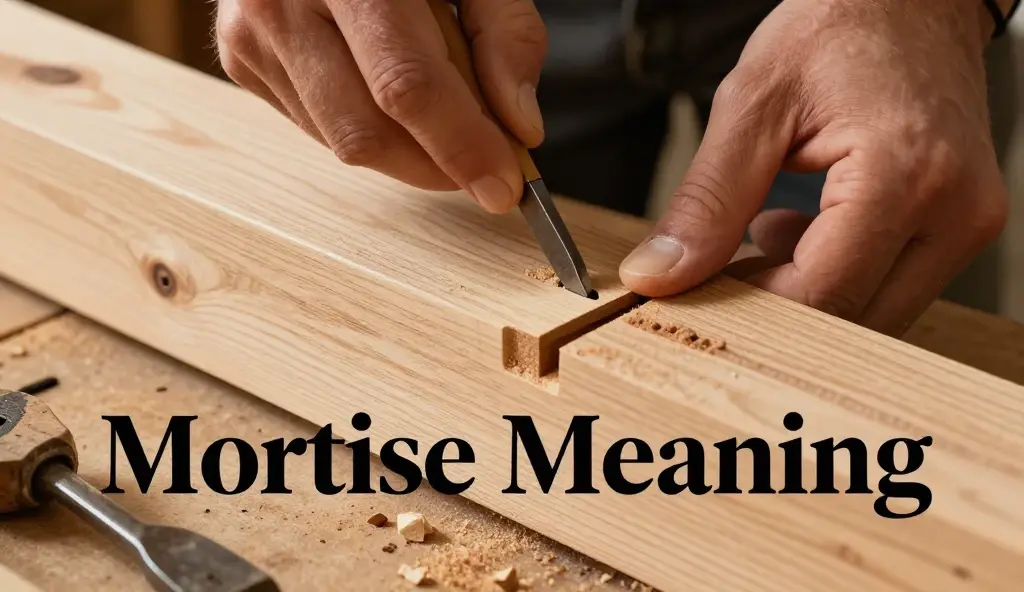
The mortise meaning depends on the context, but it most commonly refers to a hole, slot, or recess made in a piece of material so another part can fit into it.
You may hear the word in woodworking, construction, carpentry, architecture, and even anatomy.
In woodworking, for example, a mortise-and-tenon joint connects two pieces of wood: one has a hollow space called a mortise, while the other has a projecting piece called a tenon
. The word can also be used as a verb, meaning to make or cut such a recess.
In anatomy, a mortise can describe a socket-like structure that receives another part.
Because the word has several related uses, its exact meaning depends on the subject.
In simple terms, think of a mortise as a specially shaped opening designed to receive and hold another part.
Quick Answer
A mortise is a hole, slot, or recess made in one material so another part can fit into it. It is especially common in woodworking, where a mortise receives a matching tenon to form a strong joint. The word can also describe certain socket-like structures in anatomy and construction.
Quick Meaning Table
| Term | Main meaning | Full form, if relevant | Pronunciation | Usage | Example |
| Mortise | A hole or recess designed to receive another part | Not an abbreviation | MOR-tis | Woodworking, construction, anatomy | “The tenon fits into the mortise.” |
What Does Mortise Mean?
A mortise is an opening or recess cut into a material, usually so another piece can fit inside it.
The most familiar example is a mortise-and-tenon joint.
The two parts work together:
- Mortise = the hole or recess
- Tenon = the projecting piece that fits into the hole
For example:
“The carpenter cut a mortise in the wooden frame.”
This means the carpenter made a specially shaped opening in the wood.
The word can also be used as a verb:
“The carpenter mortised the joint.”
Here, mortised means that the carpenter cut or made the mortise.
Mortise Meaning in Simple Words
In simple English:
A mortise is a specially made hole or slot that another piece fits into.
Think of it like a socket and a matching plug.
The opening is the mortise, while the piece that goes into it is the tenon.
This design can create a strong connection between two parts.
Different Meanings of Mortise
1. Mortise in Woodworking
In woodworking, a mortise is a recess cut into a piece of wood to receive a tenon.
For example:
“The chair leg has a tenon that fits into a mortise in the frame.”
Mortise-and-tenon joints have been used in furniture, buildings, doors, and other wooden structures for centuries.
2. Mortise in Construction
The word can also refer to a recess designed to receive another structural component.
For example, a component may be shaped to fit precisely into an opening in another component.
3. Mortise in Door Hardware
You may also encounter the term when discussing mortise locks.
A mortise lock is installed inside a pocket or recess cut into the edge of a door.
For example:
“The door uses a mortise lock.”
Here, mortise refers to the recessed space where the lock mechanism is installed.
4. Mortise in Anatomy
In anatomy, mortise can describe a socket-like arrangement in which one structure fits into another.
A well-known example is the ankle mortise. It is formed by parts of the lower leg bones and receives the upper part of the talus, helping form the ankle joint.
So, in anatomy, the basic idea is still similar:
one structure forms a socket that receives another structure.
Mortise-and-Tenon Meaning
The mortise-and-tenon joint is one of the best-known uses of the word.
A simple version looks like this:
Mortise → [ opening ]
Tenon → [ projecting piece ]
The tenon fits into the mortise.
When properly made, the two pieces can form a strong and stable joint.
For example:
“The table was built using traditional mortise-and-tenon joints.”
This type of joint is especially associated with woodworking and traditional carpentry.
Mortise Meaning in Anatomy
In anatomy, a mortise is essentially a socket or recess that receives another structure.
The ankle mortise is a common example.
The lower ends of the tibia and fibula form a structure that surrounds and receives the upper part of the talus. This arrangement helps create the ankle joint.
The anatomical use therefore shares the same basic idea as the woodworking meaning:
a shaped space receives another part.
How to Pronounce Mortise
Mortise is commonly pronounced:
MOR-tis
The first syllable sounds like “more,” followed by a short “tis.”
mortise (/ˈmɔːrtɪs/)
Origin of Mortise
The word mortise comes through Middle English and Anglo-French, ultimately relating to a word meaning a mortise or cavity. It has long been associated with woodworking and the idea of cutting a recess into one material to receive another piece.
The related mortise-and-tenon construction method has a very long history in woodworking and architecture.
How to Use Mortise in a Sentence
Here are 10 natural examples:
- “The carpenter cut a mortise into the wooden frame.”
- “The tenon fits tightly into the mortise.”
- “This chair uses traditional mortise-and-tenon joints.”
- “The door has a mortise lock.”
- “The mortise was cut too deep.”
- “The carpenter measured the mortise carefully.”
- “A strong tenon should fit securely inside the mortise.”
- “The table was assembled with several mortise-and-tenon joints.”
- “The ankle mortise helps stabilize the ankle joint.”
- “The craftsman mortised the wooden pieces by hand.”
Conversation Examples
Conversation 1: Woodworking
Tom: “How are these two pieces connected?”
Ben: “The smaller piece is the tenon, and it fits into this mortise.”
Tom: “So the mortise is the opening?”
Ben: “Exactly.”
Conversation 2: Door Hardware
Anna: “Why did the installer make a large opening in the door?”
James: “It’s for the mortise lock. The lock mechanism sits inside that recess.”
Synonyms and Similar Words
There is no perfect synonym for mortise, but several words are related.
Recess
A space cut or set below the surrounding surface.
This is a broad term and can describe many types of openings.
Slot
A narrow opening or groove.
A mortise can be slot-shaped, but not every slot is a mortise.
Cavity
A hollow space inside something.
This is broader than mortise.
Socket
A space designed to receive another component.
This is especially useful when discussing anatomy or mechanical connections.
Joint
A connection between two parts.
A mortise itself is not the entire joint; a mortise-and-tenon joint is the complete connection.
Common Confusions
Mortise vs. Tenon
These are two different parts of the same joint.
Mortise = the opening
Tenon = the projecting piece
The tenon fits into the mortise.
Mortise vs. Mortar
These words sound somewhat similar but have completely different meanings.
Mortise = a recess or opening for receiving another part.
Mortar = a material used to bond masonry, such as bricks or stones.
Mortise vs. Groove
A groove is usually a long, narrow channel cut into a surface.
A mortise is generally a recess intended to receive another component, especially in a joint.
Mortise vs. Dovetail
A dovetail is a specific type of woodworking joint with interlocking, wedge-shaped parts.
A mortise-and-tenon joint uses a recess and a projecting tenon.
Is Mortise a Verb?
Yes.
Mortise can be used as a verb meaning to cut or make a mortise.
For example:
“The carpenter mortised the frame.”
This means the carpenter cut a recess into the frame.
The word is more commonly encountered as a noun, especially in discussions of woodworking, construction, and anatomy.
FAQs:
1. What does mortise mean in simple terms?
A mortise is a hole, slot, or recess made to receive another part. In woodworking, it is the opening into which a tenon fits. The two parts form a mortise-and-tenon joint.
2. What is a mortise in woodworking?
In woodworking, a mortise is a recess cut into one piece of wood to receive a matching tenon from another piece. Together, the mortise and tenon form a strong traditional joint used in furniture and construction.
3. What is the difference between a mortise and a tenon?
A mortise is the opening, while a tenon is the projecting piece that fits into the opening. They are designed to work together to form a mortise-and-tenon joint.
4. What is a mortise lock?
A mortise lock is a lock mechanism installed inside a recess cut into a door. The recessed installation allows much of the lock body to sit inside the door rather than being mounted entirely on its surface.
5. What does mortise mean in anatomy?
In anatomy, a mortise refers to a socket-like structure that receives another anatomical part. The ankle mortise is a common example, where the lower leg bones form a socket around the upper part of the talus.
6. Is mortise a noun or a verb?
Mortise can be both a noun and a verb. As a noun, it means a recess or opening. As a verb, it means to cut or make such a recess. For example, “The carpenter mortised the joint.”
7. How do you pronounce mortise?
Mortise is commonly pronounced “MOR-tis.” In phonetic form, it is approximately /ˈmɔːrtɪs/. The first syllable is stressed.
8. What is a mortise-and-tenon joint?
A mortise-and-tenon joint connects two pieces by fitting a projecting tenon into a matching mortise. It is a traditional woodworking joint known for creating a strong connection when properly designed and constructed.
9. Is a mortise the same as a hole?
Not exactly. A mortise is a specific type of recess or opening designed to receive another component. A general hole can have many purposes, while a mortise is typically part of a joint, fitting, or structural connection.
10. What is the meaning of mortise in a door?
In a door, mortise usually refers to the recess cut into the door to hold hardware, especially a mortise lock. The lock body fits inside this recessed area, which is why the hardware is called a mortise lock.
Conclusion:
The mortise meaning is a hole, slot, or recess made to receive another part.
The word is especially common in woodworking, where a mortise receives a tenon to create a strong mortise-and-tenon joint.
It is also used in door hardware, construction, and anatomy, where the basic idea remains similar: one part forms a shaped space that receives another.
Remembering “mortise = opening” and “tenon = piece that fits into it” makes the term easy to understand.

Lexical Research Expert specializing in word origins, historical language development, and dictionary references.