
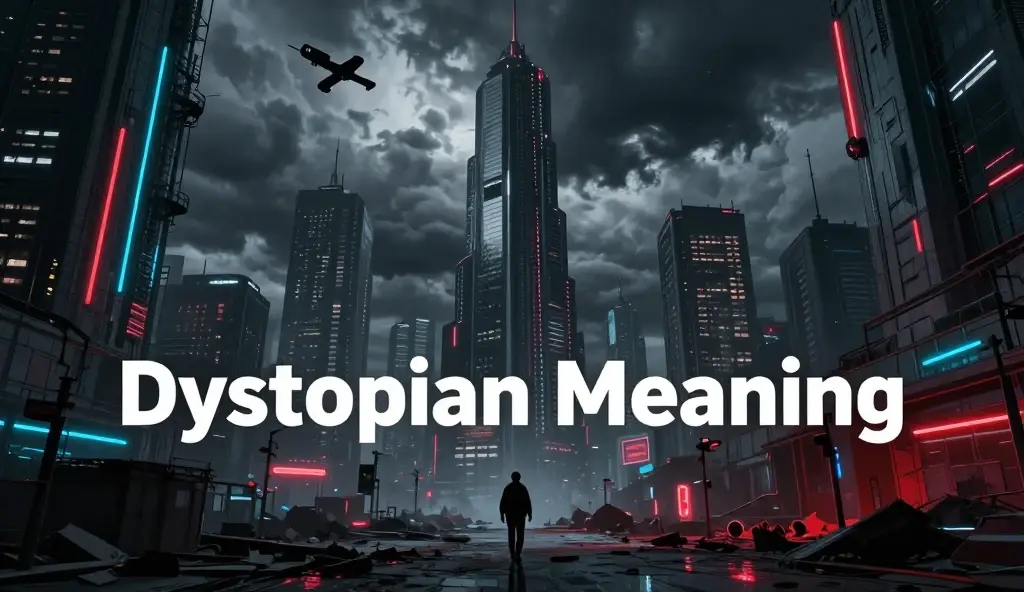
Have you ever watched a movie where society is controlled by a powerful government, technology invades every aspect of life, or people struggle to survive in a bleak future? If so, you’ve likely encountered a dystopian world.
The word dystopian is widely used in books, films, television shows, and social media to describe imagined societies that are deeply flawed or oppressive.
Dystopian describes an imaginary society or future that is unpleasant, unjust, or frightening, often marked by oppression, loss of freedom, environmental disasters, or extreme social inequality.
It is the opposite of utopian, which refers to an ideal or perfect society.
Quick Answer
Dystopian means relating to an imagined society or future that is extremely unpleasant, oppressive, or dysfunctional. It is commonly used to describe fictional worlds in books, movies, games, and discussions about society.
What Does Dystopian Mean?
The adjective dystopian comes from the word dystopia, meaning a bad or undesirable place or society.
A dystopian setting often includes:
- Authoritarian governments
- Constant surveillance
- Limited personal freedom
- Environmental destruction
- Poverty or inequality
- Advanced technology used for control
- Social injustice
The purpose of dystopian stories is often to explore the consequences of current social, political, or technological trends.
Examples
- “The novel depicts a dystopian future where artificial intelligence controls daily life.”
- “The abandoned city looked almost dystopian.”
What Does Dystopian Mean in Literature?
Dystopian fiction is a popular literary genre that imagines societies where life is difficult, unfair, or dangerous.
Common themes include:
- Government control
- Censorship
- Loss of privacy
- Rebellion
- Survival
- Technology gone wrong
- Environmental collapse
Many dystopian stories encourage readers to think critically about real-world issues.
What Does Dystopian Mean in Movies and TV?
Many famous films and television series feature dystopian settings.
These stories often include:
- Post-apocalyptic worlds
- Strict governments
- High-tech surveillance
- Resource shortages
- Resistance movements
A dystopian setting creates tension by showing how society might change if certain problems become extreme.
What Does Dystopian Mean in Texting?
In text messages, dystopian is often used figuratively.
Examples
- “That traffic was dystopian.”
- “This weather feels dystopian.”
- “The empty mall looked dystopian.”
People use it to describe something that feels strangely bleak, unsettling, or like a scene from a science-fiction movie.
What Does Dystopian Mean in Love and Relationships?
Dystopian is not a romantic term.
However, someone might use it humorously to describe a difficult situation.
Example
- “Trying to date during the apocalypse would be completely dystopian.”
Here, the word describes the setting rather than the relationship itself.
What Does Dystopian Mean in Slang?
Dystopian is not slang, but it is frequently used informally online.
People sometimes describe real-life situations as dystopian when they seem:
- Strange
- Unsettling
- Overly controlled
- Extremely bleak
This is usually a figurative use rather than a literal one.
What Does Dystopian Mean on Social Media?
On platforms like TikTok, Instagram, Reddit, X (formerly Twitter), and YouTube, dystopian is often used to describe:
- Viral videos showing unusual events
- AI-generated content
- Advanced surveillance technology
- Environmental concerns
- Empty cities
- Unusual weather
- Discussions about the future
Example:
- “This AI video looks completely dystopian.”
Does Dystopian Have a Spiritual Meaning?
No.
Dystopian has no specific spiritual or religious meaning.
It is primarily a literary, cultural, and descriptive term.
Does Dystopian Have a Cultural Meaning?
Yes.
Dystopian stories often reflect real-world concerns about:
- Politics
- Technology
- Climate change
- Artificial intelligence
- Social inequality
- Human rights
Because of this, the term is frequently used in discussions about current events and future possibilities.
Examples and Usage
Here are some examples of dystopian in everyday English.
Literature
“The author wrote a dystopian novel about a society without freedom.”
Movies
“The film presents a dystopian future controlled by machines.”
Social Media
“The deserted streets looked almost dystopian.”
Everyday Conversation
“That abandoned factory has a dystopian atmosphere.”
How Context Changes the Meaning of Dystopian
| Context | Meaning |
| Literature | Imaginary oppressive society |
| Movies | Dark futuristic world |
| Social media | Bleak or unsettling situation |
| Everyday conversation | Something resembling a dystopian setting |
| News commentary | Warning about possible future developments |
The core idea remains an unpleasant or oppressive imagined society.
Similar Words to Dystopian
Here are some related words:
| Word | Meaning |
| Utopian | Ideal or perfect society |
| Apocalyptic | Relating to widespread destruction |
| Futuristic | Related to the future |
| Oppressive | Harshly controlling |
| Bleak | Cold, depressing, or hopeless |
| Totalitarian | Controlled by an authoritarian government |
These words are related but have distinct meanings.
How to Reply When Someone Says “That’s Dystopian”
If someone says:
“This feels dystopian.”
You could reply:
- “It really does seem unsettling.”
- “It looks like something from a science-fiction movie.”
- “Hopefully reality never becomes like that.”
The response depends on whether they’re speaking literally or figuratively.
Common Mistakes About Dystopian
Myth 1
Dystopian always means post-apocalyptic.
False.
A dystopian society can exist without a global disaster. The key feature is that the society is oppressive or deeply flawed.
Myth 2
Dystopian and futuristic mean the same thing.
False.
A futuristic setting simply takes place in the future. A dystopian setting specifically portrays a negative or oppressive future.
Myth 3
Every science-fiction story is dystopian.
False.
Many science-fiction stories depict hopeful or neutral futures rather than dystopian ones.
FAQs:
Q1. What does dystopian really mean?
Dystopian means relating to an imagined society or future that is oppressive, unpleasant, or deeply flawed.
Q2. Is dystopian positive or negative?
Dystopian has a negative meaning because it describes undesirable societies or situations.
Q3. Is dystopian romantic?
No.
It is not a romantic term.
Q4. How should someone reply if something is described as dystopian?
You can acknowledge the comparison by saying:
- “It definitely feels unsettling.”
- “It looks like a science-fiction movie.”
- “I hope things don’t become like that.”
Q5. Is dystopian commonly used on social media?
Yes. It is frequently used to describe unusual events, technology, AI, environmental issues, and futuristic-looking scenes.
Q6. How do you pronounce dystopian?
Dystopian is commonly pronounced:
dis-TOH-pee-un
(IPA: /dɪsˈtoʊ.pi.ən/)
Conclusion:
Dystopian describes an imagined society or future that is oppressive, unjust, or deeply unpleasant.
Commonly used in literature, movies, games, and online discussions, the term often explores themes like government control, technology, environmental collapse, and social inequality.
In everyday conversation, people also use dystopian to describe real-life situations that feel unusually bleak or unsettling.
Now that you understand the meaning of dystopian, you’ll be able to recognize and use the term confidently when discussing books, films, current events, or conversations about the future.

Senior Content Editor producing trusted educational materials for students, professionals, and language learners.